
Are Bonded Titles Reported on Car History?
Blog post description.
6/30/202618 min read
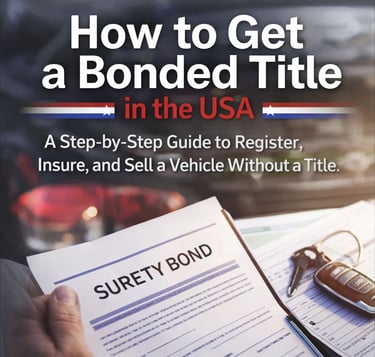
Are Bonded Titles Reported on Car History?
If you’re here, you’re probably dealing with one of the most stressful situations a vehicle owner can face: you own (or want to buy) a car, but the title situation is messy. Maybe the seller “lost the title.” Maybe the DMV rejected your paperwork. Maybe you inherited a vehicle, bought one at auction, or picked up a deal that seemed too good to pass up—until the word bonded title entered the conversation.
And now the big question is haunting you:
Are bonded titles reported on car history reports?
Because if they are, you’re worried about resale value.
You’re worried about red flags.
You’re worried about whether buyers, dealers, banks, or insurers will see it and walk away.
This article is written to answer that question with absolute clarity, in plain American English, without fluff, without legal fog, and without half-answers.
We are going deep—very deep—because bonded titles sit at the intersection of DMV law, vehicle history databases, insurance practices, and real-world resale behavior. Shallow explanations cause expensive mistakes. This guide exists so you don’t make one.
By the time you finish reading, you will know:
Whether bonded titles appear on vehicle history reports
Which databases may show them—and which usually don’t
How bonded titles are actually recorded at the state level
What buyers, dealers, and lenders really see
How long bonded title “flags” last (and when they disappear)
How to protect your resale value
How to convert uncertainty into confidence and control
Let’s start at the foundation—because if you misunderstand what a bonded title actually is, everything else will feel confusing.
What a Bonded Title Really Is (Not What People Think)
A bonded title is not a “bad title.”
It is not a salvage title.
It is not proof the car is stolen.
A bonded title is a state-issued legal title that exists to solve one problem:
The ownership history of the vehicle cannot be fully proven through standard documentation.
That’s it.
The most common scenarios include:
The previous owner lost the title and is unreachable
The seller signed the title incorrectly
The vehicle was abandoned or bought at auction without proper paperwork
A lien release is missing and the lienholder no longer exists
An inherited vehicle lacks probate documentation
A vehicle was purchased decades ago and never titled correctly
In these cases, the DMV doesn’t want to deny ownership forever—but it also can’t blindly trust the applicant. So it creates a risk-management mechanism.
That mechanism is the surety bond.
You purchase a bond (usually for 1.5× the vehicle’s value). The bond protects any prior legal owner who might later prove they had a legitimate claim.
If no one makes a claim during the bond period (typically 3–5 years), the risk expires.
The vehicle becomes, for all practical purposes, a normal titled vehicle.https://bondedtitleusa.com/get-bonded-title-usa-ebook
This distinction matters immensely when we talk about reporting.
How Car History Reports Actually Work (Behind the Curtain)
To understand whether bonded titles are reported, you need to understand how car history systems collect data.
Vehicle history reports are not government systems. They do not have universal access to all DMV records in real time. Instead, they rely on data feeds from a patchwork of sources.
The two dominant players are:
Carfax
AutoCheck
These companies collect information from:
State DMVs (limited, inconsistent access)
Insurance companies
Salvage auctions
Police accident reports
Emissions inspections
Service centers
Title branding events
Lien and auction data partners
Here’s the critical insight most people miss:
Car history reports do not show “everything that exists.”
They only show what was reported to them.
This is why two reports on the same vehicle can look different.
It’s also why bonded titles occupy a gray area.
The Short Answer (Before the Deep Dive)
Let’s address the core question directly:
Are bonded titles reported on car history reports?
Sometimes—but often no.
A bonded title may appear indirectly, inconsistently, or temporarily, depending on:
The state that issued the bonded title
How that state codes title status internally
Whether that code is shared with reporting agencies
Whether the reporting agency chooses to display it
Whether a later “clean title” event overwrites it
There is no universal rule that says “bonded titles always show up” or “bonded titles never show up.”
Anyone who tells you otherwise is oversimplifying.
Now let’s unpack exactly how and when they appear—and when they don’t.
How Bonded Titles Are Recorded at the DMV Level
When a state issues a bonded title, it must record that status somewhere in its system. But how it records it varies dramatically by state.
Common internal DMV notations include:
“Bonded”
“Surety Bond”
“Certificate of Title – Bond”
“Ownership in Doubt”
“Bond Period Active”
“Conditional Title”
Some states print this clearly on the title itself.
Others encode it digitally but issue a title that looks visually normal.
Some place a brand. Others do not.
And here’s the key:
Only some of these notations are shared with external databases.
Many DMVs do not transmit bonded status as a “brand” in the same way they transmit salvage, flood, or rebuilt status.
Why?
Because a bonded title is temporary and conditional, not a permanent declaration about the vehicle’s condition or legitimacy.
Title Brands vs. Administrative Flags (This Is Critical)
Vehicle history reports are very good at showing title brands.
Examples of title brands:
Salvage
Rebuilt
Flood
Junk
Lemon
Hail damage
Odometer rollback
These are permanent labels that materially affect safety, value, and insurability.
Bonded titles are different.
A bonded title is an administrative safeguard, not a condemnation.
Most states treat bonded titles as:
A process
A temporary risk period
A procedural status
Not a brand.
As a result, many DMVs do not transmit bonded status as a brand to history providers.
And if it’s not transmitted as a brand, it often never appears.
When Bonded Titles Do Appear on Car History Reports
Now let’s talk about the scenarios where bonded titles can show up.
1. Explicit Title Status Reporting by the State
Some states—particularly those with more transparent title coding—do send a bonded indicator to data partners.
In those cases, a report may show language such as:
“Title issued – bond posted”
“Bonded title issued”
“Surety bond on file”
This is not universal and not consistent.
2. Interim Ownership Events Trigger Flags
During the bonded period, certain events may trigger secondary reporting:
A lien filing
A transfer attempt
A title correction
An insurance total loss claim
A theft recovery report
If these occur while the bonded status is active, a reporting agency may pick up language suggesting an “ownership issue.”
This doesn’t always say “bonded title,” but it may raise questions.
3. Auction or Dealer Annotations
If the vehicle passes through an auction or dealer that discloses bonded status internally, that disclosure can leak into reporting systems.
This is more common with wholesale transactions than private sales.https://bondedtitleusa.com/get-bonded-title-usa-ebook
When Bonded Titles Usually Do Not Appear
Now the more comforting side of the equation.
Bonded titles often do not appear on vehicle history reports when:
The state does not classify bonded titles as brands
The bonded period expires without a claim
A standard title is issued afterward
No adverse events occur during the bond period
The vehicle is registered and insured normally
In many cases, once the bond expires and the title converts to a regular certificate, there is no visible trace on the report.
This surprises a lot of people—but it’s consistent with how the system is designed.
Example: Two Identical Cars, Two Different Reports
Let’s look at a practical example.
Vehicle A
2014 Toyota Camry
Texas bonded title issued due to lost title
Bond period: 3 years
No claims filed
Converted to standard title
Sold privately
Vehicle B
Same year, same model
Same bonded process
Sold through an auction during the bond period
Dealer disclosure entered into internal system
Vehicle A’s report may show nothing unusual at all.
Vehicle B’s report may show a vague note like:
“Title issued – special handling”
or
“Ownership documentation discrepancy reported”
Same legal process. Different reporting outcomes.
This is why blanket statements are dangerous.
What Buyers Actually See (And What They Care About)
Here’s an uncomfortable truth:
Most buyers do not understand bonded titles.
If they see the word “bonded” without explanation, they may assume:
The car was stolen
There’s a lien
There’s a legal risk
They won’t be able to resell it
This is not because bonded titles are bad—it’s because the system never educated them.
That’s why control of the narrative matters.
If your vehicle has or had a bonded title, your goal is not secrecy—it’s clarity.
And that’s exactly what we’re going to cover next.
In the next section, we’ll break down:
How bonded titles affect resale value in the real world
Whether dealers will accept them
What happens with financing and insurance
How long bonded title traces last
And how to position your vehicle so buyers feel confident, not afraid
Because the truth is: a bonded title handled correctly does not have to cost you thousands of dollars.
Handled incorrectly, it absolutely can.
And that difference comes down to knowledge, timing, and documentation—especially when dealing with car history reports, which are powerful, but not all-knowing.
Let’s keep going—because now we’re entering the part that actually protects your money, your leverage, and your peace of mind.
How Bonded Titles Affect Resale Value (The Reality, Not the Myths)
Resale value is where fear really kicks in.
People hear “bonded title” and immediately think “discount,” “lowball offers,” or “unsellable car.”
That reaction is emotional—not analytical.
The actual impact depends on three variables, not one:
Whether bonded status is visible
Whether the bond period is active or expired
How the seller presents the documentation
Let’s break this down properly.
Active Bond Period vs. Expired Bond Period
An active bonded title (still within the 3–5 year bond window) does carry perceived risk for some buyers. Not legal risk—they’re protected—but emotional risk.
An expired bonded title, followed by issuance of a standard title, is functionally no different from a normal title in most states.
Many buyers never know it existed.
And when they do? With the right explanation, most stop caring.
Private Buyers vs. Dealers
Private buyers are driven by fear and trust.
Dealers are driven by policy.
Some franchise dealers won’t touch bonded titles during the active period—not because they’re illegal, but because their internal compliance systems flag anything nonstandard.
Independent dealers are often more flexible, especially if the price reflects market reality.
Once the bond expires and the title converts? Most dealers treat it as a clean title.
Financing and Insurance
This is another big anxiety point.
Insurance companies generally insure bonded titles without issue, as long as the VIN is valid and the vehicle is legally registered.
Financing is more complex.
Most traditional lenders won’t finance a vehicle with an active bonded title. But once converted to a standard title, financing usually proceeds normally.
Again, this reinforces the idea that bonded titles are temporary administrative states, not permanent stains.
At this point, you can probably feel the shift.
The bonded title isn’t the villain—it’s the misunderstanding.
And misunderstanding is exactly what car history reports can amplify if you don’t know how to navigate them.
In the next section, we’re going to answer one of the most searched follow-up questions online:
How long does a bonded title stay on a car history report—if it shows up at all?
Because time is leverage.
And understanding the timeline can save you money, stress, and bad decisions…
…especially if you’re planning to sell, transfer, or retitle the vehicle and you want to do it once, correctly, without triggering unnecessary red flags.
Let’s continue—because this is where strategy starts to matter more than paperwork, and where most people get it wrong by rushing instead of planning, assuming instead of verifying, and reacting instead of controlling the process when the car history report shows something unexpected and they panic instead of realizing that what they’re seeing is only a snapshot of a much larger system that doesn’t actually tell the whole story unless you know how to read between the lines and understand what’s missing, what’s outdated, what’s conditional, and what’s already expired but still lingering in a database that hasn’t yet been refreshed or corrected because the system relies on delayed reporting cycles that vary wildly from state to state and from provider to provider, which is why timing your next move—whether it’s selling, transferring, re-titling, or simply waiting for the bond period to lapse—can make the difference between a smooth transaction and a frustrating dead end that feels unfair but is actually avoidable if you understand exactly how bonded titles intersect with vehicle history reporting at the technical, administrative, and human levels, and that’s what we’re going to unpack next, step by step, without skipping anything, without simplifying the hard parts, and without pretending that the answer is as simple as “yes” or “no,” because it isn’t, and pretending it is would only set you up for the kind of surprise that costs real money, real time, and real peace of mind when you least expect it and most need certainty…
continue
…when you least expect it and most need certainty, which brings us directly to the timeline question—the one that determines whether you should act now, wait, or restructure your next move entirely.
How Long Does a Bonded Title Stay on a Car History Report?
This is one of the most misunderstood aspects of bonded titles, largely because people assume vehicle history reports work like permanent criminal records.
They don’t.
Car history reports are event-based databases, not legal ledgers.
They log reported events, not legal conclusions.
That distinction is everything.
The Bond Period vs. the Reporting Period
A bonded title has a legally defined bond period, usually:
3 years (most common)
5 years (in some states)
This bond period is governed entirely by state law.
Car history reports, however, operate on data refresh cycles, not legal clocks.
That means:
A bonded title can legally expire
But a related note might linger in a database
Until a new title event overwrites it
This is not a flaw. It’s a design reality.
What Actually Clears a Bonded Title From Reports
Here’s the key insight:
Bonded title indicators don’t “time out.”
They get overwritten.
What overwrites them?
Issuance of a standard (non-bonded) title
A clean title transfer
A state title reissue
Sometimes even a registration renewal tied to a clean title status
Once a clean title event is reported, many prior administrative notes simply disappear—or become buried so deep they never surface in consumer-facing reports.
This is why two people can run reports on the same vehicle at different times and see different things.
Why Some Old Bonded Titles Still Appear (Rare, But Real)
Occasionally, you’ll hear someone say:
“My car had a bonded title 8 years ago and it still shows up.”
This can happen—but it’s not the norm, and it’s usually due to one of three causes:
1. No Subsequent Title Event Was Reported
If the bonded title expired but the owner never triggered a new title issuance (for example, by selling or retitling), the database may still show the last known title event.
Legally clean. Administratively stale.
2. State-to-Database Sync Issues
Some states batch-report title events infrequently. If the clean title issuance wasn’t pushed to the data partner, the old note may remain.
This is fixable—but only if you know how.
3. Misclassified Internal Codes
Rarely, a bonded title code is incorrectly mapped as a permanent brand instead of a conditional status.
This is not common—but when it happens, it requires a formal dispute.
Can You Remove a Bonded Title From a Car History Report?
This question comes up constantly, and the answer is nuanced.
You cannot “erase history.”
But you can correct inaccurate or outdated information.
If a report still reflects bonded status after:
The bond period has expired, and
A standard title has been issued,
Then the report is no longer accurate.
In that case, correction is not only possible—it’s appropriate.
The correction process typically involves:
Obtaining a copy of the current clean title
Providing proof that the bond period expired without claims
Submitting documentation through the report provider’s dispute process
Waiting for verification with the issuing state
This is not fast—but it works when done correctly.
And most people fail at it because they don’t understand what evidence actually matters.
Should You Disclose a Bonded Title to Buyers?
This is where ethics, strategy, and psychology intersect.https://bondedtitleusa.com/get-bonded-title-usa-ebook
Let’s be clear:
If the bonded title is active, disclosure is the smart move.
If the bonded title is expired and replaced by a clean title, disclosure is usually not legally required.
But legality is not the same as strategy.
The Smart Disclosure Framework
Here’s how experienced sellers handle this:
Active bond: Disclose early, explain clearly, provide documentation
Expired bond: Disclose only if asked, and explain confidently
Clean title with no report trace: No disclosure necessary
Why?
Because unnecessary disclosure can create fear where none exists.
Confidence comes from documentation—not over-sharing.
What Dealers, Auctions, and Lenders Really Think
Behind closed doors, professionals view bonded titles very differently from consumers.
Dealers
Most independent dealers understand bonded titles perfectly.
They care about:
Whether the title is transferable
Whether the bond period is active
Whether resale will be delayed
They do not assume fraud.
Franchise dealers are stricter—not because of risk, but because of corporate policy.
Auctions
Many auctions accept bonded titles—but label them clearly during the bond period.
Once the bond expires? They’re treated like any other vehicle.
Lenders
Lenders dislike uncertainty.
Active bonded titles introduce uncertainty.
Expired bonded titles do not.
That’s the entire calculation.
Emotional Reality: Why Bonded Titles Feel Scarier Than They Are
Here’s the psychological truth no one talks about:
Bonded titles trigger fear because they challenge the illusion of paperwork certainty.
People want black-and-white documentation.
Bonded titles are gray by design.
But gray does not mean dangerous.
It means managed risk.
And once you understand the system, the fear dissolves.
Strategic Timing: When to Sell a Vehicle With a Bonded Title
Timing can mean the difference between:
Accepting a $2,000 discount
Or selling at full market value
Best Times to Sell
After bond expiration
After issuance of a standard title
After at least one clean title-related event is recorded
Worst Times to Sell
Immediately after bonded title issuance
During unresolved documentation disputes
Before you’ve assembled proof
Waiting is often the smartest financial move.
The Biggest Mistake People Make With Bonded Titles
The biggest mistake is treating bonded titles as a problem instead of a process.
People panic.
They rush.
They accept low offers.
They over-disclose.
They assume the worst.
Bonded titles are not warnings—they are solutions.
They exist so ownership issues can be resolved without litigation, without permanent damage, and without denying legitimate owners their rights.
And when handled correctly, they do exactly that.
Why This Matters So Much If You’re Buying a Car
If you’re considering buying a vehicle with a bonded title, this knowledge gives you leverage.
You can:
Negotiate confidently
Ask the right questions
Avoid irrational fear
Protect your resale value
Time your ownership strategically
Most buyers either walk away unnecessarily—or buy blindly.
You don’t have to do either.
The Bonded Title Is Not the End—It’s the Bridge
A bonded title is a bridge from uncertainty to clarity.
The car history report is just one snapshot along that bridge.
If you understand how the snapshot is taken, what it includes, what it omits, and how it updates over time, you regain control.
And control is what separates smart owners from stressed ones.
Final Truth You Should Remember
Let this sink in:
A bonded title does not define the vehicle.
It defines a moment in its paperwork history.
Moments pass.
Titles change.
Databases update.
What remains is the vehicle itself—and the owner who understands the system well enough to navigate it without fear.
Ready to Handle a Bonded Title the Right Way?
If you’re dealing with a bonded title right now—or you’re considering buying or selling a vehicle with one—guesswork is expensive.
You need a step-by-step, state-aware, mistake-proof roadmap.
That’s exactly what the Get Bonded Title USA Ebook was created for.
Inside, you’ll find:
Exact DMV requirements by state
How to value your bond correctly
How to avoid rejection and delays
How to protect resale value
How to convert a bonded title into a clean title smoothly
What to do if a claim is filed
How to fix reporting issues when they happen
No myths.
No panic.
No costly trial and error.
👉 Get Bonded Title USA Ebook and take full control of the process—before confusion costs you money, time, or the deal you worked hard to secure.
continue
…and before you think “okay, that’s the end,” it’s not—because most real-world problems with bonded titles don’t happen at the DMV counter or on the Carfax screen.
They happen after.
They happen when:
a buyer hesitates,
a dealer pauses,
an insurer asks a follow-up question,
or a lender quietly declines without explanation.
So now we’re going to push even deeper, into the edge cases, failure points, and real-life scenarios that separate people who understand bonded titles from people who get blindsided by them months or even years later.
This is where high-intent knowledge actually saves money.
What Car History Reports Do Not Tell Buyers (But They Assume Anyway)
One of the most dangerous things about car history reports is not what they show—it’s what buyers assume they imply.
When a buyer sees any non-standard notation, their brain fills in the gaps with worst-case stories:
“There must be a hidden lien.”
“Someone else probably owns it.”
“This could be stolen.”
“I’ll never be able to sell it again.”
None of those are true for bonded titles—but the report doesn’t explain that.
Car history reports do not educate.
They signal.
And humans are terrible at interpreting signals without context.
That’s why bonded titles—when poorly understood—get lumped emotionally with salvage titles, even though legally and financially they are worlds apart.
Why Bonded Titles Are Treated Differently From Salvage (Legally and Practically)
This distinction cannot be overstated.
A salvage title is a judgment about a vehicle’s condition.
A bonded title is a placeholder for documentation risk.
Salvage:
Permanent
Based on damage
Affects safety perception
Triggers insurance restrictions
Always reported
Bonded:
Temporary
Based on paperwork gaps
Does not imply damage
Usually insurable
Inconsistently reported
Yet on a car history report, both may appear as “something unusual.”
That visual similarity creates confusion—and confusion creates leverage loss for uninformed owners.
The Silent Role of Insurance Databases
Here’s something almost no consumer considers:
Insurance companies maintain their own vehicle databases, separate from public history reports.
These databases focus on:
VIN validity
Theft status
Loss history
Title legality for coverage
Most insurers do not treat bonded titles as higher risk.
In fact, many don’t flag them at all—as long as:
The vehicle is legally registered
The VIN clears national theft databases
There is no salvage or total loss branding
This means an insured bonded-title vehicle quietly builds a normal insurance record over time.
That insurance activity—renewals, coverage history, claim-free periods—becomes far more persuasive to future buyers than an old administrative note buried in a report.
In real negotiations, insurance continuity equals legitimacy.
Real Scenario: The Buyer Who Walked Away (And Why They Were Wrong)
Let’s walk through a real-world scenario that happens constantly.
A private seller lists a vehicle at fair market value.
A buyer runs a car history report.
They see:
“Title issued – special condition noted”
They message the seller:
“Why does the report say this? Is there a problem with the title?”
The seller panics.
They reply:
“It was a bonded title a few years ago but everything is fine now.”
The buyer disappears.
What went wrong?
Not the bonded title.
The presentation.
A stronger response would have been:
“The vehicle was titled through a bonded process years ago due to a lost title from a prior owner. The bond period expired without claims, and the car now has a standard state-issued title. I’m happy to provide documentation.”
That response reframes the issue from risk to resolution.
Most buyers don’t walk away from bonded titles.
They walk away from uncertainty.
Why Bonded Titles Exist at All (And Why That’s a Good Thing)
To really eliminate fear, you need to understand why bonded titles exist.
Before bonded titles, ownership disputes were handled through:
Lawsuits
Court orders
Long probate processes
Permanent title denial
Bonded titles were introduced to prevent people from being trapped by missing paperwork.
They balance:
The state’s obligation to protect prior owners
The current owner’s right to use and transfer property
In other words, bonded titles exist because the system recognizes reality:
Paperwork gets lost.
People move.
Companies dissolve.
Mistakes happen.
A system that didn’t allow bonded titles would punish honest owners.
That’s why bonded titles are not treated as negative brands.
The Truth About “Hidden Problems” and Bonded Titles
A persistent myth is that bonded titles “hide problems.”
In reality, bonded titles expose uncertainty openly and manage it transparently.
If a vehicle were truly stolen or illegally transferred:
It would fail VIN checks
It would trigger theft database alerts
It would be seized regardless of title status
Bonded titles do not shield illegal vehicles.
They shield owners who lack paperwork, not owners who lack rights.
That distinction is critical.
What Happens If Someone Files a Claim Against a Bond?
This question scares people—and it shouldn’t, when understood properly.
If someone files a claim during the bond period:
The surety company investigates
The claimant must prove legitimate ownership
The burden of proof is high
Most claims fail.
If a claim succeeds:
The surety company pays the claimant
The bonded title holder may be financially responsible
The vehicle ownership may be re-evaluated
This is rare.
And when it happens, it confirms the system worked as intended.
The presence of this mechanism is why bonded titles are trusted by states.
Bonded Titles Across State Lines (Where Reports Get Messy)
Interstate transfers are where car history reports become the most unreliable.
Each state:
Codes bonded titles differently
Reports title events differently
Shares data differently
When a vehicle moves states:
The receiving state may issue a clean title
The reporting database may lag or misinterpret the change
This is why you may see:
A bonded notation from State A
A clean title from State B
Both appearing out of chronological context
To an untrained eye, this looks alarming.
To someone who understands the system, it’s just a data artifact.
Why Waiting Out the Bond Period Is Often the Best Strategy
If you don’t need to sell immediately, patience is leverage.
Waiting until:
The bond expires
A standard title is issued
A new title event is recorded
dramatically reduces:
Buyer resistance
Dealer pushback
Financing friction
Reporting anomalies
Many people lose thousands by rushing a sale six months too early.
Time resolves bonded titles naturally.
The Psychological Shift That Changes Everything
Once you truly understand bonded titles, something changes.
You stop seeing them as:
A red flag
A liability
A permanent scar
And start seeing them as:
A documented process
A time-bound safeguard
A resolved uncertainty
That shift is powerful—because buyers can feel confidence.
And confidence closes deals.
Why Most Online Advice About Bonded Titles Is Dangerous
A huge amount of online content about bonded titles is written by:
Forums
Anonymous commenters
People repeating hearsay
AI summaries with no nuance
They say things like:
“Bonded titles ruin resale”
“Carfax will always show it”
“Never buy a bonded title car”
These statements are categorically false.
They collapse a complex legal mechanism into a fear headline.
And fear-based advice leads to bad financial decisions.
Knowledge Is the Only Real Protection
You don’t beat the system by hiding.
You beat it by understanding it better than the other side.
That’s what this entire article has been about:
Replacing panic with clarity
Replacing myths with mechanics
Replacing fear with leverage
One Last Reality Check
If bonded titles were truly dangerous:
States wouldn’t issue them
Insurers wouldn’t cover them
Courts wouldn’t recognize them
Dealers wouldn’t touch them
But they do—every day.
The problem isn’t the title.
The problem is not knowing what you’re looking at when you see a line on a car history report without context.
Take Control—Don’t Guess
If you’re dealing with a bonded title right now, guessing is the most expensive option.
Every state is different.
Every DMV is different.
Every timeline is different.
Every mistake compounds.
That’s why the Get Bonded Title USA Ebook exists.
It’s not theory.
It’s not opinion.
It’s not forum noise.
It’s a step-by-step operational guide that shows you:
Exactly what your state requires
Exactly how bonded titles are recorded
Exactly how to avoid reporting problems
Exactly how to transition to a clean title
Exactly how to protect resale value
Exactly how to explain bonded titles with confidence
No stress.
No surprises.
No money left on the table.
👉 Get Bonded Title USA Ebook and handle your bonded title once—correctly, confidently, and on your terms—because when you understand how bonded titles and car history reports actually intersect, you stop reacting to fear and start making decisions that work in your favor, now and years from now, whether you’re buying, selling, transferring, insuring, or simply sleeping better knowing that the paperwork attached to your vehicle is not a ticking time bomb but a managed, temporary, legally recognized bridge that exists for one reason only: to turn uncertainty into certainty without destroying value, reputation, or opportunity, and once you truly internalize that, everything about the process becomes calmer, clearer, and far more predictable, which is exactly what you want when money, property, and peace of mind are all on the line and there’s no reason—none at all—to stumble through it blind when a proven roadmap already exists and is waiting to be used.
BondedTitleUSA.com is an informational resource and does not provide legal advice. DMV rules vary by state.
Contact
infoebookusa@aol.com
© 2026. All rights reserved.