Are Bonded Titles Safe or Risky?
Blog post description.
2/15/202615 min read
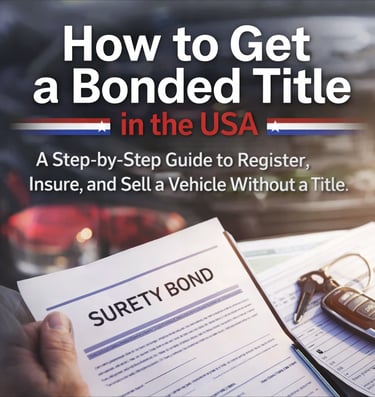
Are Bonded Titles Safe or Risky? The Complete, No-Nonsense Truth Every Buyer Must Know Before Taking the Gamble
If you’re here, you’re probably facing a very specific, high-stress situation.
You’ve found a vehicle at a great price.
Maybe too great.
Then you hear the words “bonded title.” https://bondedtitleusa.com/get-bonded-title-usa-ebook
Suddenly, doubt creeps in.
Is this a loophole?
Is it legal?
Is it a trap?
Could this car be taken away from you months—or years—later?
These questions aren’t academic. They can cost you thousands of dollars, destroy your ability to register or insure a vehicle, and in worst-case scenarios, leave you with a car you legally cannot own.
This article exists for one reason:
to give you the full, unfiltered truth about bonded titles—what they are, when they are safe, when they are risky, and how to decide whether you should proceed or walk away.
No shortcuts.
No glossing over red flags.
No “it depends” without explaining exactly what it depends on.
Let’s start from the beginning.
What a Bonded Title Really Is (Not What People Think It Is)
A bonded title is not a normal title.
It’s also not a fake title.
And it’s definitely not a guaranteed path to ownership.
A bonded title is a conditional title issued by a state when:
A vehicle does not have a clear, transferable title, and
The applicant claims ownership but cannot fully prove it, and
The state wants to protect any prior legal owner or lienholder who might surface later.
To do this, the state requires the applicant to purchase a surety bond—usually for 1.5× the vehicle’s appraised value.
That bond acts as insurance for the state and any potential claimant, not for you.
If no one challenges ownership within a set period (usually 3–5 years), the bonded title converts into a normal, clean title.
That’s the theory.
But theory and reality are very different things.
Why Bonded Titles Exist in the First Place
Bonded titles exist because vehicle ownership documentation fails constantly in the real world.
Here are the most common scenarios that trigger bonded title situations:
1. Lost or Destroyed Titles
A private seller loses the title
A vehicle sits abandoned for years
Paper records are destroyed (fires, floods, moves)
2. Improper Title Transfers
A seller signs the title incorrectly
A title was never transferred after purchase
A dealer skips paperwork
3. Vehicles Purchased at Auction or From Estates
Estate sales with incomplete records
Storage lien or mechanic lien situations
Abandoned vehicle recoveries
4. Older Vehicles With Paper Trail Gaps
Vehicles from the 80s, 90s, or earlier
States that changed title systems
Inconsistent VIN formats
In these cases, states use bonded titles as a legal compromise:
“We’ll allow registration, but ownership is provisional.”
That word—provisional—is where risk enters the picture.
The Core Question: Are Bonded Titles Safe or Risky?
The honest answer is:
Bonded titles can be either safe or extremely risky, depending on factors most buyers never check.
The danger isn’t the bonded title itself.
The danger is what caused it—and whether that cause hides unresolved legal claims.
Let’s break this down properly.
When Bonded Titles Are Generally SAFE
There are situations where bonded titles are relatively low-risk and even smart.
Here’s when.
Scenario 1: Clean History, Missing Paper Only
If:
The vehicle was never reported stolen
No liens appear in state or national databases
The seller has a plausible, documented ownership trail
The bonded title was issued by the same state where the vehicle is registered
VIN checks return clean across NMVTIS, DMV, and insurance databases
Then the bonded title is often just a bureaucratic solution to a paperwork problem.
In these cases:
The bond is unlikely to ever be claimed
Ownership disputes are rare
The title usually converts cleanly after the bonding period
Scenario 2: Vehicle Value Is Low and Risk Is Acceptable
For inexpensive vehicles:
Project cars
Farm trucks
Off-road or utility vehicles
Vehicles purchased far below market value
Some buyers intentionally accept bonded titles because:
The financial downside is limited
The car’s utility outweighs resale concerns
They plan to keep the vehicle long-term
This can be rational—if done knowingly.
Scenario 3: Bonded Title Issued After Strict DMV Review
Some states conduct extensive verification before issuing bonded titles:
Affidavits of ownership
VIN inspections
Police or DMV physical inspections
Multiple database cross-checks
When the state does real due diligence, risk drops significantly.
But this is state-dependent, and assuming all states behave equally is a common and costly mistake.
When Bonded Titles Are HIGH-RISK (and Often a Bad Idea)
Now let’s talk about the scenarios that destroy buyers financially.
Red Flag #1: Recent or Unverified Seller Ownership
If the seller:
Owned the vehicle for only a short time
Cannot explain how they acquired it
Has no bill of sale or chain of ownership
Avoids questions about the vehicle’s past
That bonded title may be masking:
Title washing
Fraud
Theft
Lien evasion
Red Flag #2: Liens That “Shouldn’t Exist” (But Might)
A bonded title does not erase liens.
If:
A lender later proves a valid lien
A prior owner proves unpaid financing
A mechanic or storage facility files a claim
You could lose the vehicle without compensation.
The bond pays them, not you.
Red Flag #3: Out-of-State Transfers
Bonded titles often do not transfer cleanly across state lines.
Common issues:
New state refuses to recognize the bonded title
Requires a new bond
Forces a title re-issuance
Denies registration entirely
Many buyers discover this after moving or reselling the vehicle. https://bondedtitleusa.com/get-bonded-title-usa-ebook
Red Flag #4: Vehicles With Salvage, Theft, or Export History
Bonded titles are sometimes used to:
Reintroduce stolen vehicles
Launder salvage vehicles
Mask export/import violations
If the VIN has any ambiguity, bonded titles multiply risk instead of reducing it.
The Legal Reality Most Buyers Miss
Here’s the hard truth most sellers won’t tell you:
A bonded title does not prove ownership—it postpones disputes.
During the bond period:
Ownership is conditional
Claims can surface
Courts can intervene
States can revoke registration
Even if:
You paid fair market value
You acted in good faith
You registered and insured the vehicle
You are not immune.
That’s why due diligence is not optional—it’s survival.
Insurance, Financing, and Resale: The Hidden Costs
Even if everything goes right, bonded titles carry long-term friction.
Insurance Issues
Some insurers:
Refuse full coverage
Limit comprehensive/collision
Flag bonded titles for manual review
This matters if:
The car is damaged
The car is stolen
You need claim payouts
Financing Limitations
Most banks:
Will not finance bonded title vehicles
Consider them unsecured assets
Require cash purchases
This limits liquidity and flexibility.
Resale Penalties
Buyers:
Demand discounts
Walk away immediately
Require conversion to clean title first
Even after conversion, title history remains visible in some records.
Real-World Example: Two Buyers, Two Outcomes
Buyer A: Smart Risk Management
Buys a bonded title vehicle for 40% below market
Runs VIN checks
Confirms no liens
Keeps documentation
Holds vehicle through bonding period
Result: Clean title conversion, significant equity gain.
Buyer B: Blind Trust
Buys bonded title car at near-market price
Skips checks
Seller disappears
Lienholder files claim 18 months later
Result: Vehicle seized. No reimbursement. Total loss.
Same mechanism. Very different preparation.
The Question You Must Ask Yourself
The real question isn’t:
“Are bonded titles safe?”
It’s:
“Do I fully understand and control the risk I’m accepting?”
Most buyers don’t.
They rely on:
Seller reassurance
DMV clerks who can’t give legal advice
Internet myths
“It worked for my friend” logic
That’s how mistakes happen.
What You Must Verify Before Trusting a Bonded Title
Before proceeding, you must verify:
VIN history (multiple databases)
Lien status (state and national)
State-specific bonded title laws
Transferability
Bond duration and amount
Seller’s acquisition story
Physical VIN inspection
Skipping any one of these is gambling.
Why This Topic Is More Dangerous Than It Looks
Bonded titles sit at the intersection of:
DMV bureaucracy
Contract law
Property law
Insurance law
State-specific regulations
Most people are not equipped to navigate this without guidance.
That’s why mistakes cluster around bonded titles more than almost any other vehicle ownership issue.
And it’s why the smartest buyers never rely on guesswork.
Coming Up Next
In the next section, we’ll go deeper into:
Exact state-by-state differences
How bond claims actually happen
What happens if a claim is filed against your bonded title
How to decide—objectively—whether to proceed or walk away
And how to protect yourself even if you move forward
Because understanding bonded titles at a surface level isn’t enough.
You need to understand how they fail, when they fail, and who pays when they do—and that’s where most guides stop short, leaving buyers exposed.
And that’s exactly where we’re going next, because when a bonded title goes wrong, it doesn’t go wrong slowly—it goes wrong all at once, usually when you least expect it and right after you’ve invested money, time, repairs, registration fees, insurance premiums, and emotional attachment into a vehicle that suddenly, legally, is no longer yours, which is why the next thing you need to understand is how bond claims are actually triggered in the real world and what happens the moment a prior owner, lender, or claimant decides to challenge your ownership by filing paperwork that starts a chain reaction involving the surety company, the DMV, and potentially the courts, because once that process starts, your options narrow fast and the clock starts ticking in ways most buyers don’t realize until it’s already too late, especially when the notice arrives by certified mail and says that a claim has been filed against the bond because…
continue
…because once that process starts, your options narrow fast and the clock starts ticking in ways most buyers don’t realize until it’s already too late, especially when the notice arrives by certified mail and says that a claim has been filed against the bond because someone, somewhere, has asserted a legal right to the vehicle that predates your ownership, and at that moment the bonded title stops being an abstract concept and becomes a very real legal problem with real consequences.
How Bond Claims Actually Happen (Not the Simplified DMV Version)
Most people imagine bond claims as rare, dramatic events—someone suddenly showing up with paperwork from ten years ago and a sheriff knocking on the door the next day.
Reality is quieter, slower, and far more dangerous.
Step 1: A Claimant Discovers the Vehicle
A claim usually starts when:
A lienholder audits old unpaid accounts
An insurance company reconciles total-loss records
An estate executor reviews missing assets
A prior owner notices the vehicle resurfaced during a registration check
A vehicle is flagged during resale or re-registration
No confrontation is needed.
No warning to you is required.
The claimant contacts:
The DMV
Or the surety company directly
Or both
Step 2: The Surety Company Gets Involved
The surety bond exists to protect the claimant, not you.
Once a claim is filed:
The surety company opens an investigation
They request documentation from the claimant
They notify the bonded title holder (you)
This is often the first time you realize something is wrong.
Step 3: The Burden of Proof Shifts
Here’s the critical part most buyers don’t understand:
You may now be required to prove that the claimant is wrong.
Not the other way around.
Depending on the state:
You may need to produce purchase records
Bills of sale
Affidavits
Proof of good-faith purchase
Evidence that the lien was satisfied or invalid
If you can’t—and many people can’t—the bond pays the claimant.
Step 4: What Happens After the Bond Pays
Once the surety pays out:
The claimant is compensated
The surety company comes after you for reimbursement
The DMV may revoke or suspend the title
Registration can be canceled
The vehicle can be seized or declared improperly titled
This is the part no one likes to talk about.
Surety bonds are not insurance.
If the bond pays, the surety has a legal right to recover that money from you.
The Myth of “If It’s Registered, I’m Safe”
Registration is not ownership.
You can:
Register a bonded title vehicle
Insure it
Drive it for years
And still lose it.
DMVs issue bonded titles with the explicit understanding that:
“This does not extinguish prior claims.”
That disclaimer is often buried in fine print, but it’s legally decisive.
What Happens If You Improve the Vehicle?
This is where emotional pain turns into financial damage.
Imagine:
You buy a bonded title vehicle
You put $5,000 into repairs
You replace the engine
You repaint it
You customize it
You depend on it for work
Then a claim hits.
In most states:
Improvements do not increase your compensation
Labor is not reimbursed
Parts are not reimbursed
Emotional investment is irrelevant
You lose:
The vehicle
The upgrades
The time
Often the money you borrowed to fund those upgrades
The law does not care how much you improved the car.
Why Some Bonded Titles Are Practically Time Bombs
Certain bonded titles are statistically more likely to be challenged.
Vehicles Most Likely to Generate Claims
Late-model vehicles with missing titles
Vehicles that were financed within the last 10 years
Vehicles sold far below market value
Vehicles with prior out-of-state registration
Vehicles that disappeared from insurance databases
Vehicles that changed hands multiple times without title transfer
Each of these increases the odds that someone else has paperwork you don’t.
The Psychological Trap: “It’s Been Fine So Far”
Many bonded title holders get comfortable.
Months pass.
Nothing happens.
The vehicle runs fine.
Life moves on.
This creates a false sense of security.
But claims often surface:
During resale
During refinancing
During registration renewal
After data audits
When records are digitized years later
The danger window remains open until the bond period expires.
State-by-State Differences That Change Everything
One of the most dangerous assumptions buyers make is that bonded title rules are “basically the same everywhere.”
They’re not.
Bond Duration Varies
Some states: 3 years
Others: 5 years
Some: longer under certain conditions
Transferability Rules Differ
Some states allow easy transfers
Others require rebonding
Some refuse bonded titles from other states entirely
Claim Standards Are Not Uniform
Some states require strong proof
Others accept minimal documentation
Some shift burden heavily onto the bonded title holder
Buying a bonded title vehicle without understanding your specific state’s rules is reckless.
Why Sellers Push Bonded Titles So Aggressively
Ask yourself this question:
If bonded titles were truly low-risk, why do sellers rush to unload these vehicles?
Common seller motivations:
Avoiding responsibility for title defects
Offloading legal risk
Monetizing vehicles they cannot legally title cleanly
Exploiting buyer ignorance
Not all sellers are dishonest—but bonded titles disproportionately attract bad actors because they shift uncertainty onto the buyer.
How Professional Flippers Handle Bonded Titles
Experienced flippers do not treat bonded titles casually.
They:
Buy at deep discounts
Avoid financing
Avoid upgrades
Avoid long-term holding
Convert titles quickly
Exit before claim windows close
If you are not operating at this level of sophistication, you should not assume the same outcomes.
The “Conversion to Clean Title” Misconception
Many people believe:
“Once the bond period ends, everything is erased.”
Not exactly.
While the title may convert:
Historical records remain
VIN histories can reflect bonded status
Some buyers and lenders remain cautious
Conversion removes legal exposure—but not stigma. https://bondedtitleusa.com/get-bonded-title-usa-ebook
What Due Diligence Actually Looks Like (Not Just a VIN Check)
True bonded title due diligence involves:
NMVTIS reports
State DMV lien checks
Insurance loss databases
Physical VIN inspections
Seller affidavit scrutiny
Cross-state registration verification
Understanding bond issuer terms
Reviewing claim procedures in advance
Most buyers do none of this.
Why “DMV Approved” Means Less Than You Think
DMVs process paperwork.
They do not validate ownership claims beyond procedural requirements.
A bonded title being issued means:
Forms were accepted
Fees were paid
Minimum thresholds were met
It does not mean:
Ownership is undisputed
Liens are cleared
Risk is eliminated
Confusing administrative approval with legal certainty is one of the most expensive mistakes buyers make.
The Question That Decides Everything
Before buying or accepting a bonded title vehicle, ask yourself:
“If I lose this vehicle tomorrow with no reimbursement, can I afford that outcome?”
If the answer is no, you are accepting risk you cannot handle.
Why Most Online Advice Is Incomplete or Dangerous
Most articles:
Oversimplify
Avoid worst-case scenarios
Focus on “how to get a bonded title,” not “whether you should”
Repeat DMV talking points
They don’t walk you through:
Claims
Seizures
Financial aftermath
Legal recovery (which is rare)
That’s why buyers get blindsided.
The Strategic Decision Framework
A bonded title is acceptable only if:
Price reflects risk
You understand state-specific law
You can absorb total loss
You verify history aggressively
You plan ownership duration carefully
Anything less is gambling.
Why Smart Buyers Use Structured Guidance
This is not a problem you solve with intuition.
It’s a problem you solve with:
Checklists
Documentation
Legal awareness
Risk modeling
People who succeed with bonded titles don’t “get lucky.”
They follow a system.
The Hard Truth
Bonded titles are not inherently evil.
They are inherently uncertain.
If you treat uncertainty casually, it punishes you.
If you manage it deliberately, it can be navigated.
But most buyers don’t manage it—they hope.
And hope is not a legal strategy.
What Comes Next Matters Most
In the next section, we’ll go deeper into:
How to evaluate a bonded title offer line by line
How to calculate whether the discount truly compensates for risk
How to spot bonded title scams before money changes hands
How to protect yourself legally if you proceed anyway
Because understanding bonded titles conceptually is not enough—you need a decision framework that tells you exactly when to say yes, when to say no, and when to walk away without hesitation, even if the deal feels emotionally compelling, the seller is persuasive, and the price looks irresistible, because bonded titles are one of those areas where the cheapest mistake can easily become the most expensive lesson you ever learn if you don’t stop, slow down, and apply a disciplined process before you sign anything, hand over money, or drive away in a vehicle that might legally belong to someone else…
continue
…else, because the moment you drive away, the leverage shifts entirely away from you, and if you haven’t done the work beforehand, you’re relying on hope, silence, and luck to carry you through a multi-year legal exposure window, which is not a strategy, it’s a gamble—so now we’re going to build the exact decision framework you should be using when evaluating any bonded title vehicle, step by step, without shortcuts, because this is the difference between a calculated risk and a financial disaster.
The Bonded Title Decision Framework (Use This or Walk Away)
This framework is deliberately strict.
If a bonded title fails any of these stages, you walk. No exceptions.
Step 1: Price Must Absorb Total Loss Risk
The first rule is brutal but necessary:
The purchase price must assume the vehicle could become worthless tomorrow.
That means:
Deep discount relative to clean-title market value
No emotional premium
No “it’s exactly what I wanted” bias
As a rule of thumb:
20–30% discount = not enough
40–50% discount = minimum consideration
60%+ discount = starting to make sense
If the seller won’t price it like a high-risk asset, you should not treat it like one.
Step 2: Ownership Story Must Be Coherent and Verifiable
You need a complete, logical narrative of how the seller acquired the vehicle.
Ask:
Where did it come from?
Who owned it previously?
Why was the title unavailable?
When was the bond issued?
In which state?
Under what statute?
If the story changes, contains gaps, or relies on “I don’t know,” that’s a stop sign.
A bonded title with a weak story is a legal liability.
Step 3: VIN History Must Be Boring
You want boring.
That means:
No theft flags
No unexplained gaps
No salvage inconsistencies
No export/import anomalies
No mileage jumps
No insurance oddities
You should run:
NMVTIS
At least one commercial VIN service
State-specific lien checks
Insurance loss history
If anything requires interpretation, assume worst case.
Step 4: Lien Risk Must Be Near Zero
This is where most buyers fail.
You must ask:
Was this vehicle ever financed?
In what state?
During which years?
With which types of lenders?
Older vehicles and cash purchases reduce lien risk.
Late-model vehicles amplify it.
If there is any reasonable chance a lien exists, the bond does not protect you.
Step 5: Bond Terms Must Be Understood Before Purchase
You must know:
Bond amount
Bond duration
Claim procedures
Your reimbursement obligations
Whether the bond follows the vehicle or the owner
Many buyers don’t read the bond at all.
That’s unacceptable.
Step 6: State Law Must Be Favorable to You
Not neutral. Favorable.
Some states:
Shift burden of proof heavily onto the bonded title holder
Make rebonding expensive
Limit appeal rights
If your state is hostile to bonded titles, your risk multiplies.
Step 7: Exit Strategy Must Exist
Before buying, know:
How long you’ll hold the vehicle
Whether you’ll wait for conversion
Whether you’ll sell after conversion
Whether resale market exists
No exit plan = high risk.
The Biggest Bonded Title Scams to Watch For
Scams cluster around bonded titles because confusion is high.
Scam #1: “It’s Basically a Clean Title”
False.
Any seller who minimizes the bonded aspect is either ignorant or deceptive.
Scam #2: Fake or Incomplete Bonds
Some sellers:
Present expired bonds
Use invalid surety companies
Misrepresent bond terms
Always verify the bond issuer.
Scam #3: Out-of-State Title Laundering
Vehicles bounce between states to exploit inconsistencies.
Red flag:
Recently bonded in a different state
Quickly resold
Minimal seller ownership period
Scam #4: Pressure Tactics
“You’ll lose the deal.”
“Someone else is coming.”
“This won’t last.”
Urgency is poison in bonded title deals.
Emotional Bias: The Silent Killer of Good Decisions
People don’t lose money on bonded titles because they lack intelligence.
They lose money because:
The car feels special
The price feels like a steal
They’ve already invested time
They don’t want to start over
This is sunk-cost bias in action.
Bonded titles punish emotional decision-making brutally.
Why Bonded Titles Feel More Common Now
There’s a reason bonded titles appear more frequently today:
Used car shortages
Higher vehicle prices
Title processing backlogs
Increased private sales
Online marketplaces
More volume means more risk—and more bad actors.
What Happens If You Decide to Walk Away
Here’s the upside no one mentions:
Walking away:
Costs you nothing
Preserves optionality
Protects capital
Avoids multi-year anxiety
There will always be another car.
There will not always be another financial recovery.
When a Bonded Title Might Actually Be Smart
Let’s be clear—sometimes they make sense.
Examples:
Old trucks used on private land
Vehicles for parts
Project cars bought cheap
Temporary use vehicles
Cases where you’re the one applying for the bonded title, not inheriting one
The difference is control.
Buying someone else’s bonded title is riskier than creating your own.
The One Scenario People Underestimate the Most
The most dangerous scenario is not a stolen car.
It’s this:
A legitimate prior lienholder with paperwork.
No drama.
No crime.
Just paperwork.
That’s all it takes.
Why Legal Recourse Is Usually a Dead End
Even if you’re wronged:
Lawsuits cost money
Sellers disappear
Judgments are hard to collect
States disclaim responsibility
Bonded title losses are rarely recoverable.
The Mental Cost No One Calculates
Living with a bonded title:
Uncertainty during the bond period
Fear during mail delivery
Hesitation to invest in the vehicle
Anxiety during resale
That stress has a cost.
The Final Reality Check
Bonded titles are not shortcuts.
They are legal compromises.
They exist to balance risk—not eliminate it.
If you understand that and act accordingly, you can navigate them.
If you don’t, they will eventually navigate you.
What Smart Buyers Do Differently
Smart buyers:
Assume worst-case outcomes
Prepare documentation obsessively
Keep reserves
Avoid emotional attachment
Know when to walk
They don’t “hope” things will be fine.
The Bottom Line (Without Sugarcoating)
Bonded titles are safe only when treated as risky.
They are dangerous when treated as normal.
Most losses happen because people pretend the risk doesn’t exist.
Your Next Move Matters
If you’re dealing with:
A bonded title purchase
A missing title
A rejected title transfer
A lien you can’t clear
A vehicle the DMV won’t title normally
You should not rely on guesswork, forum posts, or seller assurances.
You need a clear, step-by-step playbook designed specifically for U.S. bonded title situations—one that explains exactly what to do, what to avoid, how to document ownership correctly, how to minimize risk, and how to get from uncertainty to a clean, marketable title without accidentally exposing yourself to legal or financial disaster.
Get the Bonded Title USA eBook
If you want to handle bonded titles the right way, without panic, without mistakes, and without learning the hard way, the Get Bonded Title USA eBook walks you through:
When bonded titles are worth it—and when they aren’t
How to verify ownership properly
How to avoid hidden liens
How to protect yourself during the bond period
How to convert a bonded title into a clean title safely
And how to exit without loss
This isn’t theory.
It’s a practical system built for real buyers, real DMVs, and real consequences.
👉 Get Bonded Title USA eBook and take control of the risk before it controls you, because bonded titles don’t punish ignorance immediately, they punish it later, when the stakes are higher, the money is already spent, and the options are gone, and the only thing worse than walking away from a questionable deal today is realizing years from now that the warning signs were there all along and you ignored them because you didn’t have a clear process to follow when it mattered most.
BondedTitleUSA.com is an informational resource and does not provide legal advice. DMV rules vary by state.
Contact
infoebookusa@aol.com
© 2026. All rights reserved.