
Can You Drive While Waiting for a Bonded Title?
Blog post description.
3/6/202612 min read
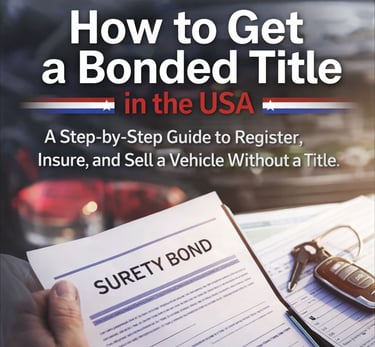
Can You Drive While Waiting for a Bonded Title?
If you’re asking “Can I drive my car while waiting for a bonded title?”, you’re not just curious—you’re probably stressed, stuck, and worried about doing the wrong thing.
You may have bought a used car with no title, inherited a vehicle with missing paperwork, or discovered too late that the seller never transferred ownership properly. Now the car is sitting in your driveway (or worse, in a tow lot), and every day you’re not driving it feels like money burning.
Here’s the hard truth—and the relief you’ve been looking for:
In most cases, you CANNOT legally drive a vehicle while waiting for a bonded title.
But there are critical exceptions, state-specific loopholes, and temporary solutions that may allow limited legal use—if you do things correctly.
This guide will walk you through exactly:
When driving is illegal
When driving may be conditionally legal
How police, insurance companies, and DMVs actually enforce this
What happens if you drive anyway
How to legally get back on the road as fast as possible
No fluff. No myths. No dangerous shortcuts.
What a Bonded Title Really Means (And Why It Matters for Driving)
Before we answer the driving question properly, you need to understand what a bonded title represents legally.
A bonded title is not a temporary permit.
It is not proof of ownership yet.
It is a legal claim in progress.
When you apply for a bonded title, you’re telling the state:
“I believe I own this vehicle, but I can’t prove it with a standard title. I am willing to post a surety bond to protect prior owners or lienholders if my claim is challenged.”
Until the bonded title is issued, the state has not officially recognized you as the owner.
And that single fact controls everything about whether you can drive.
The Core Legal Rule: No Title = No Legal Operation
In the United States, every state requires three things to legally drive a vehicle on public roads:
Valid registration
Valid license plates
Proof of ownership (title or state-approved substitute)
When you’re waiting for a bonded title:
You do not yet have a recognized title
Registration is usually denied or suspended
Plates cannot be legally issued in most cases
That’s why, by default, driving is illegal.https://bondedtitleusa.com/get-bonded-title-usa-ebook
But “default” doesn’t mean “always.”
Let’s break this down carefully.
Scenario 1: You Have NO Plates, NO Registration, NO Title
❌ Can You Drive? Absolutely Not
This is the most common—and most dangerous—scenario.
If your vehicle:
Has no valid plates OR
Has plates that belong to a previous owner OR
Is unregistered in your name
Then driving it is illegal in all 50 states.
What Happens If You Get Pulled Over?
You’re exposed to:
Traffic citations
Vehicle impoundment
Fines
Possible misdemeanor charges in some states
And here’s the part most people don’t realize:
Driving illegally while waiting for a bonded title can delay or destroy your bonded title application.
DMVs take violations seriously when ownership is unresolved.
Scenario 2: The Car Still Has Old Plates
❌ Still Illegal (Even If “Everyone Does It”)
This is one of the most common mistakes people make.
You bought a car.
It still has plates on it.
You think: “I’ll just drive carefully until the bonded title comes through.”
That logic can cost you thousands.
Why This Is Illegal
Those plates are:
Registered to someone else
Tied to their insurance (or lack of it)
Legally not yours
If you’re stopped:
Police can seize the vehicle immediately
You may be accused of misuse of plates
Insurance will likely deny any claim
This is true even if:
The seller said it was fine
The plates aren’t expired
You’re only driving short distances
Scenario 3: You Have Insurance but No Title
❌ Insurance Does NOT Make It Legal to Drive
Many people think:
“I insured the car, so I’m covered.”
Insurance ≠ legal permission to operate.
Insurance only:
Reduces financial risk after an accident
Does not replace registration or title requirements
In fact, insurers can—and often do—deny claims if:
Ownership is unclear
Registration is invalid
Plates don’t match the driver
So driving insured but untitled is still illegal—and still risky.
Scenario 4: Temporary Permits or Transit Tags
⚠️ Maybe Legal — Depending on the State
This is where things get interesting.
Some states do allow limited operation under specific conditions.
Examples of Temporary Permissions (State-Dependent)
Some DMVs may issue:
Temporary operating permits
Transit tags
In-transit permits
Temporary registration without title (rare)
These are not automatic and usually require:
Proof of bonded title application
VIN inspection
Proof of insurance
Fees
A narrow time window (often 30–90 days)
Even then:
Driving may be limited to specific purposes (inspection, repair, DMV visits)
Long-distance or daily commuting may still be prohibited
You must have written authorization—not verbal advice.
Scenario 5: The Vehicle Is Registered but Title Is Pending
⚠️ Rare, But Possible in Certain States
In a few states, registration and title are separate processes.https://bondedtitleusa.com/get-bonded-title-usa-ebook
In limited cases:
The DMV may allow registration based on a bonded title application
Plates may be issued before the bonded title finalizes
This is uncommon and usually applies only when:
Ownership history is partially documented
No theft or lien flags exist
The vehicle value is low
The DMV exercises discretion
Never assume this applies to you without written DMV confirmation.
What Happens If You Drive Anyway?
Let’s be brutally honest.
Thousands of people drive while waiting for a bonded title.
Many are never stopped.
Some get away with it.
But the downside risk is severe.
Potential Consequences
Immediate impound
Towing fees
Storage fees
Court costs
Loss of bond eligibility
Permanent DMV flags on the VIN
If the vehicle is impounded before your bonded title is issued, reclaiming it can become legally impossible.
Real-Life Example: How a $2,500 Car Became a $7,800 Problem
A buyer in Texas purchased a pickup truck without a title for $2,500.
He:
Applied for a bonded title
Insured the vehicle
Drove it “carefully” while waiting
Two weeks later:
Pulled over for a broken tail light
Officer ran the plates
Vehicle impounded on the spot
Final cost:
$450 towing
$1,200 storage
$600 fines
Bond application delayed
Additional inspections required
Total out-of-pocket: $4,200
On a $2,500 truck
This happens every day.
Why States Are So Strict About Driving Without a Title
This isn’t about bureaucracy.
It’s about fraud prevention.
States are trying to stop:
Title washing
Stolen vehicle laundering
Lien avoidance
Tax evasion
Until ownership is clear, the state assumes risk.
That’s why bonded titles exist—and why driving before issuance is treated seriously.
The Fastest Legal Way Back on the Road
If you need to drive now, you have only three safe options:
Wait until the bonded title is issued
Secure a state-issued temporary operating permit
Use the vehicle only on private property
Anything else is gambling.
How Long Does a Bonded Title Take?
Typical timeline:
Application: 1–2 weeks
Bond issuance: 1–3 days
DMV processing: 2–6 weeks
Total: 4–8 weeks (sometimes longer)
The faster and cleaner your application, the faster you drive legally.
Mistakes cause delays.
Why Most Bonded Title Applications Get Delayed (or Rejected)
Common errors:
Incorrect VIN history
Missing bills of sale
Wrong bond amount
State-specific form mistakes
Incomplete affidavits
Each mistake can add weeks or months.
And during that time—you’re still not driving.
The Smart Move: Do It Once. Do It Right.
If you’re serious about:
Getting your bonded title approved
Avoiding fines and impounds
Driving legally as fast as possible
You need a step-by-step, state-specific roadmap.
That’s exactly what the Get Bonded Title USA Ebook gives you:
Exact forms
Correct bond calculations
DMV strategies that work
Mistake-proof instructions
Real examples from every major state
No guessing.
No delays.
No expensive lessons.
Final Answer: Can You Drive While Waiting for a Bonded Title?
Usually: No.
Sometimes: Only with written state permission.
Never: Without registration, plates, and authorization.
If your car matters to you—don’t risk it.
👉 Ready to Get Back on the Road the Right Way?
Stop wasting time. Stop stressing. Stop guessing.
Get the Bonded Title USA Ebook today and follow the exact system thousands have used to:
Secure approval faster
Avoid legal trouble
Drive with confidence again
Because the only thing worse than waiting…
…is losing the car entirely.
Get Bonded Title USA Ebook now.
continue
…entirely.
State-by-State Reality: Why the Answer Changes Depending on Where You Live
One of the most dangerous mistakes people make with bonded titles is assuming there is a single national rule.
There isn’t.
Each state has its own DMV statutes, internal memos, enforcement culture, and tolerance level. Two people in the same situation—same car, same missing title—can face completely different outcomes depending on the state.
Let’s break down how this actually plays out in practice.
Texas: Strict Enforcement, Zero Mercy Without Paper
Texas is one of the most common bonded title states, but also one of the least forgiving if you drive early.
https://bondedtitleusa.com/get-bonded-title-usa-ebook
In Texas:
You cannot register a vehicle without a title or bonded title
You cannot legally operate the vehicle on public roads
Temporary permits are rare and tightly controlled
Even if:
You have insurance
You have a bill of sale
You’ve already paid for the surety bond
If you’re caught driving:
Vehicle is usually impounded immediately
Your bonded title application may be flagged
You may be required to restart the process
Texas DPS does not “warn.” They enforce.
California: Technically Possible, Practically Risky
California law allows more flexibility on paper, but less in reality.
In CA:
The DMV may issue a Temporary Operating Permit (TOP)
But only after VIN verification and partial compliance
And often only for inspection or emissions testing
What most people don’t realize:
CHP officers on the road often don’t honor verbal DMV explanations
If your paperwork isn’t perfect, enforcement still happens
So yes—California may allow limited driving while waiting for a bonded title.
But one missing form can undo everything.
Florida: Almost Always a No
Florida is extremely strict about ownership documentation.
Without a title:
Registration is denied
Plates are denied
Driving is illegal
Florida does not commonly issue operating permits for title issues.
If you drive:
Expect citations
Expect impoundment
Expect delays
Florida assumes that no title = no road access.
Georgia, Alabama, Mississippi: Enforcement Depends on the Officer
Some Southern states are more inconsistent—but that’s not a benefit.
In states like:
Georgia
Alabama
Mississippi
You might:
Drive for weeks without an issue
Then get stopped once and lose the vehicle
Inconsistency creates false confidence, which leads to expensive mistakes.
The law still says no.
The risk is still real.
Midwest States: Paperwork First, Movement Later
States like:
Illinois
Ohio
Indiana
Michigan
Are paperwork-driven.
If the DMV system doesn’t show:
Title issued
Registration active
Then:
Driving is illegal
Officers enforce by database, not discretion
No database match = no mercy.
Western States: More Permits, More Conditions
States like:
Arizona
Nevada
Colorado
Sometimes issue:
Transit permits
Temporary movement authorizations
But these are:
Time-limited
Purpose-specific
Easily violated by “normal driving”
One wrong trip—work commute, grocery run—and you’re out of compliance.
The Insurance Trap Nobody Warns You About
Let’s talk about the biggest silent risk: insurance denial.
Even if:
You have an active policy
You’re fully paid
The insurer issued an ID card
If:
Ownership isn’t legally recognized
Registration isn’t valid
Plates are improper
Then after an accident:
The insurer investigates
The claim gets flagged
Coverage may be denied retroactively
This is not theoretical.
This happens every day.
Example: “But I Had Insurance” Didn’t Matter
A buyer in Arizona insured a car while waiting for a bonded title.
He was rear-ended.
No fault.
Clear liability.
The other driver’s insurer asked:
Who owns the car?
Where is the title?
Why is registration missing?
Claim denied.
Why?
Because the vehicle was not legally operable on public roads at the time of the accident.
The buyer paid:
Repairs out of pocket
Medical bills
Legal fees
Insurance didn’t save him.
Why Driving “Just a Little” Is the Worst Strategy
People justify early driving with logic like:
“Only to work”
“Only nearby”
“Only until the bond clears”
But enforcement doesn’t measure intent.
It measures:
Legal status
Database flags
Compliance
And violations are binary:
Either legal
Or not
There is no “almost legal” on the road.
Can Police Seize the Vehicle Permanently?
Yes. In some cases.
If:
The vehicle is suspected stolen
Ownership can’t be verified
VIN history is inconsistent
Law enforcement can:
Hold the vehicle
Transfer it to state custody
Require proof you may not be able to provide
Once that happens, bonded title eligibility can disappear entirely.
The Emotional Cost Nobody Talks About
This isn’t just about money.
It’s about:
Stress
Anxiety
Constant fear of being stopped
Avoiding highways
Avoiding police cars
Driving with a knot in your stomach
That pressure compounds daily.
And for what?
To save a few weeks?
The Psychological Trap: “I’ve Already Waited This Long”
This is where people make their worst decision.
They think:
“I’ve already waited 3 weeks. What’s another few days of driving?”
That’s when:
The stop happens
The accident happens
The application gets delayed
The last mile is where most people fail.
How Professionals Handle Bonded Title Waiting Periods
People who deal with this correctly do three things:
They stop driving completely
They accelerate the bonded title process
They remove all risk variables
They don’t gamble.
They execute.
How to Speed Up Your Bonded Title (Legally)
If you want to drive sooner, your goal isn’t bending the rules.
It’s compressing the timeline.
That means:
Correct bond amount the first time
Correct VIN verification
Correct affidavits
Correct forms for your exact state
Zero rejections
Zero resubmissions
Every mistake adds weeks.
Why Most People Waste 2–4 Extra Months
Because they:
Follow random forum advice
Use generic online checklists
Guess at bond values
Submit incomplete packets
Miss state-specific nuances
DMVs don’t help you fix mistakes.
They just send you to the back of the line.
The Bonded Title USA Ebook Advantage
The Get Bonded Title USA Ebook exists for one reason:
To eliminate guessing.
Inside, you get:
State-by-state instructions
Exact bond calculations
DMV language that works
Common rejection triggers
Real examples from real cases
A clear timeline from start to finish
This is the difference between:
Driving in 4–6 weeks
Or waiting 6 months while your car sits
Final Reality Check
Ask yourself one honest question:
Is driving illegally for a few weeks worth risking the entire vehicle?
For most people, the answer—once they understand the real risk—is no.
Waiting feels slow.
But restarting feels brutal.
👉 The Smartest Move You Can Make Right Now
If you’re serious about:
Getting approved fast
Avoiding impoundment
Avoiding insurance disasters
Driving legally and confidently
Then stop experimenting.
Get the Bonded Title USA Ebook and follow a proven, state-specific system that works.
No delays.
No fines.
No panic.
Just a clear path from no title → legal ownership → back on the road.
Get Bonded Title USA Ebook now.
continue
…now.
What Happens During the “Bonded Period” (And Why Driving Still Matters)
Even after you receive a bonded title, many states impose a bonded period—typically 3 to 5 years—during which the title is marked as “bonded” or “surety.”
This period exists to protect:
Prior owners
Lienholders
Creditors
Victims of theft or fraud
But here’s what most people misunderstand:
The rules about driving change only AFTER the bonded title is issued—not before.
Before Bonded Title Issuance
You are not legally recognized as the owner
Driving is usually illegal
Registration is typically blocked
After Bonded Title Issuance
You ARE legally recognized as the owner
You can register the vehicle
You can legally drive
The “bonded” label does NOT restrict daily use
The bonded period affects ownership challenges, not your right to drive.
This distinction matters because many people confuse the waiting period before issuance with the bonded period after issuance.
Only one of those allows legal driving.
Can You Drive on Private Property While Waiting?
Yes—and this is one of the few safe answers.
You may legally operate a vehicle without title or registration on:
Private land
Farms
Ranches
Private driveways
Closed tracks
Non-public roads
As long as:
The area is not accessible to the general public
No state or local ordinance prohibits it
You are not endangering others
This is why some people:
Store vehicles on private property
Test-drive only on private land
Move vehicles using trailers instead of driving
Once you enter a public roadway, everything changes.
What About Moving the Vehicle for Repairs or Inspection?
This is a gray area—and a dangerous one.
Some states allow:
Movement permits
Repair permits
Inspection-only permits
But:
These must be issued before driving
They are purpose-limited
They are time-limited
Driving to a mechanic without a permit is still illegal.
Even a one-mile trip can result in:
Citation
Impoundment
Bonded title delays
If your car needs work:
Tow it
Trailer it
Get written authorization first
Never assume “repair necessity” equals permission.
Why Police Don’t Care That You’re “In the Process”
This is one of the most painful truths.
From a law enforcement perspective:
You either have legal authority to operate
Or you don’t
Being “in the process”:
Doesn’t show up in databases
Doesn’t override statutes
Doesn’t stop enforcement
An officer on the roadside:
Sees VIN
Sees registration status
Sees plate ownership
They don’t evaluate intent.
They enforce law.
The Myth of “As Long As I’m Insured”
This myth persists because insurers happily sell policies on vehicles without titles.
Why?
Because:
Selling a policy ≠ guaranteeing coverage
Underwriting ≠ claims approval
Insurance companies collect premiums first.
Coverage decisions happen after an incident, when:
Legal operation status is reviewed
Ownership is scrutinized
Registration is verified
That’s when problems surface.
The DMV Doesn’t Warn You—It Just Denies You
DMVs do not proactively tell applicants:
“Don’t drive while waiting”
“This could hurt your case”
They assume you already know.
If they discover:
Violations
Citations
Impoundments
They may:
Pause your application
Request additional proof
Deny issuance outright
And they won’t explain why in plain language.
Why Bonded Title Delays Cost More Than You Think
Every week you wait:
The car depreciates
Storage risks increase
Mechanical issues worsen
Motivation drops
People end up:
Abandoning vehicles
Selling at a loss
Walking away entirely
All because of avoidable delays and mistakes.
The “I’ll Just Sell It” Trap
Some people think:
“I’ll sell the car while waiting for the bonded title.”
This is often illegal.
In many states:
You cannot legally sell a vehicle you do not legally own
Selling before bonded title issuance can be considered fraud
Even if:
The buyer knows
The buyer agrees
You disclose everything
The transaction can be void.
And it can permanently complicate your bonded title eligibility.
Why DIY Advice Fails So Often
Online forums are full of advice like:
“I drove for months, nothing happened”
“My cousin did it, you’ll be fine”
“Police don’t care”
What those stories don’t include:
The thousands who weren’t lucky
The impounds
The denied claims
The rejected applications
Survivorship bias is real—and expensive.
The One Thing That Changes Everything: Preparation
People who succeed with bonded titles:
Prepare everything upfront
Submit complete packets
Avoid all violations
Follow state-specific rules exactly
They don’t rely on luck.
They rely on process.
What the Bonded Title USA Ebook Actually Does
This isn’t theory.
The Get Bonded Title USA Ebook walks you through:
Whether your state allows any driving exceptions
Which permits (if any) apply
Exact steps to get approved faster
How to avoid red flags
How to protect yourself legally while waiting
It’s built from:
Real DMV procedures
Real state statutes
Real outcomes
Not forum myths.
Ask Yourself This Before You Turn the Key
One final question—be honest:
If the car were impounded today, could you afford the loss?
If the answer is no, then the decision is already made.
Waiting isn’t weakness.
It’s strategy.
👉 Take Control Instead of Taking Risks
You don’t need to gamble.
You don’t need to guess.
You don’t need to hope.
You need a clear, legal path.
Get the Bonded Title USA Ebook and follow a proven system that gets you:
Approved faster
On the road legally
Out of limbo permanently
The sooner you do it right, the sooner you drive without fear.
Get Bonded Title USA Ebook now.
BondedTitleUSA.com is an informational resource and does not provide legal advice. DMV rules vary by state.
Contact
infoebookusa@aol.com
© 2026. All rights reserved.