Can You Sell a Car With a Bonded Title?
Blog post description.
3/8/202618 min read
Can You Sell a Car With a Bonded Title?
If you’re staring at a bonded title and wondering whether it’s a dead end—or a ticking time bomb—you’re not alone. This is one of the most misunderstood areas of vehicle ownership in the United States, and misinformation here can cost you thousands of dollars, delay a sale for months, or even expose you to legal liability after the car is gone.
Let’s be clear from the start:
Yes, you can sell a car with a bonded title in many cases—but whether you should, how, and to whom depends on very specific legal, financial, and strategic factors.
This article does not skim the surface. It does not sugarcoat. And it does not give you generic “it depends” answers.
Instead, you’re about to get a deep, practical, state-aware, real-world breakdown of:
What a bonded title really means
Why bonded titles exist in the first place
Whether selling with one is legal
Who will (and will not) buy a car with a bonded title
How value is affected
What risks transfer—and which ones don’t
How to sell legally, ethically, and safely
When selling is a smart move—and when it’s a mistake
How to protect yourself from future claims
How to convert a bonded title into a clean title (and why timing matters)
This is written in authoritative American English, for people who are serious about selling—or buying—a vehicle with a bonded title and don’t want surprises later.
Let’s start at the foundation.
What Is a Bonded Title, Really?
A bonded title (also called a certificate of title with surety bond) is not a “fake” title, a temporary registration, or a loophole.
It is a state-issued legal title that allows a person to register, insure, and legally operate a vehicle when standard proof of ownership is missing or defective.
The keyword here is missing—not stolen.
A bonded title exists because real life is messy.
Titles get lost.
Paperwork gets destroyed.
Vehicles are abandoned.
Cars change hands without proper documentation.
Old projects are found in barns.
Vehicles are inherited informally.
DMV records don’t match reality.
A bonded title is the state’s way of saying:
“We can’t fully verify ownership through standard documents, but we’ll issue a title if you post a bond that protects anyone who might later prove a superior ownership claim.”
That bond is typically:
Issued by a licensed surety company
Equal to 1.5× to 2× the vehicle’s appraised value
Held for a fixed period (usually 3–5 years, depending on state)
During the bond period, someone else could theoretically come forward and claim ownership. If they win, the bond pays them—not you, not the buyer, not the state.
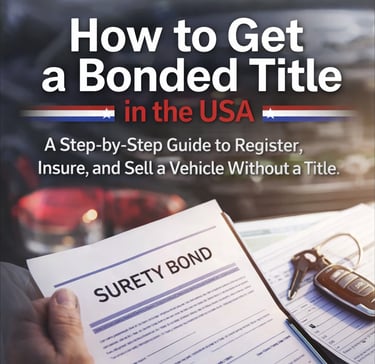
This is the core risk that colors everything else in this article. https://bondedtitleusa.com/get-bonded-title-usa-ebook
Why Do Bonded Titles Exist at All?
States do not issue bonded titles casually.
They exist because eliminating them would strand millions of legitimate vehicles in legal limbo.
Consider these very real scenarios:
A private seller sells a car but never hands over the title
A vehicle is abandoned on private property with no reachable owner
A classic car is restored after decades with no paperwork
A family member passes away without probate
A vehicle is bought at a lien sale with incomplete documentation
A VIN exists, but records are outdated or mismatched
Without bonded titles, these vehicles would be:
Impossible to register
Impossible to insure
Impossible to sell legally
Worth only scrap value
So states created a risk-shifting mechanism:
The owner posts a bond
The state issues a title
Any future ownership dispute is handled through the bond
That’s why bonded titles are legal in most—but not all—states.
And it’s why selling a car with one is not automatically illegal or shady.
But legality does not equal simplicity.
Is It Legal to Sell a Car With a Bonded Title?
In most states, yes—it is legal to sell a vehicle with a bonded title.
However, legality depends on three conditions:
1. The Title Must Be Properly Issued
You cannot sell a vehicle with:
A pending bonded title application
A rejected bond
A provisional registration
A “receipt” in place of a title
The bonded title must be:
Fully issued
In your name
Free of restrictions prohibiting transfer
Some states place temporary transfer limitations on bonded titles during the bond period. Others do not.
2. You Must Disclose the Bonded Status
Failing to disclose that a title is bonded can constitute:
Fraud
Misrepresentation
Contract rescission
Civil liability
Even in states that don’t explicitly mandate disclosure, courts routinely side with buyers when sellers conceal bonded status.
Disclosure is not optional if you want to stay safe.
3. The Buyer Must Be Able to Register It
A sale is pointless if the buyer cannot:
Transfer the title
Register the vehicle
Insure it
Obtain plates
Some states:
Allow free transfer of bonded titles
Reset the bond clock upon transfer
Require a new bond in the buyer’s name
Prohibit transfer until bond maturity
You must verify this before selling.
So the real answer to “Is it legal?” is:
Yes, if issued correctly, disclosed properly, and transferable under state law.
Now let’s address the bigger question most people are actually asking.
Should You Sell a Car With a Bonded Title?
This is not a legal question.
It’s a strategic one.
And the honest answer is:
Sometimes yes. Sometimes absolutely not.
Let’s break down when selling makes sense—and when it’s a mistake.
Situations Where Selling With a Bonded Title Makes Sense
1. The Vehicle Is Low-Value or High-Risk
If the car is:
Older
High mileage
Cosmetic damage
Salvage-adjacent
A project vehicle
Worth under market average
Then waiting years to clear the bond may not be worth it.
In these cases:
The depreciation curve is already steep
Buyers expect imperfections
The bonded status is “priced in”
Selling sooner can preserve value.
2. You’re Selling to a Dealer, Exporter, or Rebuilder
Certain buyers:
Understand bonded titles
Factor the risk into pricing
Have legal teams or processes in place
These buyers often:
Buy at a discount
Accept the bonded risk
Plan to resell after bond maturity
Export vehicles where title rules differ
This is common in:
Wholesale markets
Auctions
Export channels
Specialty rebuilders
3. You Need Liquidity Now
Life happens.
Medical bills.
Relocation.
Divorce.
Business cash flow.
Estate liquidation.
If holding the vehicle for 3–5 years is not feasible, selling now—even at a discount—may be rational.
4. The Bond Period Is Nearly Complete
If you’re:
Months away from bond expiration
Confident no claims exist
Transparent with buyers
Some buyers will accept a short remaining bond period with minimal hesitation.
Now let’s talk about when selling is a bad idea.
Situations Where You Should NOT Sell With a Bonded Title
1. The Vehicle Is High-Value
Luxury vehicles.
Late-model cars.
Rare classics.
Collector vehicles.
These buyers:
Expect clean titles
Perform deep due diligence
Walk at the first sign of title irregularity
The discount required to move such a car with a bonded title can be brutal—sometimes 30–50% below market.
Waiting to clear the title often yields a far better outcome.
2. The Buyer Is a Private Consumer With Financing
Banks hate bonded titles.
Most lenders:
Will not finance bonded-title vehicles
Will not accept them as collateral
Will not insure them easily
That kills a huge portion of the buyer pool.
If your target buyer needs:
A loan
Full-coverage insurance
A smooth DMV transfer
Selling with a bonded title becomes extremely difficult.
3. You Cannot Clearly Explain the Title History
If you don’t know:
Why the bond was required
Whether prior owners exist
Whether liens were properly cleared
Then you are increasing the odds of a future dispute—and that risk doesn’t always disappear when the car changes hands.
Who Will Buy a Car With a Bonded Title?
This is where expectations must be realistic.
Buyers Who Often WILL Buy
Used car dealers (with conditions)
Exporters
Rebuilders
Project car enthusiasts
Mechanics
Flippers with experience
Cash buyers
Auction buyers
These buyers understand risk.
They price for it.
They move quickly.
Buyers Who Usually Will NOT Buy
First-time buyers
Buyers needing financing
Risk-averse consumers
Corporate fleets
Ride-share drivers
Lease buyers
Anyone advised by a cautious bank or insurer
This directly impacts how you should market the vehicle.
How Does a Bonded Title Affect the Sale Price?
There is no fixed formula, but patterns are clear.
Typical price impact:
10–20% reduction for low-value vehicles
20–30% reduction for mid-range vehicles
30–50% reduction for high-value vehicles
The discount reflects:
Legal uncertainty
Buyer inconvenience
Financing difficulty
Insurance complications
Resale friction
The more transparent and documented you are, the smaller the discount tends to be.
Disclosure: What You Must Tell the Buyer (And How)
This is where sellers get into trouble.
You must disclose:
That the title is bonded
Why it was issued
How long the bond lasts
Whether the bond transfers or resets
Any known risks or claims
Best practice:
Include bonded status in the listing
Explain it verbally
Include it in the bill of sale
Have the buyer acknowledge it in writing
This protects you long after the sale.
Does the Bonded Risk Transfer to the Buyer?
This is a critical question—and one many sellers misunderstand.
The risk does not disappear when you sell.
Depending on state law:
The bond may remain attached to the vehicle
A new bond may be required
The buyer may inherit the remaining bond period
The bond clock may restart
If a valid ownership claim arises:
The surety company pays the claimant
The surety company then seeks reimbursement from the bonded party
That could be you—or the buyer—depending on structure
This is why documentation matters so much.
Can a Buyer Sue You After the Sale?
Yes—if you:
Failed to disclose bonded status
Misrepresented ownership
Sold a vehicle with unresolved liens
Provided false statements
No—if you:
Fully disclosed
Documented everything
Sold “as-is”
Followed state procedures
Selling a bonded-title vehicle is not inherently dangerous.
Selling one carelessly is.https://bondedtitleusa.com/get-bonded-title-usa-ebook
How to Sell a Car With a Bonded Title Step by Step
Here is a practical, risk-minimized process.
Step 1: Confirm Transferability in Your State
Check:
DMV rules
Whether transfer is allowed
Whether a new bond is required
Whether the bond period resets
Never assume.
Step 2: Gather Documentation
Prepare:
Bond certificate
Appraisal used for bond
VIN inspection (if applicable)
Proof of how you acquired the vehicle
Any lien releases
Copies of DMV correspondence
Transparency builds confidence.
Step 3: Price Realistically
Do not price at clean-title market value.
You will:
Waste time
Scare buyers
Invite lowball offers anyway
Price with the bonded status clearly reflected.
Step 4: Target the Right Buyers
Focus on:
Cash buyers
Experienced buyers
Trade professionals
Auctions where bonded titles are common
Avoid platforms dominated by financed buyers.
Step 5: Use a Strong Bill of Sale
Include:
“Bonded title disclosed”
Vehicle sold as-is
No warranties
Buyer acknowledgment
This is not overkill. It’s protection.
Can You Convert a Bonded Title to a Clean Title Before Selling?
Yes—and this is often the smartest move.
After the bond period expires:
No claims were made
You apply for a standard title
The bond is released
The title becomes “clean”
This:
Removes stigma
Increases value
Expands buyer pool
Simplifies financing
Reduces legal risk
But many owners don’t know:
How long their bond lasts
Whether they qualify
How to apply
What documents are needed
This is where most people get stuck.
The Biggest Mistakes Sellers Make With Bonded Titles
Assuming “bonded” means “temporary”
Failing to disclose
Pricing like a clean title
Selling to the wrong buyer
Not understanding state-specific rules
Ignoring bond expiration opportunities
Using vague bills of sale
Each of these can cost real money.
Emotional Reality: Why Bonded Titles Feel So Stressful
Let’s be honest.
A bonded title feels like:
A cloud over your ownership
A question mark buyers fixate on
A red flag you didn’t ask for
A bureaucratic punishment for paperwork mistakes
Many owners feel:
Embarrassed
Defensive
Anxious about future claims
Afraid of doing something wrong
That’s normal.
But uncertainty disappears when you understand the system and act deliberately.
Strategic Question: Sell Now or Wait?
Ask yourself:
How much value do I lose by selling now?
How long until the bond clears?
What’s my carrying cost?
What’s my risk tolerance?
Do I need the cash?
Is the vehicle depreciating fast?
There is no universal answer—but there is a rational one for your situation.
Final Truth: Bonded Titles Are Not Deal-Killers—Ignorance Is
A bonded title is:
A legal ownership instrument
A risk-management tool
A temporary status
A solvable problem
Selling a car with one is not shady.
Doing it without understanding the rules is.
If you want absolute clarity—state by state, step by step, with zero guesswork—there is a faster path than trial and error.
👉 Ready to Do This the Right Way?
If you want:
To know exactly whether you can sell your bonded-title vehicle
To avoid legal mistakes
To maximize resale value
To understand your state’s rules without DMV confusion
To convert a bonded title into a clean title when possible
To protect yourself from future claims
Then you don’t need another forum thread or half-answer.
You need a complete, practical roadmap.
Get the Bonded Title USA eBook
It breaks down:
Every major state’s bonded title rules
Sale and transfer scenarios
Bond expiration strategies
Real examples
Step-by-step checklists
Mistakes that cost thousands
How to turn uncertainty into certainty
Get Bonded Title USA eBook and stop guessing—because when it comes to titles, guessing is expensive.
And once you understand this system, a bonded title stops being a problem and starts being just another step you know how to handle.
(If you want me to continue deeper into buyer negotiations, state-by-state nuances, or edge cases like inherited vehicles, lien sales, or abandoned cars, just reply: CONTINUE)
continue
…and edge cases like inherited vehicles, lien sales, abandoned cars, interstate transfers, and buyer negotiations are exactly where most bonded-title sales collapse if you don’t know what you’re doing.
So let’s keep going—deeper, more practical, more tactical.
Selling a Car With a Bonded Title: Advanced Scenarios That Break Most Deals
Most articles stop at “yes, you can sell it” and walk away.
Real life doesn’t.
Real life throws edge cases at you that turn a simple sale into a nightmare if you’re unprepared.
This section exists to make sure that doesn’t happen to you.
Scenario 1: Selling a Bonded Title Vehicle Across State Lines
This is one of the most dangerous assumptions sellers make.
They assume:
“If my state issued the bonded title, the buyer’s state will accept it.”
That assumption is often wrong.
The Hard Truth About Interstate Bonded Title Sales
Bonded title acceptance is state-specific, not federal.
When you sell across state lines:
The buyer’s DMV decides whether the title is acceptable
The buyer’s state may:
Accept the bonded title as-is
Require a new bond
Reject bonded titles entirely
Require additional inspections
Demand lien searches or affidavits
Reset the bond period
This is where deals die after money changes hands, which is the worst possible timing.
States That Commonly Create Problems
Some states are known for:
Stricter title verification
Reluctance to accept bonded titles from other states
Aggressive lien enforcement
Buyers in these states will often walk unless everything is crystal clear.
How to Protect Yourself
Before agreeing to an out-of-state sale:
Have the buyer call their DMV before paying
Ask specifically:
“Will you accept an out-of-state bonded title?”
“Will I need to post a new bond?”
“Will the bond period reset?”
Get the answer in writing if possible
If the buyer can’t register the vehicle, they may come back after you, even if you disclosed everything.
Scenario 2: Selling an Inherited Vehicle With a Bonded Title
This is extremely common—and emotionally charged.
A family member passes away.
There’s a car.
There’s no probate.
The title is missing or in the deceased person’s name.
The heirs want to sell.
A bonded title is often the only solution.
Why Inherited Vehicles Trigger Bonded Titles
No executor appointed
No formal estate opened
Title never transferred
DMV records outdated
Multiple heirs with unclear authority
States will often issue a bonded title to:
One heir
A family representative
A person who can prove possession but not clean ownership
Selling Risks in This Scenario
Buyers worry about:
Other heirs coming forward
Estate disputes
Probate reopening
Claims years later
These fears are not irrational.
How to Sell Safely
If you’re selling an inherited vehicle with a bonded title:
Document your relationship to the deceased
Keep death certificates
Keep affidavits of heirship
Disclose inheritance history
Avoid vague explanations
Transparency here can mean the difference between a smooth sale and a lawsuit.
Scenario 3: Selling a Bonded Title Vehicle Acquired Through a Lien Sale
This is where things get legally sharp.
Lien sales happen when:
Storage fees aren’t paid
Towing charges accrue
Vehicles are abandoned
Mechanics assert liens
Sometimes lien paperwork is incomplete, triggering a bonded title.https://bondedtitleusa.com/get-bonded-title-usa-ebook
The Risk Buyers Fear Most: Hidden Liens
Even with a bonded title:
A prior lienholder may still have a claim
Improper notice can invalidate a lien sale
Banks aggressively pursue errors
If a buyer later loses the vehicle due to a lien claim, they will:
Go after the bond
Go after you
Go after anyone involved
Best Practices Before Selling
Verify lien notices were properly served
Keep certified mail receipts
Keep lien sale affidavits
Ensure the bond amount covered potential claims
Disclose lien sale origin explicitly
Never describe a lien-sale vehicle vaguely.
Precision builds trust.
Scenario 4: Selling a Bonded Title Vehicle That Was Previously Abandoned
Abandoned vehicles are fertile ground for bonded titles—and buyer fear.
Buyers immediately think:
“Was it stolen?”
“Why was it abandoned?”
“Who might come back?”
Even if everything is legal, perception matters.
How to Neutralize Buyer Fear
Explain where it was abandoned
Explain how possession was obtained legally
Show DMV correspondence
Show VIN checks
Provide timeline clarity
Buyers fear unknowns, not facts.
Negotiation Strategy: How to Handle Buyer Objections to Bonded Titles
You will hear these objections.
Prepare for them.
Objection 1: “I’ve Never Dealt With a Bonded Title Before”
Your response:
“That’s common. A bonded title is a state-issued ownership document used when paperwork is missing. It allows legal registration and operation. The bond protects against prior ownership claims, and everything is fully disclosed.”
Calm, factual, confident.
Objection 2: “What If Someone Claims the Car Later?”
Your response:
“That’s exactly what the bond covers. If a valid claim arises during the bond period, the surety compensates the claimant. That’s why the bond exists.”
Never minimize—explain.
Objection 3: “Can I Get Insurance?”
Your response:
“Most insurers will provide coverage once the vehicle is registered. Some require additional documentation, but bonded titles are insurable in most states.”
Encourage them to confirm—not guess.
Objection 4: “Why Is the Price Lower?”
Your response:
“Because bonded titles carry temporary administrative complexity. The discount reflects that, not the condition of the vehicle.”
This reframes the discount as rational—not suspicious.
Financing and Insurance: The Hidden Deal-Killers
Let’s be blunt.
Financing
Most lenders:
Do not finance bonded-title vehicles
Treat them as higher risk
Reject them outright
This eliminates:
Most mainstream buyers
Buyers without cash
Buyers relying on banks or credit unions
Insurance
Insurance is easier than financing—but not automatic.
Some insurers:
Require VIN inspections
Require proof of title issuance
Delay comprehensive coverage
If the buyer needs full coverage immediately, expect friction.
How to Write Listings That Don’t Scare Buyers Away
The worst thing you can do is:
Hide the bonded title
Mention it vaguely
Drop it at the last minute
Bad Listing Example
“Clean car, priced to sell, title in hand.”
This is how disputes start.
Better Listing Example
“Vehicle has a bonded title issued by the state due to missing prior documentation. Fully registered and legal. Priced accordingly.”
This filters out the wrong buyers instantly.
Tax and Reporting Considerations
Selling a bonded-title vehicle still triggers:
Sales tax obligations (depending on state)
Capital gains reporting if applicable
Bill-of-sale documentation
Bonded status does not exempt you from:
IRS reporting
State tax rules
Transfer fees
Do not ignore this.
What Happens If a Claim Is Filed After You Sell?
This question keeps sellers up at night.
Let’s clarify.
If a valid ownership claim arises:
The claimant files against the bond
The surety investigates
If the claim is valid, the surety pays
Then one of two things happens:
The surety seeks reimbursement from the bonded party
Or the buyer’s bond (if reissued) is triggered
Your exposure depends on:
How the bond was structured
Who is named
Whether the buyer posted a new bond
State-specific rules
This is why understanding bond transfer mechanics matters so much.
Can You Sell “As-Is” and Avoid All Risk?
No.
“As-is” protects against:
Mechanical issues
Condition disputes
Wear and tear
It does not protect against:
Title fraud
Non-disclosure
Ownership misrepresentation
Titles are a separate legal universe.
When Waiting to Clear the Bond Is the Smartest Move
If:
The bond expires soon
The vehicle is appreciating
The buyer pool is thin
Financing matters
You want maximum value
Then waiting can:
Increase sale price dramatically
Eliminate buyer objections
Simplify paperwork
Remove legal uncertainty
But only if you know:
When the bond expires
How to convert the title
What documents you’ll need
Most people don’t—and that’s where they stall.
Why Most People Get Bonded Titles Wrong
They assume:
It’s temporary “paperwork”
It works the same in every state
Disclosure is optional
Buyers won’t care
DMV employees will guide them correctly
Every one of those assumptions is dangerous.
The Psychological Trap: Panic Selling
Many sellers panic when they hear:
“Bonded title”
“Potential claim”
“Three to five years”
“Surety bond”
They rush to sell.
They underprice.
They overshare emotionally.
They accept bad deals.
Bonded titles are not emergencies.
They’re processes.
And processes reward patience and clarity.
Strategic Summary (Without Summarizing)
Selling a car with a bonded title is:
Legal in many states
Possible in most cases
Profitable if done correctly
Risky if done blindly
It requires:
Disclosure
Documentation
Strategy
State-specific knowledge
Buyer targeting
Legal awareness
This is not a Craigslist flip.
This is a regulated transaction.
The One Thing That Changes Everything
Knowledge.
Not opinions.
Not forum anecdotes.
Not “my cousin did it once.”
Actual rules. Actual steps. Actual state guidance.
When you understand:
How bonded titles work
How long bonds last
How to convert them
How sales affect liability
How buyers perceive risk
How to structure a safe transaction
The anxiety disappears.
👉 Final CTA: Stop Guessing. Get Certainty.
If you’re dealing with a bonded title and want:
To know exactly whether you can sell
To avoid lawsuits and DMV nightmares
To understand your state’s rules
To maximize value instead of panic-selling
To convert a bonded title into a clean one when possible
To handle buyers confidently and professionally
Then you need more than scattered answers.
Get Bonded Title USA eBook
It is built for people who:
Want clarity, not confusion
Want strategy, not fear
Want results, not delays
Get Bonded Title USA eBook and turn a bonded title from a liability into a controlled, manageable step—because the only real danger is not knowing what you’re doing.
…and once you understand the system, you’ll realize that most people lose money on bonded titles not because of the title—but because they never learned how to use it correctly.
continue
…and the moment you understand that, you stop reacting emotionally and start acting strategically.
Let’s go even deeper—into the parts nobody talks about, the gray zones, the timing traps, and the subtle legal and psychological mechanics that decide whether selling a car with a bonded title becomes a clean win or a lingering regret.
Timing the Sale: WHEN You Sell Matters Almost as Much as HOW
Most people ask can you sell a car with a bonded title.
Very few ask when is the optimal moment.
That’s a costly mistake.
The Bond Timeline Trap
A bonded title is not static. Its risk profile changes over time.
Month 1 of the bond period = highest perceived risk
Year 1 = moderate buyer resistance
Final 6–12 months = dramatically reduced fear
Post-expiration = essentially a clean title (once converted)
Yet many sellers:
Panic-sell early
Accept massive discounts
Give buyers all the upside
Smart sellers time the market.
Example: Same Car, Two Different Outcomes
Vehicle market value (clean title): $12,000
Bond period: 3 years
Scenario A: Sell immediately
Buyer discount demanded: 30%
Sale price: ~$8,400
Scenario B: Wait 30 months
Buyer discount demanded: 10–15%
Sale price: ~$10,200–$10,800
Same car. Same title. Different timing.
That $1,800–$2,400 difference is not luck—it’s strategy.
The Buyer Psychology Nobody Explains
Buyers don’t evaluate bonded titles rationally.
They evaluate them emotionally.
Understanding this lets you control the conversation instead of reacting to it.
What Buyers Actually Fear
Not paperwork.
Not DMV visits.
They fear:
Embarrassment if they can’t register it
Looking “stupid” for buying a risky car
Telling friends “it has a bonded title”
Losing money later
Being the one holding the bag
This is why confidence and clarity matter more than technical explanations.
How Sellers Lose Control
They:
Overexplain nervously
Use disclaimers like “I think” or “probably”
Apologize for the title
Seem unsure
Uncertainty kills trust.
How Sellers Gain Control
They:
Explain bonded titles calmly
State facts without emotion
Frame the bond as a protective mechanism
Show documents proactively
Price appropriately
Buyers don’t need reassurance.
They need certainty.
The Silent Risk: Online Marketplaces and Bonded Titles
Selling online adds another layer of complexity.
Platforms That Are Bonded-Title Hostile
Some marketplaces:
Flag bonded titles automatically
Remove listings for “title issues”
Side with buyers in disputes by default
If a buyer complains after the sale—even unfairly—you may lose both:
The vehicle
The money
How to Reduce Platform Risk
Disclose bonded status in the listing
Use clear language
Avoid euphemisms (“special title,” “alternative title”)
Keep all communications on-platform
Save screenshots of disclosures
If the platform can see you disclosed, you’re safer.
Selling to Dealers: Not All Dealers Are Equal
Many sellers assume:
“Dealers won’t touch bonded titles.”
That’s false.
But which dealers matters.
Dealers Who Commonly Accept Bonded Titles
Independent used car dealers
Buy-here-pay-here lots
Wholesale dealers
Export-focused dealers
Auction buyers
Dealers Who Usually Refuse
Franchise dealerships
Manufacturer-certified programs
Corporate chains
Lease-focused dealers
Approach the wrong dealer and you’ll think selling is impossible.
Approach the right one and the deal may close same-day.
Auctions: The Nuclear Option (Sometimes the Best One)
Auctions are often misunderstood.
Why Auctions Work for Bonded Titles
Professional buyers
Risk is priced in
No emotional negotiation
Clear terms
Fast liquidation
You will get:
Less than retail
But more certainty
And less drama
For sellers who:
Want speed
Want finality
Want zero buyer interaction
Auctions can be ideal.
The Legal Fine Print That Actually Matters
Let’s talk about what lawyers and courts care about—not what people argue about online.
Courts Focus On Three Things
Disclosure
Intent
Documentation
If you disclosed bonded status clearly, documented the sale, and acted in good faith, courts are extremely reluctant to punish sellers.
Most lawsuits succeed because sellers:
Hid information
Lied by omission
Used misleading language
Acted recklessly
Bonded title ≠ automatic liability.
Deception = liability.
“What If the Buyer Asks Me to Wait Until the Bond Clears?”
This happens more often than you’d think.
Your Options
Hold the car
Buyer commits in writing
Non-refundable deposit
Clear timeline
Convert the title first
Highest value
Least friction
Decline and move on
Avoid uncertainty
What you should not do:
Make verbal promises
Hold without a contract
Remove the listing prematurely
Partial Payments, Deposits, and Bonded Titles
This is dangerous territory.
If a buyer:
Pays a deposit
Takes possession
Does not transfer title
You may:
Still be legally responsible
Still be tied to the bond
Still face claims
Best practice:
No possession without full payment
No possession without executed bill of sale
No possession without title transfer initiation
Half-measures create full problems.
Selling to Friends or Family: The Emotional Landmine
This seems “safer.”
It often isn’t.
Why These Sales Go Wrong
Informal agreements
Assumed understanding
Poor documentation
Delayed transfers
Hurt feelings turning into lawsuits
If anything goes wrong, it’s personal.
If you sell to someone you know:
Document everything
Treat it like a stranger transaction
Disclose twice
Get signatures
Trust does not replace paperwork.
The DMV Myth: “They’ll Tell Me What To Do”
DMV employees:
Are not lawyers
Often give inconsistent advice
May misunderstand bonded titles
Do not bear responsibility for errors
Never rely solely on:
Verbal DMV guidance
“This is how we usually do it”
One employee’s opinion
Documentation beats conversations.
Clearing the Bond: The Moment Most Sellers Miss
Many people don’t even realize:
Their bond period has expired
They’re eligible for a clean title
They’re selling at a discount unnecessarily
This is one of the most painful mistakes.
Why It Happens
People forget the bond date
DMV never notifies them
Life gets busy
The vehicle sits unused
Before selling:
Check the bond issuance date
Confirm bond duration
Ask whether conversion is available
One DMV visit can add thousands to your sale price.
The Hidden Upside of Bonded Titles (Yes, There Is One)
Here’s something counterintuitive.
Bonded titles:
Filter out unserious buyers
Attract knowledgeable buyers
Reduce frivolous negotiations
Speed up serious deals
In some markets, sellers with bonded titles:
Waste less time
Deal with fewer tire-kickers
Close faster at fair prices
If you embrace transparency, bonded titles can actually simplify the selling process.
International Buyers and Export: A Special Case
Export buyers often:
Care less about bonded status
Operate under different title regimes
Focus on VIN and bill of sale
However:
Export rules are complex
Title errors can delay shipments
Mistakes can trigger seizures
If exporting:
Use experienced exporters
Do not improvise
Document everything
The Long-Term Risk Myth
Many sellers fear:
“What if something happens years later?”
Reality:
Most ownership claims occur early
The longer time passes, the lower the risk
Courts view delayed claims skeptically
Bonded titles are structured around this reality.
They are not indefinite liabilities.
Why People Lose Money on Bonded Titles (The Real Reason)
Not because of the bond.
Because they:
Don’t understand their state’s rules
React emotionally
Rush decisions
Listen to bad advice
Fail to document
Sell blindly
Information asymmetry is the enemy.
Turning the Bonded Title Into Leverage
Once you know:
The rules
The risks
The buyer psychology
The timing dynamics
You can:
Justify your price
Control negotiations
Decide whether to wait or sell
Choose the right buyer
Avoid liability
At that point, the bonded title stops controlling you.
You control it.
The Final Emotional Reality Check
A bonded title feels like:
A stain
A handicap
A problem you didn’t ask for
But in practice, it’s:
A structured legal solution
A temporary condition
A manageable risk
The people who lose are not the ones with bonded titles.
They’re the ones who never learn how to handle them.
👉 Final, Non-Negotiable Truth
If you are selling—or thinking about selling—a car with a bonded title, guessing is the most expensive option.
Every wrong assumption costs:
Time
Money
Sleep
Peace of mind
You can either:
Learn through mistakes
Or learn once, correctly
👉 Get the Tool That Removes All Doubt
The Get Bonded Title USA eBook exists for one reason:
To give you certainty.
Inside, you’ll find:
State-by-state bonded title rules
Sale, transfer, and conversion strategies
Real-world scenarios
Legal-safe disclosure language
Buyer negotiation frameworks
Mistakes that trigger lawsuits
Step-by-step DMV processes
No fluff. No fear-mongering. No guessing.
Get Bonded Title USA eBook and turn a confusing, stressful title situation into a controlled, professional transaction—because when you understand the system, a bonded title is no longer a problem.
It’s just a step you already know how to handle.
BondedTitleUSA.com is an informational resource and does not provide legal advice. DMV rules vary by state.
Contact
infoebookusa@aol.com
© 2026. All rights reserved.