Everything You Need to Get a Bonded Title
Blog post description.
4/15/202615 min read
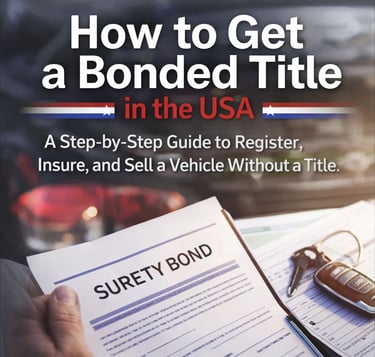
Everything You Need to Get a Bonded Title in the United States
If you’re here, you’re probably dealing with one of the most frustrating situations a vehicle owner can face in the United States: you have a car, truck, motorcycle, or trailer—but you don’t have a valid title. Maybe you bought it from a private seller who never transferred the title. Maybe the title was lost years ago. Maybe it came from an estate, an auction, a farm, or a neighbor’s backyard. Or maybe the seller swore “the title will be easy to get” and then disappeared.
Whatever the reason, you’re stuck in legal limbo.
You can’t register the vehicle.
You can’t legally drive it.
You can’t sell it.
You can’t insure it properly.
And every DMV visit feels like a dead end.
That’s exactly where a bonded title comes in.
This guide is written to be the most complete, practical, and authoritative resource on bonded titles in the U.S.—from what a bonded title is, to who qualifies, to how the process really works behind the scenes, to common mistakes that cost people months (or thousands of dollars), to how to get through the system with confidence.
This is not a high-level overview.
This is not theory.
This is the real-world playbook.
What Is a Bonded Title?
A bonded title (also called a certificate of title with surety bond) is a special type of vehicle title issued by a state DMV when the legal ownership of a vehicle cannot be fully proven through standard documentation.
In simple terms:
A bonded title allows you to claim legal ownership of a vehicle when the original title is missing, defective, or unavailable, by purchasing a surety bond that protects prior owners and lienholders.
The bond acts as a financial guarantee to the state and any potential rightful owner that if someone later proves a valid claim to the vehicle, they can be compensated.
This is not a loophole.
This is not a trick.
This is a formal, DMV-recognized legal process used in most U.S. states.
Why Bonded Titles Exist (And Why DMVs Allow Them)
DMVs exist to prevent:
Vehicle theft
Fraudulent transfers
Title washing
Unpaid liens
Stolen VINs
At the same time, states recognize a reality most people don’t think about:
Titles get lost
People die
Records disappear
Businesses close
Old vehicles change hands informally
Rural and private sales happen without paperwork
If states didn’t allow bonded titles, millions of legitimate vehicle owners would be permanently stuck.
So bonded titles exist as a risk-balanced solution:
The state protects prior owners and lienholders
You get a path to legal ownership
Everyone has recourse if something goes wrong
When You Typically Need a Bonded Title
You may need a bonded title if any of the following are true:
1. You Bought a Vehicle Without a Title
This is the most common scenario.https://bondedtitleusa.com/get-bonded-title-usa-ebook
Examples:
Craigslist or Facebook Marketplace purchase
Cash sale from a private seller
Seller claimed the title was “lost”
Seller promised to send the title later (and didn’t)
2. The Title Was Lost and You Can’t Contact the Previous Owner
If the last titled owner is unreachable, deceased, or unknown, the DMV may not allow a standard duplicate title.
3. The Vehicle Was Never Titled in Your State
Common with:
Out-of-state purchases
Farm vehicles
Older vehicles
Trailers and motorcycles
4. The Title Has Errors That Cannot Be Corrected
Examples:
Wrong VIN
Incorrect owner name
Missing assignments
Improper notarization
5. You Acquired the Vehicle Through Non-Traditional Means
Including:
Estate sales
Abandoned property
Storage liens
Mechanic liens (in some states)
Auctions without full documentation
When You Do NOT Need a Bonded Title
A bonded title is not required if:
You have a valid, properly assigned title
You can obtain a duplicate title from the previous owner
The vehicle is exempt due to age or classification (varies by state)
The vehicle is not required to be titled in your state
Understanding this distinction matters, because bonded titles should only be used when necessary. Some DMVs will reject your application if a simpler route exists.
How a Bonded Title Actually Works (Plain English)
Here’s what’s happening behind the scenes:
You apply for ownership of a vehicle without sufficient proof
The DMV evaluates the situation and sets a bond amount
You purchase a surety bond for that amount
The bond guarantees payment if someone later proves ownership
The DMV issues you a bonded title
After a waiting period (usually 3–5 years), the bond expires
The title converts to a regular, clean title
During the bond period:
You can usually register, insure, and sell the vehicle (state-dependent)
The bond remains in effect as protection
If no claims are filed, you keep full ownership permanently
What a Surety Bond Is (And What It Is NOT)
This part causes massive confusion.
A surety bond is NOT insurance for you.
It is:
A three-party agreement between you, the bond company, and the state
A financial guarantee that compensates others if your ownership claim is invalid
Key distinction:
Insurance protects you
A bond protects others
If a valid claim is made:
The bond company may pay the claimant
You may be required to reimburse the bond company
This is why accuracy and due diligence matter.
How Bond Amounts Are Determined
The DMV determines the bond amount based on:
Vehicle value (not what you paid)
Book value (NADA, Kelley Blue Book, etc.)
Appraisals
State formulas
Typical bond amounts:
1× vehicle value
1.5× vehicle value
2× vehicle value (common)
Example:
Vehicle value: $8,000
Bond requirement: 1.5×
Bond amount: $12,000
Important:
You do NOT pay the full bond amount.
You pay a bond premium, usually 1–10% depending on credit and provider.
Real-World Cost Examples
Let’s make this concrete.
Example 1: Low-Value Vehicle
Bond amount: $5,000
Premium: $100–$150
Example 2: Mid-Range Vehicle
Bond amount: $15,000
Premium: $150–$300
Example 3: High-Value Vehicle
Bond amount: $40,000
Premium: $400–$800+
This is a one-time cost in most cases.
Credit Requirements for a Bonded Title
Here’s the good news most people don’t expect:
Most bonded title surety bonds do NOT require good credit.
Why?
Risk is low
Claims are rare
Bond terms are limited
The DMV process filters fraud
Many providers:
Approve instantly
Do not run hard credit checks
Offer flat-rate pricing
This is one of the reasons bonded titles are widely accessible.
State-by-State Differences (Why This Matters)
Bonded title rules are state-specific.https://bondedtitleusa.com/get-bonded-title-usa-ebook
Differences include:
Bond duration (3 years vs 5 years)
Eligibility rules
Vehicle age exemptions
VIN inspection requirements
Sale restrictions during bond period
Examples:
Texas has a structured bonded title process
California has stricter alternatives
Florida often uses bonded titles for certain cases
Georgia, Tennessee, and Arizona have distinct procedures
Never assume another state’s rules apply to yours.
The Step-by-Step Bonded Title Process (End-to-End)
This is the core process most people need.
Step 1: Confirm Eligibility with the DMV
Before anything else:
Contact your state DMV
Ask specifically about bonded title eligibility
Get required forms
Many DMVs call this:
Bonded title application
Certificate of title with surety bond
Title bond process
Step 2: VIN Inspection (If Required)
Some states require:
Law enforcement VIN inspection
DMV inspection
Certified inspector verification
Purpose:
Confirm VIN matches vehicle
Check for theft records
Verify vehicle existence
Step 3: Vehicle Value Determination
The DMV will:
Assign a value
Or ask for appraisal
Or reference a pricing guide
This determines the bond amount.
Step 4: Purchase the Surety Bond
Once you know the bond amount:
Purchase the bond from a licensed provider
Ensure it meets DMV wording requirements
Get the original bond document
Step 5: Submit the Bonded Title Application
You’ll submit:
Bond certificate
Application forms
Fees
Proof of inspection
Any supporting documentation
Step 6: Receive Your Bonded Title
If approved:
You receive a bonded title
It will be marked as “bonded”
The bond period officially begins
What Happens During the Bond Period
This is where fear and misinformation spread.
During the bond period:
You are considered the legal owner
You can usually register the vehicle
You can insure it
You can often sell it (with disclosure)
If no claims are filed, the bond expires quietly.
At expiration:
The bonded notation is removed
The title becomes clean
Ownership is permanent
What Happens If Someone Files a Claim?
This is rare—but important to understand.
A claim may occur if:
Someone proves prior ownership
A lienholder surfaces
Fraud is proven
If a valid claim is made:
The claimant files against the bond
The surety investigates
If valid, the surety pays damages
You may be required to reimburse the surety
This is why honesty matters.
Common Bonded Title Mistakes (And How to Avoid Them)
Mistake 1: Skipping DMV Pre-Approval
Never buy a bond before confirming eligibility.
Mistake 2: Using the Wrong Bond Amount
Incorrect bond amounts = rejection.
Mistake 3: Incorrect VIN or Owner Info
One typo can reset the process.
Mistake 4: Using an Unlicensed Bond Provider
DMVs reject invalid bonds instantly.
Mistake 5: Assuming All States Are the Same
They are not.
Emotional Reality: Why This Process Feels So Overwhelming
Let’s be real.
Most people dealing with bonded titles are:
Stressed
Angry at a seller
Afraid they wasted money
Overwhelmed by DMV bureaucracy
Tired of conflicting information
You’re not doing this because it’s fun.
You’re doing it because you want resolution.
A bonded title isn’t just paperwork—it’s closure.
It’s the moment when:
The vehicle becomes legally yours
You can finally drive, sell, or register it
The anxiety ends
Can You Sell a Vehicle with a Bonded Title?
In many states, yes—but with conditions.
Typically:
The bonded status must be disclosed
The buyer must accept the bond
The bond remains attached to the vehicle
Some buyers hesitate. Others don’t care—especially if the bond period is nearly over.
Can a Bonded Title Be Rejected?
Yes.
Reasons include:
Vehicle reported stolen
Active liens
VIN tampering
Incomplete documentation
False statements
This is why preparation matters.
Why Most People Fail the First Time
Most failures come from:
Guessing instead of following state rules
Relying on forum advice
Using generic instructions
Not understanding DMV expectations
Bonded titles are procedural.
They reward precision, not effort.
Why Having a Proven Playbook Changes Everything
When you have:
The exact steps
Correct forms
Proper timing
State-specific logic
The process becomes predictable.
And predictability is power.
The Smartest Way to Get This Right the First Time
If you want to:
Avoid rejection
Save weeks or months
Eliminate guesswork
Follow a proven, step-by-step system
There is a reason thousands of vehicle owners use a dedicated bonded title guide instead of trial and error.
Final Call to Action
If you’re serious about getting legal ownership without delays, confusion, or costly mistakes, the fastest and safest path is to follow a proven roadmap.
👉 Get Bonded Title USA Ebook
This guide walks you through:
Exact DMV steps
State-specific pitfalls
Bond purchasing shortcuts
Real-world examples
Common rejection triggers
How to protect yourself legally
Stop guessing.
Stop stressing.
Start finishing.
Get Bonded Title USA Ebook now—and turn a paperwork nightmare into a solved problem.
https://bondedtitleusa.com/get-bonded-title-usa-ebook
Because here’s the truth most DMV clerks will never tell you plainly: bonded titles are not just paperwork; they are a legal risk-transfer mechanism, and every state treats that risk slightly differently. Understanding the why behind each rule is what separates people who get approved on the first try from those who bounce between counters, mail forms back and forth for months, or get outright denied.
So let’s keep going—deeply, practically, and without shortcuts.
Understanding Ownership vs. Possession (This Is Where Most People Get Tripped Up)
One of the most critical concepts in the bonded title process is the difference between possessing a vehicle and owning a vehicle.
You may:
Have the vehicle physically
Have keys
Have paid for it
Have been using it for years
None of that automatically equals legal ownership in the eyes of the state.
From a DMV perspective, ownership is defined by:
Title records
Chain of ownership
Lien status
Statutory compliance
A bonded title exists specifically because possession without provable ownership happens all the time—and the law needs a controlled way to resolve it.
This is why the DMV does not simply “believe you.”
This is why affidavits matter.
This is why bonds exist.
The Legal Theory Behind Bonded Titles (Why States Trust Them)
Bonded titles are built on a principle called indemnification.
In plain English:
The state allows you to claim ownership if you back that claim with financial accountability.
The bond:
Does not say you are definitely the owner
Says you are willing to financially stand behind your claim
That distinction matters legally.
If someone later proves:
Prior ownership
Unreleased lien
Fraudulent transfer
The state is not exposed.
The claimant is not left empty-handed.
The surety bond absorbs the risk.
This is why bonded titles are recognized across the U.S. legal system.
The Bond Period Explained in Extreme Detail
Most states require a bond period of:
3 years, or
5 years
This is not arbitrary.
It reflects:
Statute of limitations on ownership claims
Time for lienholders to surface
Time for disputes to arise
During this period:
The bond remains active
Claims can be filed
The title remains branded as “bonded”
Once the period expires:
The state considers the risk extinguished
The title converts automatically or via application
The bond is no longer needed
Important nuance:
The bond does not reset if the vehicle is sold.
It stays with the vehicle until expiration.
What DMVs Look for When Reviewing a Bonded Title Application
DMVs don’t approve bonded titles emotionally.
They approve them procedurally.
Here’s what they are quietly checking:
1. Is There Evidence of Theft?
VIN database checks
National theft records
State and interstate flags
If yes → automatic denial.
2. Are There Outstanding Liens?
UCC searches
Title history checks
Finance company records
If yes → denial until resolved.
3. Does the Applicant’s Story Make Sense?
Timeline consistency
Supporting documents
Affidavit credibility
Contradictions raise red flags.
4. Is the Bond Correct?
Exact amount
Correct legal wording
Licensed surety
Proper state form
One error = rejection.
5. Are All Required Inspections Completed?
VIN verification
Law enforcement sign-off (if required)
Missing inspection = denial.
This is not subjective.
It’s checklist-driven.
Affidavits: The Silent Power Tool in Bonded Titles
Most states require one or more affidavits, such as:
Statement of facts
Affidavit of ownership
Lost title affidavit
These documents are legal declarations under penalty of perjury.
They matter more than people realize.
A strong affidavit:
Explains how you acquired the vehicle
Clarifies why the title is unavailable
Demonstrates good faith
Matches all other documentation exactly
A weak affidavit:
Uses vague language
Omits dates
Conflicts with other records
Looks copy-pasted
DMVs can—and do—reject applications based on affidavit quality alone.
VIN Inspections: Why They Exist and How to Avoid Problems
VIN inspections are not just about matching numbers.
They are designed to detect:
Altered VIN plates
Frame swaps
Stolen parts
Salvage fraud
During inspection:
VIN must be readable
VIN must match application
VIN must match any bills of sale
Common problems:
Dirt or corrosion covering VIN
Aftermarket modifications
Mismatched engine and frame VINs (older vehicles)
If there’s an issue:
Do not argue on the spot
Ask what documentation would resolve it
Fix before re-submitting
Vehicle Value Disputes (And How to Handle Them)
DMVs often assign values higher than expected.
Why?
They use book values, not purchase price
They err on the side of protecting claimants
If you believe the value is inflated:
Request an appraisal
Provide photos
Submit repair estimates
Show condition issues
Some states allow appeals.
Some don’t.
Knowing this ahead of time saves frustration.
Bond Providers: Why Choosing the Right One Matters
Not all surety bond providers are equal.
The DMV will reject:
Generic bonds
Incorrect state forms
Out-of-state unlicensed sureties
Missing seals or signatures
A proper bonded title provider:
Is licensed in your state
Uses DMV-approved language
Issues bonds quickly
Understands bonded title nuances
This is one of the biggest failure points for DIY applicants.
Can You Register and Drive with a Bonded Title?
In most states:
Yes, once the bonded title is issued
But:
You cannot drive on just the bond
You must complete registration
Insurance is still required
Bonded status does not equal temporary status.
It is a real title, with conditions.
Insurance and Bonded Titles: What Actually Happens
Most insurers:
Do not care about bonded status
Care only that you have a valid title
However:
Some specialty insurers may ask questions
Some lenders will not finance bonded-title vehicles
This matters if you plan to:
Resell quickly
Use the vehicle as collateral
Finance improvements
Financing and Bonded Titles (Usually a No-Go)
Most banks and credit unions:
Will not finance bonded title vehicles
Consider them higher risk
This is not personal—it’s policy.
If financing is your goal:
Wait until bond period expires
Or use private financing options
Selling a Bonded Title Vehicle: Strategy Matters
If you plan to sell before bond expiration:
Be transparent
Provide documentation
Explain bond expiration timeline
Smart sellers:
Discount slightly
Offer reassurance
Share DMV guidance
Informed buyers are less afraid.
The Psychological Toll of the Process (And Why People Quit)
This process breaks people because:
It’s unfamiliar
It feels accusatory
It involves bureaucracy
It lacks clear guidance
Many people abandon vehicles entirely—not because they couldn’t get a bonded title, but because they didn’t understand the path.
That’s the real tragedy.
Why a Single Mistake Can Reset the Entire Clock
Bonded title timelines are unforgiving.
One rejection can mean:
New inspection
Updated bond
New fees
Weeks of delay
This is why first-time accuracy matters more than speed.
How Long the Entire Process Really Takes
Typical timelines:
Prepared applicant: 2–4 weeks
Average applicant: 1–3 months
Unprepared applicant: 6+ months
The difference is not luck.
It’s preparation.
Bonded Titles vs. Title Services vs. Loopholes
Be careful.
There are services that:
Promise “guaranteed titles”
Avoid bonded processes
Use questionable methods
Risks include:
Invalid titles
Rejections
Criminal exposure
Permanent VIN flags
If it sounds too easy, it usually is.
Why Knowledge Beats Shortcuts Every Time
Bonded titles are a legal system.
Systems reward:
Understanding
Precision
Compliance
They punish:
Guessing
Cutting corners
Rushing
Once you understand the system, it stops feeling hostile—and starts feeling navigable.
The Difference Between Hoping and Knowing
Most people hope their application works.
The smart ones know it will.
They know because they:
Followed state-specific steps
Used correct bond forms
Avoided common pitfalls
Submitted airtight documentation
That confidence is not accidental.
This Is Why a Dedicated Bonded Title Guide Exists
No DMV will:
Walk you through every step
Warn you of every pitfall
Optimize your timing
Protect you from rejections
They process paperwork.
They do not coach applicants.
That’s the gap.
Final, Unmistakable Call to Action
If you want:
Certainty instead of anxiety
Speed instead of delays
Approval instead of rejection
Ownership instead of limbo
👉 Get Bonded Title USA Ebook
This is not theory.
This is a battle-tested, step-by-step roadmap built specifically for real people dealing with real DMV problems.
Stop wasting time.
Stop risking denial.
Stop guessing.
Get Bonded Title USA Ebook now—and finish what you started.
If you say CONTINUE, I will pick up exactly where this sentence would naturally continue, without summarizing, without skipping, and without shortening.
continue
—and once you truly understand how this system works, you start to see patterns that most people never notice, patterns that explain why some bonded title applications sail through while others get quietly buried under “additional documentation required” notices.
So let’s keep going, deeper into the parts no one explains.
The Hidden Role of Chain of Ownership (Even When You Don’t Have a Title)
Even when a title is missing, the DMV is still thinking in terms of chain of ownership.
They are asking, silently:
Who owned this vehicle last?
How did it move from them to you?
Are there gaps?
Are those gaps explainable?
You do not need a perfect chain.
You do need a believable one.
This is why documents like:
Bills of sale
Handwritten receipts
Estate paperwork
Auction invoices
Mechanic lien notices
suddenly matter far more than people expect.
Each document is a link.
And a bonded title application with some links is infinitely stronger than one with none.
Bills of Sale: What Actually Matters (And What Doesn’t)
People obsess over bill of sale templates, notarization, formatting.
Here’s what the DMV actually cares about:
Names match other documents
VIN matches perfectly
Dates make sense
Seller and buyer roles are clear
No obvious alterations
Things that usually don’t matter:
Fancy formatting
Official-looking templates
Notarization (unless your state requires it)
A handwritten bill of sale on plain paper that’s consistent is often better than a polished document full of inconsistencies.
When the Previous Owner Is Deceased
This is a common—and emotionally charged—scenario.
If the previous owner is deceased:
The DMV is not heartless
But they are procedural
Possible supporting documents:
Death certificate (sometimes optional)
Estate sale paperwork
Executor statements
Probate documents (if available)
You are not required to solve the estate.
You are required to show good-faith acquisition.
This distinction matters enormously.
Abandoned Vehicles and Bonded Titles
Some states allow bonded titles for abandoned vehicles. Others do not.
If abandonment is involved, expect:
Notice requirements
Waiting periods
Certified mail attempts
Public notice postings
Skipping these steps is one of the fastest ways to get denied.
Storage Liens, Mechanic Liens, and Bonded Titles
This is where things get technical.
In some states:
Properly executed liens eliminate the need for a bond
In others:
A bond is still required
Key factors:
Whether statutory notice was followed
Whether lien timelines were met
Whether the lien extinguished prior ownership claims
This is one of the most state-specific areas of the process.
Salvage Titles vs. Bonded Titles (They Are Not the Same)
People confuse these constantly.
A salvage title relates to vehicle condition.
A bonded title relates to ownership certainty.
A vehicle can be:
Bonded and not salvage
Salvage and not bonded
Both
Neither
One does not imply the other.
VIN Red Flags That Kill Applications Instantly
There are certain VIN issues that almost always stop the process:
VIN plate missing
VIN plate tampered
Frame VIN unreadable
VIN mismatch across documents
VIN associated with theft or fraud
If any of these appear:
Do not push forward blindly
Ask what remediation is possible
Some issues are fixable; some are not
Knowing the difference saves months.
Why Some States Require Law Enforcement Inspections
This is not about intimidation.
Law enforcement inspections exist because:
Officers are trained in VIN fraud detection
They have access to databases civilians don’t
Their sign-off carries legal weight
Treat these inspections professionally:
Clean the VIN area
Bring documents
Be calm and factual
Do not overshare or speculate
Confidence and clarity matter.
The “Statement of Facts” Document: Your Narrative Anchor
In many states, this single document quietly determines everything.
A strong statement of facts:
Tells a clear story
Uses neutral language
Avoids emotional accusations
Aligns with all other paperwork
Bad statements:
Blame the seller aggressively
Use vague phrases like “a long time ago”
Contradict dates or names
Ramble without structure
Think of it as a sworn timeline, not a venting session.
Why Timing Matters More Than People Think
Timing affects:
Value assessments
Bond pricing
Inspection availability
DMV processing windows
Examples:
Submitting during high-volume months slows approvals
Waiting too long can raise vehicle value
Expired inspections reset steps
A good plan sequences steps efficiently.
What Happens If You Move During the Bond Period
Another overlooked issue.
If you move to another state:
The bonded status may or may not transfer cleanly
Some states honor the bond
Others require re-titling or additional steps
This is especially important for military members and relocations.
Can You Cancel a Bonded Title Bond?
Usually:
No, once issued and accepted
The bond is tied to:
The title
The risk period
Cancellation usually only occurs if:
The application is rejected
The bond was never filed
This is why accuracy before purchase matters.
Claims Against Bonds: How Rare Are They Really?
Statistically:
Claims are extremely rare
Most bonded titles expire without incident
Why?
True ownership disputes surface quickly
Fraudulent cases are filtered early
Most missing-title situations are legitimate
Fear of claims is understandable—but usually misplaced.
The Difference Between DMV Clerks and DMV Examiners
This matters more than people realize.
Clerks:
Accept documents
Check for completeness
Follow checklists
Examiners:
Review legitimacy
Analyze risk
Approve or deny
Submitting clean, organized paperwork helps both.
How Presentation Affects Outcomes (Even Though It Shouldn’t)
In theory, presentation shouldn’t matter.
In reality:
Organized submissions are processed faster
Clear copies reduce follow-ups
Logical order reduces examiner fatigue
Think like someone reviewing hundreds of files.
Why People Who “Almost” Qualify Get Stuck Forever
The most painful cases are not outright denials.
They’re limbo cases:
“We just need one more document”
“We need clarification”
“Please resubmit with corrections”
Each loop resets timelines.
Precision avoids purgatory.
The Emotional Shift That Happens When You Finally Get Approved
Ask anyone who’s been through it.
When that bonded title arrives:
Stress lifts instantly
The vehicle feels real again
The frustration fades
Confidence returns
This is not about paper.
It’s about resolution.
Why Doing This Once Teaches You a Transferable Skill
After one bonded title:
You understand DMV logic
You recognize red flags early
You can evaluate risk before buying
You stop fearing “no title” situations
Knowledge compounds.
How Experienced Buyers Use Bonded Titles Strategically
Some people:
Buy no-title vehicles intentionally
Factor bond cost into price
Follow a known process
Create value others avoid
This is advanced—but powerful.
The Difference Between Being Stuck and Being Finished
Stuck feels endless.
Finished feels inevitable.
The only difference is knowing the system well enough to stop guessing.
This Is the Point Where Most People Finally Decide
They either:
Keep piecing together advice from forums and clerks, or
Follow a structured, proven path
There is no shame in either—but one is faster, safer, and calmer.
And This Is Exactly Why the Guide Exists
A dedicated guide exists because:
DMV rules are fragmented
State nuances are critical
Mistakes are costly
Time matters
It compresses months of trial and error into a clear roadmap.
The Call to Action That Actually Changes Outcomes
If you want to be done—not “working on it,” not “waiting to hear back,” not “hoping”—but done:
👉 Get Bonded Title USA Ebook
This is for people who:
Want ownership certainty
Value their time
Refuse to gamble with DMV processes
Want approval the first time
No fluff.
No guessing.
No shortcuts that backfire.
Get Bonded Title USA Ebook now—and finally put this problem behind you, once and for all, because the moment you understand the next layer of this process, you realize that the real obstacle was never the DMV itself, but the lack of a single, coherent system explaining how every moving part connects, why each requirement exists, and how to satisfy all of them without triggering unnecessary scrutiny or delays, which brings us directly into the next critical section: how bonded titles intersect with interstate records, national databases, and title branding systems that most applicants don’t even realize are being checked while their paperwork sits in a review queue…
BondedTitleUSA.com is an informational resource and does not provide legal advice. DMV rules vary by state.
Contact
infoebookusa@aol.com
© 2026. All rights reserved.