How to Fix Any Title Problem the Legal Way
Blog post description.
8/15/202614 min read
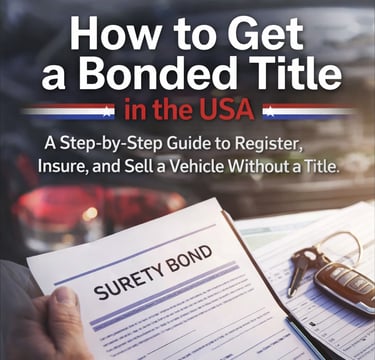
How to Fix Any Title Problem the Legal Way
A definitive, step-by-step guide for Americans who refuse to gamble with ownership, registration, or resale.
Title problems are not “paperwork issues.”
They are ownership problems.
And ownership problems can cost you thousands of dollars, months of stress, or in the worst cases, the loss of the vehicle entirely.
If you are reading this, chances are you are facing one of these situations right now:
You bought a vehicle and the seller never gave you a title
The title was lost, damaged, or destroyed
The title is in someone else’s name
The title has errors you can’t correct
The vehicle is abandoned, inherited, or gifted
The vehicle came from an auction, tow yard, or estate
The DMV rejected your paperwork — again
You keep hearing the phrase: “You need a bonded title” but nobody explains it clearly
This guide exists for one reason:
👉 To show you how to fix ANY title problem legally, permanently, and with minimal risk.
No shortcuts.
No fake paperwork.
No shady title washing.
No advice that could get you fined, denied, or flagged.
This is the lawful path — the one that works in all 50 states, even when your case feels impossible.
Why Title Problems Are So Dangerous (And Why Ignoring Them Is a Mistake)
A vehicle title is not a receipt.
It is not a registration slip.
It is not optional.
A title is the legal proof of ownership.
Without a clean title:
You do not legally own the vehicle
You may not be able to register or insure it
You cannot sell or transfer it
You may be unable to drive it legally
The vehicle can be seized or reclaimed
A previous owner or lienholder can come back years later
Many people keep driving “hoping it works out.”
That hope often ends with:
DMV denial letters
Police stops
Insurance refusing claims
Buyers backing out
Vehicles stuck in limbo for years
The law does not care that you paid cash.
The law cares about title chain integrity.
The 3 Categories of Title Problems (Every Case Falls Into One)
Before fixing anything, you must understand what kind of problem you have. Every title issue falls into one of these categories:
1. Missing or Unavailable Title
Examples:
Seller never provided title
Title lost or destroyed
Title held by deceased owner
Title held by unreachable seller
Title never issued
2. Defective or Invalid Title
Examples:
Name mismatch
VIN error
Incorrect buyer/seller info
Title signed incorrectly
Crossed-out or altered title
Wrong state format
3. Contested or Risk Title
Examples:
Possible lien
Abandoned vehicle
Auction vehicle
Inherited without probate
Vehicle off DMV record
No proof of ownership chain
Each category requires a different legal response.
Trying the wrong fix wastes time — or permanently blocks your case.
The Biggest Myth That Gets People in Trouble
“If I just explain the situation, the DMV will understand.”
No.
They won’t.
DMVs do not operate on sympathy or logic.
They operate on statutory procedures.https://bondedtitleusa.com/get-bonded-title-usa-ebook
If your paperwork does not match the statute exactly, you are denied — even if your story makes sense.
That is why so many people fail multiple times before discovering the legal solution that actually applies to their case.
The Only Legal Solutions That Actually Work
There are only five lawful pathways to fix a title problem in the United States.
Everything else is illegal, risky, or temporary.
Let’s break them down carefully.
Solution #1: Duplicate Title (When It Applies — and When It Doesn’t)
A duplicate title can be issued only if:
The previous owner is alive
The title was previously issued
The owner is cooperative
There are no disputes or liens
The DMV record is clean
If you do NOT meet all five conditions, a duplicate title will not work.
Common failure scenarios:
Seller disappeared
Seller refuses to help
Seller died
Vehicle was never titled in your state
Seller wasn’t the legal owner
If you are missing cooperation, you must move to another legal pathway.
Solution #2: Court Order Title (Rare, Expensive, Slow)
Some states allow a court order for ownership determination.
Reality check:
Requires legal filing
Requires hearings
Requires proof and witnesses
Costs more than the vehicle in many cases
Takes months or years
Judges often redirect you to the DMV anyway
This path is overkill for most private individuals and small-value vehicles.
It exists — but it is not practical in 90% of cases.
Solution #3: Lien Satisfaction (Only If the Lien Exists)
If the title issue is caused by a recorded lien, you must:
Identify the lienholder
Prove satisfaction
Obtain lien release documentation
Submit exact forms
If the lienholder no longer exists or cannot be located, this path fails — and you must use a different legal mechanism.
Solution #4: Abandoned Vehicle Process (Highly State-Specific)
This works only if:
You legally possess the vehicle
The vehicle meets abandonment criteria
You follow notice procedures
You wait the required statutory period
You file exact documentation
Failure at any step resets the clock or invalidates the claim.
This path is fragile and often misunderstood.
Solution #5 (The Universal Legal Fix): Bonded Title
This is the solution that applies when:
No title exists
The title is defective
Ownership chain is incomplete
Seller is unreachable
Vehicle came from private sale, auction, or estate
DMV refuses normal transfer
You need a clean, legal title
A bonded title is not a loophole.
It is a statutorily authorized ownership mechanism used by DMVs nationwide.
What a Bonded Title REALLY Is (And What It Is NOT)
A bonded title:
Establishes ownership legally
Protects prior owners and lienholders
Allows registration, insurance, and resale
Converts to a normal title after the bond period
A bonded title is NOT:
Fake paperwork
Title washing
A workaround
A temporary registration
A scam (despite misinformation online)
It is codified law in most U.S. jurisdictions.
Why DMVs Recommend Bonded Titles (But Don’t Explain Them)
DMVs are not allowed to give legal advice.
So they say things like:
“You may want to look into a bonded title.”
They do NOT explain:
How it works
How to qualify
How much bond coverage you need
How to avoid denial
How to structure the application
That knowledge gap causes people to give up — or make mistakes.
The Emotional Cost of Getting This Wrong
Let’s talk reality.
People dealing with title problems experience:
Anxiety every time they drive
Fear of police stops
Shame when selling fails
Anger at bureaucratic loops
Financial pressure
Sleepless nights
Some park vehicles for years because they don’t know the legal fix.
Others sell at massive losses.
And some try illegal shortcuts that permanently destroy resale value.
You do not need to live in that limbo.
How the Bonded Title Process Actually Works (High-Level Overview)
At a high level, the legal bonded title process involves:
Establishing vehicle value
Obtaining a surety bond for that value
Filing an ownership application
Submitting affidavits and proof
DMV review and issuance
Bond period completion
Title conversion
Each step must be done precisely.https://bondedtitleusa.com/get-bonded-title-usa-ebook
Skipping, guessing, or copying someone else’s case can result in denial.
Real-World Example: Private Sale With No Title
Imagine this scenario:
You buy a used truck from a private seller.
They promise to mail the title.
They disappear.
You have:
Bill of sale
Payment proof
Physical possession
You do NOT have:
A valid title
Seller cooperation
Duplicate title? Impossible
Court order? Overkill
Abandoned vehicle? Not applicable
Bonded title? ✔️ Legal solution
The bond protects any prior claimant while allowing you to move forward legally.
Why “Just Register It in Another State” Is a Terrible Idea
Some forums suggest:
“Register it in Vermont”
“Use a Montana LLC”
“Title wash it through another state”
These tactics are increasingly flagged and rejected.
Consequences include:
Title cancellation
Fraud investigations
Insurance voiding
DMV blacklisting
Criminal charges in severe cases
DMVs now cross-check databases aggressively.
If your title chain looks suspicious, you lose everything.
The Law Always Wins (So Use It)
The smartest approach is not to fight the system.
It’s to use the system exactly as written.
Bonded titles exist because legislators recognized that real-world transactions are messy.
They created a lawful safety valve.
Your job is to execute it correctly.
Who Qualifies for a Bonded Title?
Generally, you qualify if:
You possess the vehicle
You cannot obtain a normal title
You can show reasonable ownership claim
The vehicle is not stolen
The vehicle is not junked
The DMV approves bond coverage
Most people qualify — but most people fail because they don’t know the rules.
The #1 Reason Bonded Title Applications Are Denied
It’s not eligibility.
It’s documentation errors.
Common mistakes:
Incorrect bond amount
Wrong bond type
Missing affidavits
Improper valuation
Incomplete VIN verification
Incorrect owner statements
One missing line can trigger a full rejection.
What Happens After the Bond Period Ends?
After the statutory bond period (typically 3–5 years):
The bond expires
No claims were made
The title becomes normal
You can sell without disclosure
The issue is permanently resolved
This is not temporary relief.
It is final ownership closure.
Why Doing This Alone Is Risky
Yes, you can attempt this alone.
But consider:
One error = months lost
DMV instructions are vague
State rules vary
Bond amounts are confusing
Surety companies are picky
Many people fail twice — then succeed immediately once they follow a proven structure.
The Smart Way to Fix Any Title Problem
The smartest people do not guess.
They use a step-by-step legal framework that has already worked thousands of times.
That framework exists for one reason:
👉 To remove uncertainty, fear, and delay.
Final Reality Check
You have three options:
Do nothing and live with risk
Try shortcuts and risk everything
Fix it legally once and for all
Only one option gives peace of mind.
🚗 Strong Call to Action
If you are serious about fixing your title problem the right way, without wasted time or denial:
👉 Get Bonded Title USA Ebook
Inside, you get:
Exact legal steps
State-specific logic
Document templates
Bond calculation guidance
DMV-proof strategies
Real-world case breakdowns
This is not theory.
This is execution.
Get Bonded Title USA Ebook now — and turn a problem vehicle into a legally owned asset, the right way, once and for all.
continue
…the right way, once and for all.
The Bonded Title Process — Step by Step, No Gaps, No Guessing
Now we go deep.
This is where most guides stop.
This is where confusion usually starts.
We are not stopping.
What follows is the actual legal mechanics behind fixing any title problem using the bonded title framework — explained in plain but authoritative American English, without skipping steps, without “check with your DMV” cop-outs, and without hiding the parts that people find intimidating.
Step 1: Confirm That a Standard Title Is Truly Impossible
Before a DMV allows a bonded title, you must demonstrate that normal title transfer is not available.
This does not mean you must exhaust every theoretical option.
It means you must meet the statutory threshold of unavailability.
Examples of acceptable unavailability:
Seller cannot be located after reasonable effort
Seller is deceased and probate is not available
Title was lost and prior owner will not cooperate
Vehicle was never titled in your state
Vehicle came from auction without title
Vehicle was abandoned without owner claim
Title is defective beyond correction
What does not count:
“I didn’t want to deal with the seller”
“It felt complicated”
“I thought this would be faster”
The DMV is not asking for a story.
They are asking for a legally sufficient explanation.
This explanation is usually provided through a Statement of Facts / Affidavit of Ownership.
Step 2: Establish Legal Vehicle Value (This Is Where Many People Fail)
The bonded title requires a surety bond for a specific amount.
That amount is not random.
It is typically:
1.0× vehicle value
1.5× vehicle value
2.0× vehicle value
The multiplier depends on the state.
How vehicle value is determined:
DMV valuation tables
NADA / JD Power
Kelley Blue Book
State-approved appraisal
Auction value (in some cases)
Here is the critical mistake people make:
They guess the value.
Or worse — they intentionally undervalue it.
That triggers:
Bond rejection
DMV denial
Fraud suspicion
The value must be defensible, documented, and consistent with DMV expectations.
Step 3: Obtain the Correct Surety Bond (Not Insurance)
This is not car insurance.
This is not liability coverage.
This is not optional.
A bonded title uses a Title Surety Bond.
What the bond does:
Protects any prior owner or lienholder
Guarantees compensation if a valid claim arises
Allows DMV to issue title without full chain
What the bond does NOT do:
Protect you from loss
Cover mechanical issues
Replace insurance
Transfer ownership by itself
You are the principal.
The surety company is the guarantor.
The DMV is the obligee.
Miss that structure and your bond is rejected.https://bondedtitleusa.com/get-bonded-title-usa-ebook
Step 4: Why Bond Pricing Is NOT the Bond Amount
This is another point of confusion.
If your required bond amount is $10,000, you do not pay $10,000.
You pay a premium.
Typical premium range:
1% – 10% of bond amount
Often $100–$250 for most vehicles
The exact premium depends on:
Credit profile (sometimes)
Bond amount
State regulations
Anyone telling you the bond is “too expensive” does not understand the system.
Step 5: VIN Verification and Theft Check (Non-Negotiable)
Before issuing a bonded title, the DMV must confirm:
The VIN exists
The VIN matches the vehicle
The vehicle is not stolen
The vehicle is not junked or salvaged improperly
This often requires:
Law enforcement VIN check
Certified inspector
DMV field office verification
Skipping this step kills the application.
Step 6: The Ownership Affidavit (This Is a Legal Document)
This is where people get nervous — and where precision matters most.
The affidavit must explain:
How you obtained the vehicle
From whom
When
For how much
Why the title is unavailable
What efforts were made
This is not a creative writing exercise.
It is a legal statement.
False statements can result in:
Application denial
Bond claims
Criminal penalties
But here is the truth most people don’t hear:
You do not need a perfect story.
You need a truthful, structured, legally sufficient explanation.
Step 7: Submitting the Application (Sequence Matters)
Most DMVs require documents to be submitted in a specific order.
Typical package includes:
Title application
Ownership affidavit
Surety bond
VIN verification
Proof of value
Bill of sale (if available)
Fees
Submitting documents out of order can cause rejection even if everything is technically correct.
DMVs are procedural machines.
They do not “piece it together.”
Step 8: DMV Review — What They Actually Check
During review, the DMV verifies:
Eligibility
Bond sufficiency
Documentation completeness
VIN status
Fraud indicators
They are not judging you.
They are checking compliance.
If something is missing, you are either:
Sent a deficiency notice
Rejected outright
The difference often depends on how clean your submission is.
Step 9: Bonded Title Issuance (What You Receive)
Once approved, you receive a bonded title or a title branded as bonded.
This title:
Allows registration
Allows insurance
Allows legal driving
Allows resale (with disclosure during bond period)
This is a real title.
Not provisional.
Not fake.
Not temporary registration.
Step 10: The Bond Period (What Happens — and What Rarely Happens)
The bond period typically lasts:
3 years
5 years
During this time:
Any prior claimant may file a claim
Claims must be proven
Surety investigates
Reality check:
Valid claims are extremely rare.
Why?
Stolen vehicles are filtered out early
Legitimate owners usually surface quickly
Most title issues are clerical or transactional
If no claim is made, the bond expires quietly.
Step 11: Converting to a Normal Title
After the bond period:
Bond obligation ends
Title brand is removed
Vehicle becomes fully normal
At that point:
No disclosures required
Full resale value restored
Ownership is unquestioned
This is permanent resolution.
Real-World Scenarios Where Bonded Titles Save the Day
Scenario 1: Deceased Owner, No Probate
Vehicle inherited informally. No estate paperwork.
Bonded title bypasses probate while protecting any heirs.
Scenario 2: Auction Vehicle With No Title
Common with tow auctions.
Bonded title bridges missing ownership chain.
Scenario 3: Private Sale Gone Wrong
Seller vanished.
Bonded title restores legality.
Scenario 4: Old Project Car, Paperwork Lost
Decades-old vehicle.
Bonded title re-enters it into the system.
What Happens If You Sell During the Bond Period?
You can sell.
But:
Buyer must be informed
Bond stays with the vehicle
Bond period continues
Most buyers accept bonded titles when explained properly.
Some even prefer them — because the legal framework is explicit.
The Most Dangerous Mistakes People Make
Let’s be blunt.
These mistakes cost people vehicles:
Signing blank titles
Altering titles
Using fake bills of sale
Registering out of state improperly
Buying “title services” that promise shortcuts
If someone promises:
“No bond needed”
“Guaranteed title in 48 hours”
“DMV workaround”
You are being set up for failure.
Why This System Exists (And Why It’s Fair)
The bonded title system balances three interests:
You, the good-faith possessor
Prior owners, who deserve protection
The state, which must prevent fraud
It is not a loophole.
It is legislative problem-solving.
Emotional Truth: You’re Not the Problem
If you’re frustrated, angry, or exhausted — that’s normal.
Title law is intentionally rigid.
But rigidity does not mean impossibility.
It means there is a right door — and many wrong ones.
The Difference Between People Who Succeed and People Who Quit
People who succeed:
Follow a proven structure
Don’t guess
Don’t panic
Don’t take shortcuts
People who quit:
Rely on forums
Mix advice from different states
Submit incomplete paperwork
Get discouraged after denial
The difference is not intelligence.
It is process.
You Only Need to Do This Once
Fixing a title problem feels overwhelming because:
It’s unfamiliar
It feels legalistic
It involves government agencies
But once done, it’s done.
Forever.
Final, Unapologetic Call to Action 🚨
If you want clarity instead of confusion,
certainty instead of risk,
legal ownership instead of anxiety:
👉 Get Bonded Title USA Ebook
Inside you will find:
Exact step-by-step instructions
Bond calculation logic
Affidavit frameworks
DMV-safe document structure
Mistakes to avoid
Real case examples
This is not generic advice.
It is a playbook.
Stop guessing.
Stop delaying.
Stop risking your vehicle.
Get Bonded Title USA Ebook now — and fix your title problem the legal way, completely, permanently, and confidently.
If you’re ready, say CONTINUE and we’ll go even deeper into edge cases, state variations, advanced scenarios, and resale strategy during the bond period, including situations where people think a bonded title won’t work — but it actually does when executed correctly…
continue
…when executed correctly.
Advanced Edge Cases: When People Think “This Won’t Work” — and They’re Wrong
Now we move into the territory where most advice online completely collapses.
These are the scenarios where:
DMV clerks give vague answers
Forums contradict each other
People are told “it’s impossible”
Vehicles sit unused for years
In reality, these cases are exactly why bonded titles exist.
Let’s dismantle the myths one by one.
Edge Case #1: The Vehicle Was Never Titled Anywhere
This happens more than people realize.
Examples:
Farm vehicles
Old trailers
Off-road vehicles converted to on-road
Vehicles from states that did not require titles at the time
Homemade or reconstructed vehicles
Why people think this is impossible
Because the DMV asks:
“What state issued the title?”
And the answer is:
“None.”
That feels like a dead end.
Why it’s not
Bonded titles do not require a prior title.
They require:
Proof of possession
Proof of value
VIN verification
Ownership affidavit
The bond substitutes for the missing chain.
This is precisely what the statute anticipates.
Edge Case #2: The Seller Was Never the Legal Owner
This is extremely common in private sales.
Scenario:
You bought a vehicle from someone
That person never transferred the title into their name
The title is still in a previous owner’s name
Now nobody is reachable
This is called a broken chain of ownership.
Why normal transfer fails
Because only the titled owner can legally sign.
Why bonded title works
Because the bond protects the titled owner’s interest if they later appear.
The law does not punish you for someone else’s failure — it provides a remedy.
Edge Case #3: The Title Has Errors You Cannot Correct
Examples:
VIN digit wrong
Name misspelled
Wrong mileage
Incorrect state format
Cross-outs or alterations
Once a title is materially defective, many DMVs will not correct it.
They simply reject it.
A bonded title restarts the ownership record with verified data.
Edge Case #4: The Vehicle Was Abandoned on Private Property
Many people assume abandoned vehicle laws apply automatically.
They don’t.
Most states require:
Formal notice
Waiting periods
Public posting
Lienholder checks
Miss one step and the entire process collapses.
If abandonment cannot be proven cleanly, bonded title becomes the fallback.
Edge Case #5: The Vehicle Is Very Old (Pre-1980, Pre-1970, or Older)
Older vehicles often:
Pre-date modern title systems
Have incomplete records
Were transferred informally
Have missing VIN plates or formats
Bonded titles allow:
VIN verification using alternative methods
Historical valuation
Affidavit-based ownership establishment
Age is not a barrier — it’s often a justification.
Edge Case #6: The Vehicle Was a Gift With No Paperwork
A verbal gift is not ownership proof.
If the giver:
Cannot be located
Passed away
Never titled it properly
Then you still lack legal ownership.
A bonded title converts possession + affidavit into lawful ownership.
Edge Case #7: Multiple Failed DMV Attempts
This one is psychological.
People think:
“They already denied me. I’m flagged.”
In reality:
DMVs do not blacklist honest applicants
They deny incomplete or incorrect submissions
A new application with a new legal basis is evaluated independently
Bonded title applications are not appeals.
They are new statutory requests.
State Variations — Without the Confusion
Yes, laws vary by state.
But here’s the critical insight most people miss:
The structure of bonded titles is consistent.
Only the parameters change.
What varies:
Bond multiplier
Bond period length
Form names
Filing sequence
VIN inspection authority
What does NOT vary:
Legal purpose
Ownership logic
Protection mechanism
Conversion process
Once you understand the framework, state variation becomes manageable — not overwhelming.
Selling a Vehicle With a Bonded Title: Strategy Matters
Selling during the bond period is legal — but presentation matters.
What smart sellers do:
Explain bonded title clearly
Provide documentation
Price realistically
Educate buyers upfront
What hurts resale:
Hiding bonded status
Acting defensive
Undervaluing excessively
Using the word “problem”
A bonded title is not a “problem title.”
It is a statutorily protected title.
Language matters.
Insurance and Financing With Bonded Titles
Insurance
Most insurers:
Insure bonded titles normally
Require VIN verification
Do not surcharge
Financing
Some lenders:
Require clean title
Avoid bonded titles during bond period
This is not a legal issue — it’s a risk policy.
Once bond period ends, this disappears.
Why Surety Claims Are Rare (And What Happens If One Occurs)
People fear:
“What if someone claims the vehicle?”
Here’s the truth:
Claimants must prove superior ownership
They must act within the bond period
They must pursue formal claim procedures
If a claim is valid:
Surety pays claimant
Surety may seek reimbursement from you
But remember:
Vehicles that are stolen or heavily encumbered are filtered out early
Most title problems are bureaucratic, not criminal
The bond is a safeguard — not a trap.
Psychological Relief: What People Feel After Fixing a Title
This is rarely talked about.
Once ownership is resolved, people report:
Immediate stress reduction
Confidence driving
Ability to sell or invest
Emotional closure
Feeling “done” with the issue
Paperwork problems are mental burdens.
Fixing them is not just legal — it’s emotional relief.
Why Waiting Makes Everything Worse
Time does not fix title problems.
It usually makes them worse because:
Sellers become harder to locate
Records degrade
Laws change
Vehicles lose value
Motivation fades
The bonded title system does not punish delay — but delay punishes you.
The Truth About “Free Advice” Online
Forums are full of:
Partial information
Outdated rules
State mismatches
Anecdotes presented as law
Most people giving advice:
Never completed the process
Did it once, years ago
Are repeating hearsay
Title law is not crowdsourced.
It is statutory.
Why a Structured Guide Beats Guesswork
A structured guide:
Prevents errors
Saves time
Reduces stress
Avoids denial
Creates certainty
Guesswork does the opposite.
One Vehicle Can Teach You a System
Many people who fix one title problem realize something important:
They now understand a system most people fear.
This knowledge becomes:
Confidence
Negotiating power
Resale leverage
Even business opportunity
But first — you must fix the current problem correctly.
The Hard Truth (Delivered With Respect)
You don’t have a “title problem.”
You have an information gap.
And information gaps are solvable.
Final Call to Action — No Soft Language
If you want:
Clear steps
Legal certainty
Zero guessing
A proven framework
Confidence walking into the DMV
👉 Get Bonded Title USA Ebook
This ebook exists because:
DMVs don’t explain the process
Forums confuse it
People lose money unnecessarily
Inside you’ll find:
End-to-end bonded title execution
Exact document logic
Mistake-proof guidance
State-aware strategy
Real scenarios and outcomes
Stop letting a piece of paper control your vehicle, your money, and your peace of mind.
Get Bonded Title USA Ebook — and fix any title problem the legal way.
BondedTitleUSA.com is an informational resource and does not provide legal advice. DMV rules vary by state.
Contact
infoebookusa@aol.com
© 2026. All rights reserved.