How to Prove Ownership Without a Title
Blog post description.
2/25/202610 min read
How to Prove Ownership Without a Title
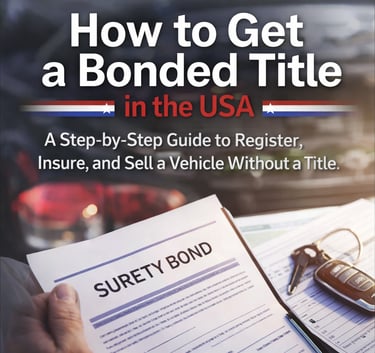
Losing a vehicle title—or never having one in the first place—can feel like hitting a brick wall. You bought the car fair and square. You have the keys. You’ve insured it. Maybe you’ve even driven it for years. And yet, without a title, the system treats you like you don’t own it.
That disconnect between reality and paperwork is where most people get stuck.https://bondedtitleusa.com/get-bonded-title-usa-ebook
This guide exists to pull you out of that trap.
If you’re searching for how to prove ownership without a title, you’re not casually browsing. You’re dealing with a real problem that’s blocking you from selling, registering, insuring, exporting, or legally driving a vehicle. Maybe the DMV rejected you. Maybe the seller disappeared. Maybe the car was inherited, abandoned, or bought decades ago when paperwork “didn’t matter.”
Here’s the truth most people won’t tell you upfront:
You absolutely can prove ownership without a title—but only if you do it the right way, in the right order, with the right evidence.
This article will walk you through that process in full, without shortcuts, without vague advice, and without leaving you halfway.
Why Vehicle Titles Matter (and Why Not Having One Is a Big Deal)
A vehicle title is the government’s official record of ownership. It links:
A specific person or entity
To a specific VIN
With a clear chain of ownership
Without it, the state has no proof that:
The vehicle isn’t stolen
There are no unpaid liens
The person claiming ownership has legal rights
That’s why DMVs default to denial when a title is missing. Not because you’re wrong—but because they need proof, not stories.
Your job is to replace the missing title with equivalent or stronger evidence.
The Core Principle: Ownership Is Proven Through Evidence, Not Just Titles
A title is only one form of proof. When it’s missing, states allow alternative paths—but only if you meet strict standards.
Ownership without a title is typically proven through a combination of:
Transaction evidence
Possession evidence
Identity verification
VIN verification
Legal affidavits
Time-based possession (in some cases)
No single document replaces a title. Instead, the weight of evidence does.https://bondedtitleusa.com/get-bonded-title-usa-ebook
Think of it like a courtroom:
One receipt won’t win the case
A complete, consistent paper trail often will
Scenario Breakdown: How People Lose or Never Get a Title
Understanding how titles go missing helps you choose the right solution.
1. Private Sale Without Title
Common with:
Old cars
Farm vehicles
Project cars
“Barn finds”
Seller says:
“I never transferred it”
“I lost it years ago”
“It doesn’t need one”
This is the most common scenario—and often the most fixable.
2. Inherited Vehicle
Someone passes away and:
Title is missing
Estate was never probated
Executor paperwork is incomplete
3. Abandoned or Towed Vehicles
You acquired a vehicle through:
Property abandonment
Mechanic’s lien
Storage lien
4. Lost Title With Original Owner Unavailable
The title existed—but:
Owner moved
Owner died
Owner refuses to cooperate
5. Very Old Vehicles
Some states didn’t require titles before certain years. Now modern systems demand proof that never existed.
Step One: Establish Possession and Control
The first thing you must prove is possession.
Not “I saw it once.”
Not “I used to have it.”
But actual, physical control.
Evidence That Proves Possession
Strong examples:
Photos of the vehicle on your property
VIN plate photos
Keys in your possession
Storage records
Insurance records
Repair invoices
Weak examples:
Verbal statements
Text messages without names
Undated photos
You should be able to show:
Where the vehicle is
That you control access to it
That it hasn’t moved unlawfully
Step Two: Prove How You Acquired the Vehicle
This is where most people fail.
The DMV doesn’t care that you have the car.
They care how it came into your possession.
Acceptable Proof of Acquisition
Depending on your state, this may include:
Bill of Sale (even handwritten)
Canceled checks
Bank transfer records
Receipts
Auction paperwork
Estate documents
A handwritten bill of sale is not automatically invalid. But it must include:
Seller’s name
Buyer’s name
Date
Vehicle description (VIN preferred)
Sale price
Signatures
If the VIN is missing, you’ll need additional proof tying the transaction to the vehicle.
Step Three: VIN Verification Is Non-Negotiable
Without a title, the VIN becomes the center of the entire process.
You must prove:
The VIN exists
It matches the vehicle
It isn’t stolen
It has no unresolved liens
VIN Verification Methods
Common options:
DMV inspection
Law enforcement inspection
Licensed VIN verifier
They will check:
VIN plate
Secondary VIN locations
Engine/transmission numbers (sometimes)
If the VIN is damaged or missing, you’re in a much harder—but not impossible—position.
Step Four: Run a Title and Lien Search
Before the state will issue anything, it needs confirmation that:
No one else legally owns the vehicle
No bank or lender has a claim
This is done through:
State DMV databases
National Motor Vehicle Title Information System (NMVTIS)
If a lien appears:
It must be released
Or legally resolved
This step is where many applications stall for months.
Step Five: Use Affidavits to Replace Missing Documents
When documents are lost, sworn affidavits become critical.https://bondedtitleusa.com/get-bonded-title-usa-ebook
An affidavit is a legal statement made under penalty of perjury.
Common Affidavits Used
Affidavit of Ownership
Affidavit of Lost Title
Affidavit of Heirship
Affidavit of Facts
These must:
Be specific
Be consistent
Match all other evidence
Generic affidavits get rejected. Detailed ones often pass.
Step Six: Understand When a Bonded Title Is Required
In many states, when ownership cannot be conclusively proven, the DMV offers a bonded title.
This is not a loophole.
It’s a state-approved ownership resolution tool.
A bonded title:
Protects prior owners or lienholders
Allows you to register and insure the vehicle
Converts to a regular title after a waiting period
This process is often misunderstood—and incorrectly executed—by applicants.
We’ll go deep into bonded titles shortly, including:
When they’re required
How bond amounts are calculated
Common mistakes that cause denial
Emotional Reality: Why This Process Feels So Overwhelming
Let’s be honest.
People don’t get stuck because they’re lazy.
They get stuck because:
DMV instructions are vague
Every clerk gives different answers
Rejections come without explanation
Timelines stretch into months
You start doubting yourself.
You wonder if the car is worthless.
You consider walking away.
That’s exactly when most people give up.
But the system isn’t designed to stop you forever—it’s designed to filter out weak claims. When you present a complete, structured ownership case, outcomes change dramatically.
Practical Example: Private Sale With No Title
Let’s walk through a real-world example.
Situation:
1998 pickup truck
Bought from private seller
Title “lost years ago”
Seller now unreachable
Evidence Collected:
Handwritten bill of sale
Photos of truck at buyer’s home
Insurance policy in buyer’s name
Repair invoices
VIN inspection report
Affidavit of ownership
Outcome:
DMV required bonded title
Bond issued based on vehicle value
Temporary registration granted
Full title issued after bond period
This is not rare. This is typical when done correctly.
The Biggest Mistakes People Make (and How to Avoid Them)
Mistake #1: Submitting Incomplete Paperwork
One missing form can reset the entire process.
Mistake #2: Inconsistent Stories
Dates, prices, and names must match exactly.
Mistake #3: Waiting Too Long
Some states impose time limits after acquisition.
Mistake #4: Assuming Verbal Approval Matters
Only written approval counts.
Mistake #5: Underestimating Bonded Title Complexity
Bonded titles are precise. Errors cause denial.
When States Flat-Out Refuse (And What That Really Means)
If the DMV says “we can’t help,” it usually means:
You’re in the wrong process
You’re missing a key document
You didn’t escalate properly
Very rarely does it mean “impossible.”
There are administrative appeals, supervisor reviews, and alternative filing paths that most applicants never explore.
The Bonded Title Process (Deep Dive Begins Here)
A bonded title is one of the most powerful tools for proving ownership without a title—but it must be executed perfectly.
What a Bonded Title Actually Is
A bonded title is a state-issued title backed by a surety bond.
The bond:
Covers potential claims
Does NOT mean you’re at fault
Is not insurance for the vehicle
The state requires it when:
Ownership evidence is sufficient but incomplete
Prior title cannot be verified
How Bond Amounts Are Calculated
Typically:
1.5× vehicle value
Based on DMV valuation, not purchase price
This is where many people panic—but bond premiums are usually low.
Who Can File for a Bonded Title
Usually:
Current possessor
Resident of the state
No active disputes
Some states restrict bonded titles for:
Newer vehicles
High-value vehicles
Common Bonded Title Rejections
Incorrect bond amount
VIN mismatch
Missing affidavits
Unresolved liens
Each rejection resets the clock.
Why Most People Fail Even When Bonded Titles Are Allowed
Because they:
Guess instead of following state logic
Use generic forms
Miss required sequencing
This is where step-by-step guidance becomes invaluable.
At this point, you should understand something critical:
Proving ownership without a title is not about luck. It’s about structure, sequencing, and evidence.
And we’re only getting started.
In the next section, we’ll break down:
State-by-state variations
How long each path realistically takes
What to do when the original owner resurfaces
How to avoid legal landmines
And exactly how to move from “no title” to “clean title” without wasting months or money
We’ll also show you how experienced applicants shortcut the process—legally—by using proven frameworks instead of trial and error.
Keep reading.
continue
reading.https://bondedtitleusa.com/get-bonded-title-usa-ebook
State-by-State Variations That Change Everything
One of the biggest traps people fall into is assuming that proving ownership without a title works the same way everywhere in the United States.
It does not.
Every state has its own statutes, thresholds, timelines, and acceptable proof standards. What works flawlessly in one state may be rejected outright in another. Understanding these differences isn’t optional—it’s foundational.
Why States Handle Title Issues Differently
States base their title laws on:
Historical fraud patterns
Vehicle theft rates
Insurance regulations
Local court precedents
That’s why:
Some states are flexible with affidavits
Others rely heavily on bonded titles
A few require court involvement
Ignoring these nuances is one of the fastest ways to waste months.
Categories of State Approaches
While every state is unique, they generally fall into five broad categories.
Category 1: Bonded Title–Friendly States
These states actively use bonded titles as a primary solution when ownership is unclear.
Typical characteristics:
Clear bonded title instructions
Standardized affidavit forms
Predictable timelines
In these states, proving ownership without a title is procedural, not adversarial.
Category 2: Court-Heavy States
Some states push unresolved ownership cases into:
Magistrate courts
Civil courts
Declaratory judgment actions
This adds:
Legal filings
Court fees
Longer timelines
But it also creates a definitive ownership ruling that overrides missing paperwork.
Category 3: Time-Based Ownership States
These states recognize ownership through:
Long-term possession
Maintenance and storage
No competing claims
Time thresholds may range from:
3 years
5 years
10+ years
Documentation of continuous possession is critical here.
Category 4: Strict Documentation States
These states:
Require original paperwork
Offer limited alternatives
Reject incomplete cases quickly
Bonded titles may still exist—but only after extensive proof.
Category 5: Hybrid Systems
Most states fall here:
Bonded titles for some cases
Court processes for others
Administrative discretion plays a large role
Understanding which category your state falls into dramatically changes your strategy.
Timeline Reality Check: How Long This Actually Takes
Let’s kill the fantasy right now.
This is not a one-week process.
But it doesn’t have to take a year either.
Realistic Timelines by Path
Clean Alternative Documentation Path
2–6 weeks if paperwork is complete
Bonded Title Path
4–12 weeks to issuance
3–5 years bond holding period (state-dependent)
Court-Based Ownership
2–6 months minimum
Sometimes longer
Most delays are caused by:
Incomplete submissions
Incorrect sequencing
Waiting for responses instead of escalating
What Happens If the Original Owner Reappears?
This question causes more anxiety than almost any other.
Here’s the truth.
If you follow the legal process correctly:
You are protected
The state has already vetted your claim
During the Bond Period
If someone claims ownership:
They must prove superior legal rights
The bond exists to protect them—not to punish you
If their claim is valid:
The bond pays them
You do NOT face criminal penalties
If their claim is invalid:
The process continues uninterrupted
This is why bonded titles exist—to balance fairness and practicality.
Legal Landmines You Must Avoid
Trying to “fix” a title problem the wrong way can create legal exposure.
Avoid these at all costs:
Altering Documents
Never modify:
Dates
Prices
VINs
Names
Even small edits can be treated as fraud.
Using False Affidavits
Affidavits are sworn statements.
Lying can escalate a civil issue into a criminal one.
Registering in the Wrong State
“Title laundering” through lenient states is illegal and increasingly flagged by NMVTIS.
Ignoring Liens
Unreleased liens don’t disappear.
They resurface—often at the worst time.
Advanced Strategy: Building an Ownership Case File
People who succeed consistently don’t submit “documents.”
They submit cases.
What a Complete Case File Includes
Table of contents
Summary of acquisition
Chronological document order
VIN verification report
Lien search results
Affidavits with supporting exhibits
DMV reviewers are human.
Clear, organized submissions get approved faster.
Practical Example: Inherited Vehicle Without Title
Situation
Vehicle inherited from deceased parent
Title missing
Estate never probated
Evidence Collected
Death certificate
Affidavit of heirship
Proof of relationship
Insurance in heir’s name
VIN inspection
Process
DMV required bonded title
Bond issued based on appraised value
Registration granted
Outcome
Clean title issued after bond period
This scenario fails constantly—unless done correctly.
Practical Example: Abandoned Vehicle on Private Property
Situation
Vehicle left on land for years
Owner unreachable
Storage costs incurred
Evidence Collected
Property ownership records
Photographic timeline
Certified mail attempts
Storage cost documentation
Process
Lien process initiated
Public notice issued
Bonded title approved
Again: not luck—structure.
Why “Just Ask the DMV” Is Terrible Advice
DMV clerks:
Are not legal advisors
Rotate frequently
Follow scripts
They answer the question you ask, not the problem you have.
If you ask:
“Can I get a title without one?”
They’ll say:
“No.”
If you ask:
“What is the correct ownership resolution pathway for a vehicle acquired via private sale with missing title and no lien?”
You’ll get a very different response.
Precision matters.
Emotional Cost: The Hidden Damage of Doing Nothing
Vehicles without titles:
Can’t be sold
Can’t be legally driven
Lose massive resale value
A $6,000 car becomes a $1,500 headache.
Every month you wait:
Options shrink
Evidence gets harder to collect
Sellers disappear further
Indecision costs real money.
The Shortcut That Isn’t a Scam (But Feels Like One)
Here’s something most people don’t realize until it’s too late:
The process itself is simple.
The complexity comes from not knowing the exact sequence.
People spend:
Weeks Googling
Hours on forums
Dozens of DMV visits
And still miss one required step.
That’s why structured guidance exists—not to bypass the law, but to navigate it efficiently.
What Experts Do Differently
People who resolve title issues professionally:
Start with NMVTIS
Validate VIN integrity early
Choose the correct ownership pathway immediately
Prepare affidavits before submission
Anticipate objections
They don’t “try and see.”
They execute.
The Final Stretch: From Bonded Title to Clean Title
Once a bonded title is issued:
You can register the vehicle
You can insure it
You can sell it (with disclosure)
After the bond period:
Title converts automatically in most states
No additional action required
This is the endgame—and it’s reachable.
The Hard Truth (and the Honest One)
If you’re still reading, it means:
You care about doing this right
You don’t want to gamble
You want certainty
Proving ownership without a title is not about fighting the system.
It’s about working within it intelligently.
And when done correctly, it works.
Strong Call to Action: Don’t Guess—Execute
If you want a step-by-step, no-mistakes roadmap that shows you:
Exactly which path applies to your situation
Which documents to gather
How to structure affidavits
How to handle bonded titles correctly
How to avoid rejections and delays
Then stop guessing.
Get the Get Bonded Title USA Ebook.
This isn’t theory.
It’s a proven framework used to resolve real ownership problems across the United States—without wasted months, without repeated denials, and without legal risk.
If your vehicle matters to you, act like it.
👉 Get Bonded Title USA Ebook now and turn a title problem into a clean, legal ownership solution.
And once you start, don’t stop—because the only thing worse than not having a title is knowing you could have fixed it and didn’t.
BondedTitleUSA.com is an informational resource and does not provide legal advice. DMV rules vary by state.
Contact
infoebookusa@aol.com
© 2026. All rights reserved.