Is a Bonded Title Legal in the United States?
Blog post description.
2/3/202614 min read
Is a Bonded Title Legal in the United States?
If you’ve ever bought a used vehicle with missing paperwork, inherited a car without a clear title, restored an abandoned project car, or tried to register a vehicle that somehow “fell out” of the system, you’ve probably run into one of the most confusing phrases in U.S. motor vehicle law: bonded title.
Some people swear by it.
Others warn you it’s risky.
Many assume it’s a loophole or a legal gray area.
So let’s answer the question properly, without shortcuts, myths, or vague advice:
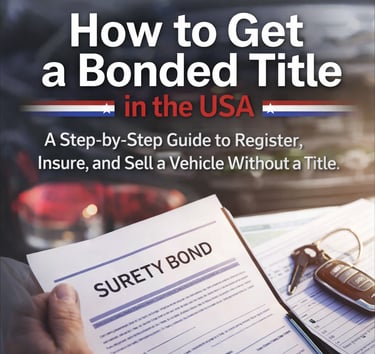
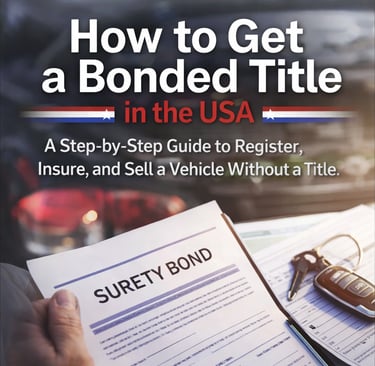
Is a bonded title legal in the United States? https://bondedtitleusa.com/get-bonded-title-usa-ebook
Yes — but only if done correctly, in the right states, following strict legal rules.
And misunderstanding those rules can cost you thousands of dollars, years of stress, or even the vehicle itself.
This guide goes deep. Very deep.
Not surface-level blog fluff — real legal clarity, practical examples, and hard truths.
What a Bonded Title Actually Is (Not What People Think It Is)
A bonded title is not:
A fake title
A workaround to steal a vehicle
A way to avoid taxes
A shortcut that skips ownership verification
A bonded title is a state-issued motor vehicle title that is backed by a surety bond. That bond protects prior owners, lienholders, or other claimants in case the applicant was not legally entitled to the vehicle.
In plain English:
A bonded title is how a state says:
“We will let you title this vehicle, but only if you financially guarantee that no one else has a legitimate claim to it.”
That guarantee is the bond.
The Legal Foundation of Bonded Titles in the U.S.
Bonded titles are not informal practices. They exist because:
Every U.S. state controls vehicle titling under state law
Legislatures recognized that titles can be lost, destroyed, or never issued
Courts and DMVs needed a lawful way to resolve ownership gaps without forcing vehicles into permanent limbo
So states created bonded title statutes.
These laws:
Authorize DMVs to issue titles conditionally
Require applicants to purchase a surety bond
Set waiting periods (usually 3–5 years)
Define when and how a bonded title becomes a regular clear title
This is not accidental.
It is written law.
Is a Bonded Title Federally Legal?
This is a common misunderstanding.
There is no federal vehicle title system in the United States.
Vehicle titles are:
Issued by states
Governed by state statutes
Administered by state DMVs or equivalent agencies
So legality is determined state by state, not federally.
That said:
Bonded titles are recognized across state lines
Other states generally honor them when properly issued
The bond itself is regulated under insurance and surety law
So while bonded titles are not “federal,” they are legally valid nationwide when issued according to state law.
Why Bonded Titles Exist at All
To understand legality, you must understand necessity.
Bonded titles exist because the real world is messy.
Here are situations where bonded titles are commonly used:
A private seller lost the title decades ago
A vehicle was abandoned on private property
A project car changed hands multiple times without paperwork
An estate sale transferred a vehicle without proper probate documents
A vehicle was never titled because it was old, off-road, or exempt at the time
A title was destroyed in a fire, flood, or disaster
A clerical error erased ownership records
Without bonded titles, these vehicles would be:
Unsellable
Unregisterable
Worthless except for parts
Permanently stuck in legal limbo
Bonded titles are the lawful release valve for broken chains of ownership.
Are Bonded Titles “Real” Titles?
Yes. Absolutely.
A bonded title:
Is issued by the state DMV
Has a title number
Can be registered
Allows plates and insurance
Permits legal operation on public roads
Can usually be sold (with disclosure)
The difference is:
The title is marked “bonded”
A bond is attached for a fixed period
Ownership is provisional, not disputed
This distinction matters legally — but it does not mean the title is fake or invalid.
The Role of the Surety Bond (This Is Where Legality Comes From)
The bond is the legal backbone of a bonded title.
Here’s what it does:
Guarantees payment if a rightful owner appears
Protects lienholders, prior owners, and the state
Shifts risk away from the DMV
Creates financial accountability for the applicant
If no one challenges ownership during the bond period:
The bond expires
The title converts to a standard clear title
The bonded designation is removed
This process is written directly into state law.
Who Can Challenge a Bonded Title?
Legally, only parties with valid legal claims can challenge a bonded title.
This includes:
Prior titled owners
Lienholders
Financial institutions
Courts enforcing judgments
Estates with documented ownership
Random claims do not invalidate bonded titles.
The burden of proof is on the challenger — not the bonded title holder.
Is a Bonded Title Legal in All 50 States?
This is where nuance matters.
Most states allow bonded titles, but:
Some use different terminology
Some restrict vehicle age or value
Some impose stricter inspections
A few do not offer bonded titles at all
Examples of states that commonly allow bonded titles:
Texas
Florida
Georgia
California
Arizona
Tennessee
North Carolina
South Carolina
Ohio
Indiana
Missouri
Arkansas
Oklahoma
Some states use alternatives:
Court-ordered titles
Title surety affidavits
Ownership hearings
Abandoned vehicle processes
But legality still exists — just through different mechanisms.
Is a Bonded Title a “Loophole”?
No.
A loophole implies:
Exploiting unclear law
Avoiding legal safeguards
Circumventing ownership rules
Bonded titles do the opposite:
They add safeguards
They impose financial liability
They create public records
They invite legal challenge
In many cases, bonded titles are harder, not easier, than regular titles.
Common Myths About Bonded Titles (And Why They’re Wrong)
Myth 1: Bonded titles are illegal or shady
False.
They are issued directly by state agencies.
Myth 2: You can’t sell a vehicle with a bonded title
False.
You can sell it — disclosure rules apply.
Myth 3: Bonded titles mean the car is stolen
False.
Stolen vehicles fail VIN checks and are rejected.
Myth 4: Insurance won’t cover bonded title vehicles
False.
Most insurers insure based on VIN and registration.https://bondedtitleusa.com/get-bonded-title-usa-ebook
Myth 5: Bonded titles are permanent
False.
They convert to clear titles after the bond period.
Real-World Example: Lost Title, Legitimate Vehicle
Imagine this:
You buy a 1998 pickup from a rural landowner
He’s owned it for 15 years
The title was lost
The DMV has no electronic record
The seller is cooperative but paperwork is gone
Without bonded titles:
You’re stuck
The truck is useless
With a bonded title:
You submit an ownership affidavit
The VIN is inspected
You buy a bond
The DMV issues a bonded title
You legally register and drive the vehicle
That is lawful, intentional, and common.
What Makes a Bonded Title Illegal?
Bonded titles themselves are legal — but misuse is not.
Illegal situations include:
Knowingly bonding a stolen vehicle
Providing false affidavits
Forging ownership documents
Hiding known liens
Using fraudulent bonds
Title washing across states
These acts are crimes — but the bonded title system is not the problem.
How DMVs Determine Eligibility
DMVs do not issue bonded titles casually.
They typically require:
VIN inspection
National theft database checks
Ownership affidavits
Proof of purchase
Appraised vehicle value
Bond amount (usually 1.5–2x value)
Waiting periods
Fees and documentation
If any red flag appears, the application is denied.
Are Bonded Titles Recognized When You Move States?
Yes — with conditions.
Most states:
Recognize bonded titles from other states
Require disclosure
May restart or continue the bond period
May require reinspection
Bonded titles are not voided simply because you cross state lines.
Is a Bonded Title Legal for High-Value Vehicles?
Yes — but scrutiny increases.
Luxury cars, classic cars, collector vehicles:
Require higher bond amounts
Face stricter verification
May trigger additional DMV review
But legality remains.
Bonded Titles vs Court-Ordered Titles
Some states offer court orders instead of bonded titles.
Legally:
Both accomplish the same goal
Both establish ownership
Both involve risk mitigation
Bonded titles are often faster and cheaper.
Emotional Reality: Why People Fear Bonded Titles
Most fear comes from:
Bad advice online
Horror stories without context
Dealership myths
Misunderstanding how bonds work
In reality:
The majority of bonded titles are never challenged
Most convert to clear titles quietly
Most owners never hear another word about the bond
The Waiting Period: Why It Exists
The bond period is not punishment.
It exists to:
Give claimants time to come forward
Protect legitimate owners
Preserve due process
Balance fairness and practicality
After the period ends:
The state considers ownership settled
What Happens If Someone Challenges the Bond?
If a valid claim arises:
The bond pays damages
The dispute is resolved financially
Courts determine ownership
The DMV follows court orders
You are not automatically criminalized — legality still applies.
Why Bonded Titles Are Still Widely Used Today
Because:
Titles still get lost
Paper records still fail
Vehicles still outlive paperwork
Law must adapt to reality
Bonded titles are not outdated — they are necessary.
The Bottom Line on Legality
A bonded title is legal in the United States when issued according to state law.
It is:
Statutory
Regulated
Enforced
Recognized
Legitimate
Problems arise only when people:
Skip steps
Rely on bad advice
Misrepresent facts
Assume rules don’t matter
Why You Should Not “Wing It”
Bonded title processes differ dramatically by state.
Mistakes can:
Delay approval by months
Force reapplication
Increase bond costs
Trigger audits
Lead to rejection
This is not something to guess at.
The Smart Way to Handle a Bonded Title (Without Stress)
If you want:
To know exactly if your state allows bonded titles
To avoid rejection
To calculate the correct bond amount
To prepare affidavits properly
To understand timelines and disclosures
To convert to a clear title smoothly
You need a step-by-step, state-aware system, not forum advice.
Final Reality Check
Bonded titles are legal.
They are common.
They are regulated.
They solve real problems.
But they are also procedural — and procedures matter.
One missed document can derail everything.
Strong Call to Action
If you’re dealing with a missing title, abandoned vehicle, inherited car, project build, or private sale with paperwork issues — don’t gamble with your time or money.
The Get Bonded Title USA Ebook was created specifically to:
Explain bonded titles in plain American English
Walk you through the process step by step
Cover state-by-state differences
Show real examples and timelines
Help you avoid rejections and delays
Save you months of frustration and costly mistakes
If your vehicle matters to you — do it right the first time.
👉 Get the Get Bonded Title USA Ebook now and take control of your vehicle’s legal future.
continue
…before small mistakes turn into expensive problems.
Deep Legal Clarification: Bonded Titles Are Statutory, Not Discretionary
One of the most dangerous misunderstandings about bonded titles is the belief that they exist at the whim of a DMV clerk or as some kind of informal accommodation.
They do not.
Bonded titles exist because state legislatures explicitly authorized them in statute.
That matters enormously.
When something is statutory:
It is enforceable
It is appealable
It is reviewable by courts
It is not optional once criteria are met
If a state allows bonded titles and you meet the legal requirements, the DMV does not get to “just say no” because a clerk feels unsure or uncomfortable.
This is why knowing the law matters more than knowing anecdotes.
The Difference Between “Legal” and “Guaranteed”
Bonded titles are legal — but legality does not mean approval is automatic.
This distinction trips people up.
Legal means:
The process exists in law
The state may issue a bonded title
The title is valid once issued
It does not mean:
Every application is approved
Documentation can be sloppy
DMV discretion disappears
The bonded title process is lawful but conditional.
Miss a condition, and legality doesn’t save you.
Why Some DMVs Seem “Hostile” to Bonded Titles
You may hear stories like:
“The DMV told me bonded titles aren’t allowed.”
Often, this is not true — it’s miscommunication.
Common reasons clerks push back:
They rarely process bonded titles
They confuse bonded titles with salvage titles
They are unfamiliar with older statutes
They misunderstand internal policy memos
They rely on outdated training
This is not malicious — but it is dangerous if you don’t know the law.
Applicants who succeed are the ones who:
Cite the statute
Bring the correct forms
Follow the precise process
Do not argue emotionally
Do not rely on “what someone online said”
The Legal Status of Bonded Titles During the Bond Period
This is critical. https://bondedtitleusa.com/get-bonded-title-usa-ebook
During the bond period:
You are the legal titled owner
You may register the vehicle
You may insure the vehicle
You may drive the vehicle
You may sell the vehicle (with disclosure)
You may transfer possession
What you are not:
Immune from valid ownership challenges
Guaranteed permanent ownership
This is not unique to bonded titles — it mirrors many areas of law where ownership is conditional pending time or notice.
The Statute of Limitations Effect
The bond period functions like a statute of limitations.
Once it expires:
Claims are barred
Ownership stabilizes
The state removes the bonded designation
The title becomes indistinguishable from a standard title
This is why bonded titles are not “forever risky.”
They are temporarily conditional, not permanently flawed.
Are Bonded Titles Legal for Dealerships?
Yes — but with caveats.
Many states:
Allow bonded titles for licensed dealers
Impose stricter scrutiny
Require additional disclosures
Limit resale until bond expiration
Some dealers avoid bonded titles because:
They slow inventory turnover
Lenders may hesitate
Buyers may misunderstand them
But legality remains intact.
Financing and Bonded Titles
This is where reality diverges from theory.
Legally:
A bonded title vehicle can be financed
Practically:
Many lenders refuse during the bond period
Some require higher interest rates
Some demand bond expiration first
This is not about legality — it’s about risk tolerance.
After bond expiration:
Financing becomes much easier
The title is treated as standard
Insurance and Legal Recognition
Insurance companies:
Do not insure titles
They insure VINs and registrations
As long as:
The VIN passes checks
The vehicle is registered
The driver is licensed
Coverage is typically available.
If someone tells you “insurance won’t cover bonded titles,” they are confusing underwriting policy with legal status.
Bonded Titles vs Salvage Titles: A Crucial Legal Distinction
These are not comparable.
Bonded titles:
Address ownership uncertainty
Do not imply damage
Do not imply total loss
Do not affect roadworthiness
Salvage titles:
Reflect damage history
Affect valuation permanently
Trigger inspection regimes
Carry resale stigma
Bonded titles are procedural, not condition-based.
When Bonded Titles Are Explicitly Prohibited
In some states, bonded titles are restricted or unavailable.
Instead, those states may require:
Court orders
Abandoned vehicle procedures
Title hearings
Probate documentation
This does not mean bonded titles are illegal — it means that state chose a different legal mechanism.
Trying to force a bonded title in such states is where people get into trouble.
Cross-State Title Washing: Where Legality Breaks
One of the most serious crimes involving titles is title washing.
This occurs when someone:
Moves a vehicle across states
Exploits differences in title rules
Conceals prior branding or issues
Attempts to “clean” a title illegally
Bonded titles do not legitimize title washing.
In fact:
Improper bonded title use can be evidence of fraud
States share databases
VIN history follows the vehicle
This is why honesty matters.
The Role of VIN Inspections in Legal Validity
VIN inspections are not formalities.
They serve to:
Confirm the vehicle exists
Match physical VINs to records
Detect tampering
Prevent stolen vehicle titling
A bonded title issued without a valid VIN inspection is vulnerable to challenge.
Legality depends on procedure.
Bond Amounts and Legal Sufficiency
Most states require:
Bond amount = 1.5× to 2× vehicle value
Why?
To cover potential claims
To include costs, interest, and damages
To discourage frivolous applications
Underbonding can:
Void the process
Trigger rejection
Invalidate protection
This is not negotiable.
How Courts View Bonded Titles
Courts generally:
Respect bonded titles issued lawfully
Enforce bond claims when valid
Treat bonded title holders as good-faith owners
Focus on evidence, not labels
If a bonded title reaches court, outcomes hinge on:
Documentation
Truthfulness
Procedural compliance
Not on stigma.
Emotional Reality: When Bonded Titles Save People
Bonded titles often:
Save family inheritances
Preserve classic cars
Protect rural transactions
Rescue long-abandoned vehicles
Prevent unnecessary destruction
They are not shady tools — they are practical legal solutions.
Why Online Advice Is So Dangerous Here
Most bonded title horror stories come from:
Partial information
State mismatch
Missing steps
Outdated rules
Secondhand anecdotes
One wrong assumption can cost:
Months of delay
Lost fees
Vehicle impoundment
Legal exposure
This is not DIY-friendly territory.
The Conversion to a Clear Title: Legal Finality
Once the bond expires:
No further action is usually required
Some states issue an updated title automatically
Others require a request
The bonded label disappears
At that moment:
Ownership is legally settled
Risk ends
Resale stigma vanishes
This is the finish line.
The Strategic Mistake Most People Make
They wait.
They delay:
Filing paperwork
Starting the bond period
Addressing title issues
Every month you wait:
Delays bond expiration
Delays clear ownership
Increases risk
Reduces flexibility
Time is not neutral here.
Why Professionals Use Guides Instead of Guessing
Even attorneys:
Use procedural checklists
Rely on state-specific manuals
Avoid assumptions
Bonded title success is about precision, not intelligence.
Final Warning Before You Proceed Alone
If you:
Guess the bond amount
Skip disclosures
Use the wrong affidavit
Miss a required inspection
Apply in the wrong jurisdiction
Misunderstand your state’s rules
You can legally sabotage yourself.
And the DMV will not fix it for you.
The Practical Solution (Not Theory)
If you want:
Certainty instead of confusion
Compliance instead of rejection
Speed instead of delays
Confidence instead of anxiety
You need a system that already accounts for:
State differences
DMV expectations
Bond requirements
Common failure points
Final Call to Action (No Sugarcoating)
A bonded title is legal — but only if you respect the law that makes it legal.
The Get Bonded Title USA Ebook exists because too many people lose time, money, and vehicles by trusting bad advice.
Inside, you’ll get:
Clear explanations without legal jargon
Step-by-step bonded title processes
State-specific considerations
Real examples and timelines
Common rejection traps to avoid
Guidance through bond expiration and title clearing
If your vehicle matters — do not gamble.
👉 Get the Get Bonded Title USA Ebook now and finish the process the right way, with confidence, clarity, and legal certainty.
continue
…instead of trusting luck with something the law treats very seriously.
The Quiet Legal Risk No One Talks About: “Defective Chain of Title”
When people ask whether a bonded title is legal, they are usually worried about future consequences, not present approval.
What they are really asking is:
“Can this come back to hurt me later?”
That concern is valid — and the answer depends on one concept almost no casual guide explains properly: chain of title.
Chain of title is the documented sequence of ownership transfers from the vehicle’s first titled owner to the current one.
When the chain is broken:
A signature is missing
A title was lost
A lien release never happened
A transfer was never recorded
The law does not pretend the problem doesn’t exist.
Instead, the law offers two solutions:
Judicial determination (court)
Financial guarantee (bonded title)
A bonded title is the legal mechanism that allows ownership despite a defective chain — without pretending the defect never existed.
That distinction is why bonded titles are defensible in court.
Why Bonded Titles Are Treated as “Good Faith Ownership”
Courts care deeply about intent.
A bonded title applicant who:
Discloses facts honestly
Submits required affidavits
Purchases the mandated bond
Accepts financial liability
Complies with statutory waiting periods
Is acting in good faith.
Good faith matters because it:
Shields you from criminal intent accusations
Weighs heavily in civil disputes
Influences judicial discretion
Protects innocent purchasers
This is why bonded title holders are rarely treated as wrongdoers — even when disputes arise.
The Legal Consequences of Lying in a Bonded Title Application
This is where legality collapses instantly.
Providing false information on a bonded title application is not a “minor error.”
It can constitute:
Perjury
Fraud
Filing false instruments
Insurance fraud (bond)
Criminal misrepresentation
And once fraud is proven:
The title can be voided
The bond can be forfeited
Civil liability follows
Criminal charges may apply
Bonded titles are legal — fraudulent bonded titles are not.
Why the Bond Is Issued in Your Name (Not the Vehicle’s)
This is subtle but important.
The bond:
Names you as principal
Names the surety company
Names the state as obligee
That structure means:
The law holds you, not the car, accountable
Responsibility is personal
Good faith is individual
This reinforces the idea that bonded titles are about responsible ownership, not mechanical shortcuts.
What Happens If You Sell a Vehicle During the Bond Period?
This is one of the most misunderstood areas.
Legally:
You may sell the vehicle
You must disclose bonded status
The bond usually stays in force
Liability may follow the bond holder
Some states:
Allow bond transfer
Require new bonds
Require buyer acknowledgments
Failure to disclose bonded status can create:
Civil liability
Contract rescission
Fraud claims
Again, legality hinges on transparency.
Are Bonded Titles Treated Differently by Law Enforcement?
No — not in terms of legality.
If:
The vehicle is registered
Plates are valid
Insurance is active
VIN is clear
Law enforcement treats it as any other legally titled vehicle.
The “bonded” designation:
Is an administrative note
Is not a criminal flag
Is not a traffic enforcement issue
The DMV’s Legal Obligation Once a Bonded Title Is Issued
Once issued:
The title has legal force
Registration rights attach
Ownership is recognized
The DMV cannot retroactively invalidate a bonded title without cause.
Causes include:
Fraud
Court orders
Proven theft
Invalid bond issuance
Absent those, the title stands.
Why Bonded Titles Do Not Violate Due Process
Critics sometimes argue bonded titles “skip” rightful owners.
They do not.
Bonded title statutes are designed to satisfy due process by:
Requiring public records
Allowing challenges
Providing financial remedies
Imposing waiting periods
This balances:
Property rights
Administrative practicality
Fairness to all parties
Courts consistently uphold this framework.
The Economic Logic Behind Bonded Titles
From a legal policy perspective, bonded titles:
Reduce waste
Preserve asset value
Encourage compliance
Avoid court overload
Stabilize vehicle markets
Destroying or immobilizing vehicles over paperwork errors benefits no one.
This is why legislatures continue to support bonded title laws.
Bonded Titles and Tax Compliance
Contrary to rumor, bonded titles:
Do not avoid sales tax
Do not bypass registration fees
Do not eliminate penalties
In fact, many states:
Require tax payment upfront
Use appraised values
Audit bonded applications
From a tax standpoint, bonded titles are fully compliant.
Why Title Bond Companies Exist at All
Surety companies do not issue bonds casually.
They:
Assess risk
Evaluate applicant credibility
Verify documentation
Price bonds accordingly
If bonded titles were legally dubious, insurers would not participate.
The existence of a robust surety market is a strong signal of legal legitimacy.
The Psychological Cost of Uncertainty
People underestimate this.
Living with:
Unclear ownership
Fear of rejection
Conflicting advice
DMV anxiety
Creates real stress.
Bonded titles exist to resolve uncertainty, not prolong it.
But only when done correctly.
The “DIY Trap” That Causes Most Failures
Most rejections come from:
Wrong affidavit format
Incorrect vehicle valuation
Missing VIN inspection
Wrong bond amount
Applying in the wrong county or state
Using outdated forms
These are procedural failures — not legal disqualifications.
And they are preventable.
Why State-by-State Differences Matter More Than People Think
Bonded title law is not uniform.
Differences include:
Bond duration (3 vs 5 years)
Bond multiplier
Vehicle age exemptions
Required notices
Inspection standards
Disclosure rules
Advice that works in one state can cause rejection in another.
This is why generic guidance fails.
The Moment a Bonded Title Becomes “Boring” (In a Good Way)
The best bonded titles are the ones no one ever talks about again.
After issuance:
You drive
You insure
You maintain
Time passes
Bond expires
Title clears
No drama. No disputes. No court.
That is the intended outcome.
Final Legal Truth (Without Marketing)
Bonded titles are not shortcuts.
They are not tricks.
They are not loopholes.
They are lawful risk-management instruments embedded in state vehicle law.
Used properly, they solve problems cleanly.
Used improperly, they create new ones.
The One Decision That Determines Everything
You will either:
Follow a structured, compliant process
orGuess, improvise, and hope
The law rewards the first approach.
Last, Clear, Direct Call to Action
If you are dealing with:
A lost or missing title
An abandoned vehicle
An inherited car
A private sale without paperwork
A project vehicle with a broken ownership chain
Stop guessing.
The Get Bonded Title USA Ebook exists to give you:
Legal clarity without legalese
Procedural certainty
State-aware guidance
Real-world examples
A clean path from confusion to clear title
This is not about hype.
It is about doing it once, doing it right, and sleeping at night.
👉 Get the Get Bonded Title USA Ebook now and take full, lawful control of your vehicle’s ownership — with confidence, compliance, and zero second-guessing.https://bondedtitleusa.com/get-bonded-title-usa-ebook
BondedTitleUSA.com is an informational resource and does not provide legal advice. DMV rules vary by state.
Contact
infoebookusa@aol.com
© 2026. All rights reserved.