Lost Car Title and DMV Says “No”? Your Options Explained
Blog post description.
2/1/202616 min read
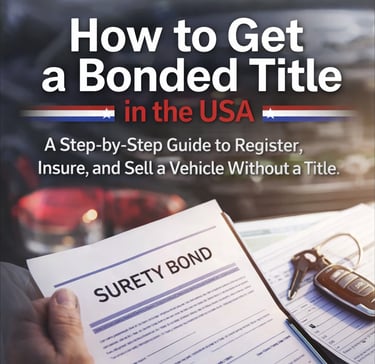
Lost Car Title and DMV Says “No”? Your Options Explained
You walked into the DMV thinking this would be annoying—but manageable. You filled out the forms. You brought what you thought were the right documents. You waited. And then the clerk looked up and said the word that freezes people in place:
“No.” https://bondedtitleusa.com/get-bonded-title-usa-ebook
No replacement title.
No transfer.
No registration.
No exceptions.
If you’ve lost a car title and the Department of Motor Vehicles says no, you are not stuck forever—but you are at a crossroads. What you do next determines whether this vehicle becomes usable property again… or a very expensive paperweight.
This guide explains every real option you have when the DMV refuses to issue or replace a title. Not theory. Not myths. Not “just go to another office and hope.” Real-world paths that actually work—what they require, who they’re for, where they fail, and how long they take.
This is written for people who are:
Staring at a car they own but can’t legally use
Trying to sell or insure a vehicle with missing paperwork
Dealing with an inherited, abandoned, gifted, or barn-find vehicle
Facing a DMV rejection and wondering if the system is broken
You are not alone. And you are not powerless.
Let’s start by understanding why the DMV said no—because the reason matters more than most people realize.
Why the DMV Says “No” in Lost Title Cases (The Real Reasons)
The DMV does not deny title requests arbitrarily. When they say no, it’s almost always because they cannot legally verify ownership to their required standard. That standard is not emotional. It is not situational. It is administrative, legal, and risk-driven.
Here are the most common—and most misunderstood—reasons for denial.
Reason #1: You Are Not the Owner of Record
This is the most brutal and common denial.
If the DMV’s database shows someone else as the last titled owner—and you are not them—you cannot simply request a replacement title. Even if:
You bought the car years ago
You paid cash
You have a handwritten bill of sale
The seller disappeared
The car has been sitting on your property
From the DMV’s perspective, you are a possessor, not a proven owner.
And possession alone is not enough.
Reason #2: The Vehicle Was Never Properly Titled
This happens more often than people expect, especially with:
Older vehicles
Farm trucks
Trailers or off-road vehicles later converted
Cars transferred “off the books”
If the vehicle was:
Sold but never retitled
Passed through multiple hands without paperwork
Registered in another state but never transferred
…the DMV may have no clean ownership chain to work from. No chain = no title. https://bondedtitleusa.com/get-bonded-title-usa-ebook
Reason #3: The Previous Owner Is Deceased or Unreachable
When the titled owner has died or cannot be contacted, the DMV cannot accept your claim without legal authority to act on their behalf.
That authority must come from:
Probate documents
Court orders
Executor or administrator status
A story—even a true one—is not enough.
Reason #4: The VIN Triggers a Red Flag
If the Vehicle Identification Number:
Does not match records
Shows as junked, salvaged, or non-repairable
Appears in theft or lien databases
Was altered, damaged, or re-stamped
…the DMV will freeze the process immediately.
In these cases, “no” is not final—but the path forward becomes narrower and more technical.
Reason #5: There Is a Lien on the Vehicle
If a bank, lender, or finance company still shows an active lien—even from decades ago—the DMV cannot issue a clean title.
Until that lien is:
Released
Proven invalid
Legally extinguished
…the title stays locked.
The Emotional Reality of a DMV Rejection
Let’s pause for a moment, because this is where most guides get it wrong.
When the DMV says no, people don’t just feel confused. They feel:
Embarrassed
Angry
Tricked
Helpless
You did the “right thing.” You showed up. You followed instructions. And the system shut the door in your face.
That emotional hit causes many people to:
Give up too early
Take bad advice from forums
Try shady shortcuts that backfire
Lose hundreds or thousands of dollars
The truth is this: there is almost always a lawful path forward—but it depends entirely on your specific situation.
Now we’ll walk through those paths one by one.
Option 1: Locate the Last Titled Owner (The “Cleanest” Fix)
If the DMV says you are not the owner of record, the most straightforward solution—when possible—is to involve the last titled owner directly.
How This Works
If the last owner is alive, reachable, and cooperative, they can:
Apply for a replacement title in their name
Sign it over to you properly
Provide a lien release if required
Once this happens, your problem essentially disappears.
When This Option Works Well
The seller is known to you
The transaction was recent
The seller understands the issue
No liens or VIN issues exist
When It Fails Completely
The seller vanished
The seller refuses to help
The seller is deceased
The seller never actually titled the car themselves
In many cases, this option is technically ideal but practically impossible.
And when it fails, people assume they’re stuck.
They’re not.
Option 2: Probate or Estate-Based Title Transfer
If the titled owner is deceased, the DMV will not deal with verbal claims or family stories. They will only accept legal authority.
What the DMV Requires
Death certificate of the owner
Probate court documents
Proof of executor or administrator appointment
Court-authorized transfer or distribution
This process can be slow, expensive, and emotionally draining—especially if the estate was never formally opened.
Critical Reality Check
If the vehicle’s value is low, probate costs may exceed the car’s worth. Many people walk away at this stage, believing the system makes no sense.
But probate is not your only option. https://bondedtitleusa.com/get-bonded-title-usa-ebook
Option 3: Court-Ordered Title (Quiet Title or Declaratory Judgment)
In some states, you can petition a court to declare you the lawful owner of the vehicle.
This is sometimes called:
Quiet title action
Declaratory judgment
Ownership determination
What This Involves
Filing a civil case
Providing evidence of possession and purchase
Notifying interested parties
Waiting for a judge’s ruling
Pros
Extremely strong legal authority
Overrides DMV objections
Works even when owners are missing
Cons
Time-consuming
Legal fees can be significant
Not available or practical in every state
For high-value vehicles, this can make sense. For everyday cars, it’s often overkill.
Which leads us to the option that solves more lost-title problems than any other.
Option 4: The Bonded Title (The Most Practical Solution When DMV Says “No”)
If the DMV cannot verify ownership but does not believe the vehicle is stolen or illegal, they may allow you to apply for a bonded title.
This is the option most people don’t understand—and the one that quietly resolves thousands of “no” cases every year.
A bonded title is not a loophole. It is a state-approved risk-management tool.
What a Bonded Title Really Is
A bonded title allows the DMV to issue a title in your name backed by a surety bond that protects:
Previous owners
Lienholders
The state
If someone later proves a legitimate ownership claim, the bond pays them—not the DMV, and not you personally.
Why the DMV Allows This
The DMV’s job is not to punish honest people. It’s to:
Prevent fraud
Prevent theft
Limit liability
A bonded title accomplishes all three.
What a Bonded Title Does NOT Mean
It does NOT mean the car is shady
It does NOT mean you did something wrong
It does NOT permanently brand the vehicle
After a waiting period (often 3–5 years), the bond expires and the title becomes normal.
What You Typically Need for a Bonded Title
Requirements vary by state, but usually include:
Completed bonded title application
VIN inspection by law enforcement or DMV
Vehicle appraisal or valuation
Surety bond (usually 1.5× vehicle value)
Statement of facts explaining how you got the car
The bond itself is not paid at full value. You pay a small premium—often $100–$200.
This is where many people get confused and quit too soon.
Why People Fail With Bonded Titles
Not because they’re ineligible—but because they:
Don’t know which forms matter
Submit the wrong narrative
Miss required inspections
Misunderstand bond amounts
Get rejected once and assume it’s over
A bonded title is procedural. Precision matters.
And when done correctly, it works.
Option 5: Abandoned Vehicle Process (Highly Situational)
If a vehicle was left on your property or towed legally, some states allow an abandoned vehicle title process.
This usually requires:
Documented notice to the last owner
Public postings or advertisements
Waiting periods
Towing or storage documentation
This path is tightly regulated and often misunderstood. Done incorrectly, it can expose you to liability.
It is not a shortcut. It is a compliance-heavy process with strict timelines.
Option 6: When There Truly Is No Path (Rare, But Real)
In rare cases, the DMV says no because:
The VIN is fraudulent
The vehicle was reported stolen
The vehicle was destroyed or junked legally
Federal restrictions apply
In these cases, the vehicle cannot be titled—period.
Knowing this early can save you from sinking more money into a dead end.
How to Know Which Option Applies to You
Here’s the hard truth most articles avoid:
The DMV will not tell you your best option.
They will only tell you what they cannot do.
Understanding your path requires:
Knowing your state’s statutes
Understanding title risk categories
Choosing the least expensive lawful route
Preparing documentation correctly the first time
This is why so many people spin their wheels for months—or years.
The Strategic Mistake That Costs People Thousands
The biggest mistake people make after hearing “no” is trying random fixes:
Calling different DMV offices
Submitting the same paperwork again
Taking advice from forums without context
Paying “title services” that promise miracles
What works is a structured approach that aligns your situation with the correct legal mechanism.
That’s exactly what the Get Bonded Title USA Ebook was created to do.
But before we get there, we need to go deeper—because bonded titles themselves have nuances that can make or break your case depending on the state, the vehicle, and your history.
And that’s where most guides stop short.
We’re not stopping.
Next, we’ll break down bonded title eligibility by scenario, walk through real-world examples, and expose hidden pitfalls that cause avoidable denials—including wording mistakes that quietly kill applications.
Because when the DMV says “no,” the difference between staying stuck and getting your title often comes down to details most people never see coming…
continue
…coming.
Let’s go deeper—because bonded titles are not one-size-fits-all, and the reason the DMV said “no” determines how you must approach the bonded title process if you want approval instead of another rejection.
Bonded Title Eligibility: The Scenarios That Actually Matter
Most people think eligibility is binary: “Either I qualify or I don’t.”
That’s wrong.
Eligibility depends on how the DMV categorizes your case. Two people can have the same missing title problem and get completely different outcomes based on context, documentation, and wording.
Below are the real-world scenarios DMV offices see every day—and how bonded titles apply to each.
Scenario 1: You Bought the Car, Never Received the Title
This is the classic case.
You:
Paid for the vehicle
Took possession
Received a bill of sale (or not)
Later discovered the title was missing, lost, or never transferred
The DMV says no because:
The seller is still the owner of record
Ownership transfer was never completed
Bonded Title Outlook
✅ Usually eligible
What matters:
Proof of purchase (even informal)
Statement explaining why the title cannot be obtained
VIN inspection showing no theft or tampering
Key mistake people make:
Writing an emotional story instead of a factual, chronological statement.
The DMV does not care that the seller “promised to mail the title” or “seemed trustworthy.” They care about dates, actions, and documentation.
Scenario 2: You Inherited a Vehicle With No Title
This happens constantly with:
Old cars in garages
Vehicles parked on family property
Informal inheritance situations
The DMV says no because:
You are not legally authorized to act for the estate
No probate documentation exists
Bonded Title Outlook
⚠️ Depends on state law
Some states allow bonded titles instead of probate when:
The vehicle value is below a threshold
No competing claims exist
You can prove possession and relationship
Other states require probate no matter what.
Critical detail:
If you start probate and then abandon it, you may lock yourself out of the bonded title path. Sequence matters.
Scenario 3: The Vehicle Was Abandoned on Your Property
You didn’t buy it. You didn’t inherit it. It was just… left. https://bondedtitleusa.com/get-bonded-title-usa-ebook
The DMV says no because:
You have no ownership claim
The titled owner still exists in records
Bonded Title Outlook
⚠️ Possible but procedural
Bonded title eligibility here often depends on:
Proof of abandonment
Notice attempts to the owner
Waiting periods
Compliance with abandoned vehicle statutes
This is where people get into trouble by skipping steps.
Important warning:
Claiming “abandonment” without following the statute can expose you to civil liability. Bonded title does not protect you from that.
Scenario 4: The Vehicle Is Very Old (Pre-Title or Early Title Era)
Some vehicles:
Pre-date modern titling systems
Were never titled in any state
Were registered differently decades ago
The DMV says no because:
There is no ownership history to verify
Bonded Title Outlook
✅ Strong candidate
Older vehicles are often ideal bonded title cases, especially when:
VINs check clean
No liens exist
The vehicle value is modest
In these cases, the bond functions as a formality rather than a barrier.
Scenario 5: The Seller Is Gone, Dead, or Uncooperative
You tried. You really did.
No response. No forwarding address. No cooperation.
The DMV says no because:
They require the owner of record’s involvement
Bonded Title Outlook
✅ One of the most common approvals
This is exactly the type of uncertainty bonded titles are designed to resolve.
But—and this is crucial—you must show that you attempted to resolve it the normal way first.
This is where wording, documentation, and sequencing matter more than people realize.
The VIN Inspection: Why This Step Quietly Determines Everything
Before the DMV will even consider a bonded title, they must be confident the vehicle itself is legitimate.
That confidence comes from a VIN inspection.
What the VIN Inspection Actually Does
It verifies:
The VIN matches the vehicle
The VIN matches records (if any)
The VIN has not been altered
The vehicle is not reported stolen
This inspection may be performed by:
Law enforcement
DMV inspectors
Authorized third parties (state-specific)
Why People Fail Here
Common mistakes:
Showing up with a dirty or obstructed VIN
Bringing a vehicle with mismatched parts
Not understanding secondary VIN locations
Assuming a prior inspection “counts”
If the VIN inspection raises questions, the bonded title process stops immediately.
No bond can fix a bad VIN.
Vehicle Valuation: The Step That Confuses Almost Everyone
Bond amounts are based on vehicle value, usually 1.5× the appraised value.
But here’s the catch:
The DMV—not you—decides what valuation method they accept.
Accepted Valuation Sources Often Include:
State-specific appraisal forms
Licensed dealer appraisals
Recognized valuation guides (in some states)
DMV internal valuation tables
The Mistake That Raises Red Flags
People try to undervalue the vehicle to reduce the bond amount.
This backfires.
An unrealistically low valuation:
Triggers manual review
Causes delays
Can lead to outright rejection
The bond premium is usually small. Fighting valuation is rarely worth it.
The Surety Bond: What It Protects (and What It Doesn’t)
Let’s kill a major myth right now.
The surety bond does NOT protect you.
It protects:
Prior owners
Lienholders
The state
If someone proves a valid ownership claim during the bond period:
They file against the bond
The surety pays them
The surety may seek reimbursement from you
That sounds scary—but here’s the reality.
Why Claims Are Rare
Claims typically require:
Proof of superior ownership
Timely action within the bond period
Legal standing
In clean bonded title cases, claims are uncommon.
What the Bond Does for You
Indirectly, it does something powerful:
It allows the DMV to issue a title
It lets you register, insure, and sell the vehicle
It starts the clock toward a clean title
After the bond period expires, the title converts to standard.
The Statement of Facts: The Most Underrated Document
This single document causes more bonded title denials than any other.
Why?
Because people treat it like a story instead of a legal statement.
What the DMV Wants
They want:
Dates
Actions
Names (if known)
Attempts made
Objective facts
They do NOT want:
Emotion
Assumptions
Accusations
Speculation
Bad Example (Common):
“I bought the car from a guy who seemed honest but then he disappeared and now the DMV won’t help me even though I paid my money.”
Good Example (Effective):
“On March 14, 2022, I purchased the vehicle identified by VIN XXXXX from John Doe. I took possession the same day. I did not receive the certificate of title. On April 2 and April 15, 2022, I attempted to contact the seller by phone and certified mail without response.”
See the difference?
One invites rejection.
The other invites approval.
Why “Trying Again” Without Strategy Makes Things Worse
Many people:
Apply
Get denied
Reapply with minor changes
Get denied again
Each denial:
Adds notes to your file
Raises scrutiny
Reduces flexibility
The DMV remembers.
What feels like persistence can actually harden the “no.”
This is why preparation matters more than speed.
Selling a Vehicle With a Bonded Title: What You Need to Know
Yes, you can sell a vehicle with a bonded title in most states.
But:
Buyers must be informed
Some lenders won’t finance
Some dealers won’t touch it
Pricing may be affected
After the bond period expires, these issues disappear.
For many people, the bonded title is not the end—it’s the bridge.
The Hard Truth Nobody Tells You
The DMV system is not designed to guide you.
It is designed to reject incomplete certainty.
When certainty is missing, you must supply a lawful substitute:
Probate
Court order
Bonded title
Abandoned vehicle compliance
Guessing wastes time. Random advice wastes money.
Why the “Get Bonded Title USA Ebook” Exists
This ebook was created for one reason:
To turn “no” into a clear, lawful “yes” without months of trial and error.
Inside, you get:
Step-by-step bonded title process
State-by-state nuances
Exact wording examples that work
Document checklists
Common rejection traps
Decision trees to choose the right path the first time
It’s written for people who are tired of guessing—and ready to move forward.
Your Next Move Matters More Than You Think
Right now, you are at a fork in the road.
One path looks like this:
More DMV visits
More confusion
More delays
More sunk costs
The other path looks like this:
A structured plan
Correct documents
One clean submission
A titled, legal vehicle
The difference is knowledge—and execution.
If the DMV has already said “no,” doing the same thing again won’t change the answer.
But choosing the right option—and executing it correctly—will.
Final CTA
If you are serious about resolving your lost car title issue once and for all, stop guessing.
👉 Get Bonded Title USA Ebook
It shows you exactly how people in your situation get unstuck—legally, efficiently, and without unnecessary risk.
When the DMV says “no,” this is how you take back control… and get your vehicle back on the road.
And if you’re still reading, good—because the difference between stuck and solved often comes down to what you do next.
continue
…next.
Because here’s something most people only realize after months of wasted time:
a bonded title is not the only thing you can mess up—you can also accidentally lock yourself out of it forever if you take the wrong step in the wrong order.
So now we need to talk about sequence, timing, and irreversible mistakes—the quiet killers of lost-title cases.
The Order You Do Things In Can Decide the Outcome
The DMV does not evaluate your situation in isolation. It evaluates your entire paper trail.
That means:
What you applied for first
What you said in earlier applications
What boxes you checked
What path you attempted before switching strategies
Once something is logged, it becomes part of the record.
Example of a Fatal Sequencing Mistake
You apply for a standard replacement title
You are denied because you’re not the owner of record
You then apply for an abandoned vehicle title
You are denied because the vehicle was not abandoned
You then try for a bonded title
At this point, the DMV may say:
“You have already acknowledged you are not the owner and that the vehicle was not abandoned. Bonded title denied.”
Nothing about the vehicle changed.
Only your paper trail did.
The One Sentence That Quietly Kills Bonded Title Applications
There is a specific type of sentence that appears innocent—but signals legal contradiction to the DMV.
It usually looks like this:
“I do not own the vehicle but I am requesting a bonded title.”
That sentence feels honest.
It also destroys your case.
Why?
Because a bonded title is not for people who admit they don’t have an ownership claim.
It is for people who assert ownership but lack formal proof.
The correct framing is not:
“I am not the owner”
It is:
“I am the owner by possession and transaction, but lack a certificate of title”
That distinction is not semantic.
It is legal.
Possession vs. Ownership: The DMV’s Quiet Legal Line
Here’s the nuance most guides miss.
The DMV recognizes three different states of control over a vehicle:
Possession – You physically have it
Equitable ownership – You acquired it through a legitimate transaction
Legal title ownership – You have the certificate
A bonded title exists to bridge the gap between #2 and #3.
If your paperwork or statements suggest you only have #1, the DMV sees risk—not legitimacy.
This is why:
Bills of sale matter
Statements of fact matter
Language matters
You are not “asking for permission.”
You are asserting a lawful claim and offering a bond as protection.
When the DMV Says “There Is Nothing Else You Can Do”
This phrase causes panic.
But it usually means one of three things:
The clerk does not know the alternative
The clerk is not authorized to explain the alternative
The alternative requires a process outside the DMV (court, bond, probate)
DMV employees are not legal advisors. They are gatekeepers.
When they say “nothing else,” what they really mean is:
“There is no standard form I can hand you for this.”
That does not mean the path does not exist.
Why Some DMV Offices Say “Yes” and Others Say “No”
People notice this and assume corruption or randomness.
It’s neither.
It’s discretion plus documentation quality.
Bonded titles, in particular, often involve:
Supervisor review
Manual assessment
Risk evaluation
Two identical vehicles can get different outcomes if:
One file is clean, chronological, and precise
The other is vague, emotional, or contradictory
The vehicle doesn’t change.
The story does.
The Silent Role of Lien Databases
Even when no lien appears on the title you don’t have, the DMV checks:
State lien databases
National lien systems
Historical finance records
An old lien—even one from a defunct lender—can stop everything.
What Most People Do Wrong Here
They assume:
“The bank is gone, so the lien doesn’t matter”
“It’s been 20 years, it must be expired”
That assumption is dangerous.
The DMV does not clear liens based on age or logic.
They clear them based on documentation.
In some states, bonded titles can bypass unresolved liens.
In others, they cannot.
Knowing which applies before you submit is critical.
Insurance, Registration, and Driving While You’re Stuck
Another hidden risk: what you do with the vehicle while the title issue is unresolved.
Some people:
Drive without registration
Insure under someone else’s name
Park on public streets without plates
Each of these can create new problems:
Tickets
Impound
Additional DMV flags
The safest approach depends on:
State law
Vehicle status
Your chosen resolution path
This is rarely explained at the DMV counter—but it matters.
Why “Title Services” Often Make Things Worse
You’ll see ads promising:
“Guaranteed title”
“No DMV hassle”
“We fix lost titles fast”
Here’s the truth.
Many of these services:
Submit the same forms you could
Use generic templates
Don’t understand your state’s nuances
Disappear when denied
Worse, some:
File incorrect applications
Create damaging records
Trigger fraud reviews
A bad third-party submission can poison your case permanently.
The Cost of Waiting Too Long
Lost-title problems do not age gracefully.
Over time:
Sellers become harder to find
Estates close
Records are archived
Vehicles depreciate
Laws change
What was solvable last year may become harder this year.
Action—correct action—is time-sensitive.
Why Bonded Titles Exist at All (The Big Picture)
States did not create bonded titles to frustrate people.
They created them because:
Paperwork gets lost
People die
Cars change hands informally
Perfection is unrealistic
A bonded title is the state saying:
“We can’t prove everything—but we can manage the risk.”
When you understand that, the process stops feeling adversarial.
The Mental Shift That Unlocks Progress
Stop asking:
“Why won’t the DMV help me?”
Start asking:
“What risk is the DMV trying to control—and how do I neutralize it?”
Bonded titles, court orders, probate, and abandonment statutes are all risk-management tools.
Your job is to choose the one that matches your facts.
Where Most People Finally Break Through
Almost everyone who resolves a “DMV said no” case reaches the same realization:
“I wasn’t missing effort. I was missing structure.”
Once the process is:
Mapped
Sequenced
Documented correctly
The resistance disappears.
This Is Why the Ebook Matters
The Get Bonded Title USA Ebook is not motivation.
It is not theory.
It is not generic advice.
It is a playbook built from real scenarios, real denials, and real approvals.
It shows:
What to do first
What to avoid doing at all
How to word critical documents
When bonded title is right—and when it isn’t
How to recover if you already made mistakes
Most importantly, it saves you from learning the hard way.
If You’re Still Reading, Here’s the Truth
People who solve lost-title problems don’t get lucky.
They get informed.
They stop guessing.
They stop hoping the next clerk will say yes.
They stop relying on half-answers.
They follow a process designed for their exact situation.
Final, Unambiguous Call to Action
If the DMV has already told you “no”, you are past the point where casual advice helps.
👉 Get Bonded Title USA Ebook https://bondedtitleusa.com/get-bonded-title-usa-ebook
It gives you the clarity, structure, and exact steps needed to turn that “no” into a lawful, permanent solution—without burning more time, money, or patience.
Because the car isn’t the problem.
The paperwork is.https://bondedtitleusa.com/get-bonded-title-usa-ebook
And paperwork—done right—can be fixed.
BondedTitleUSA.com is an informational resource and does not provide legal advice. DMV rules vary by state.
Contact
infoebookusa@aol.com
© 2026. All rights reserved.