
What Happens If Someone Files a Claim on Your Bonded Title?
Blog post description.
2/11/202621 min read
What Happens If Someone Files a Claim on Your Bonded Title?
If you’re driving a vehicle with a bonded title, there’s a question that probably sits in the back of your mind every time you renew registration, think about selling the car, or invest money into repairs:
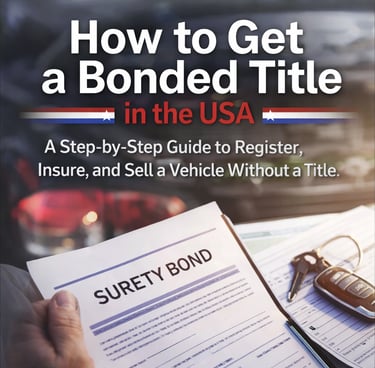
“What happens if someone actually files a claim against my bonded title?” https://bondedtitleusa.com/get-bonded-title-usa-ebook
This is not a hypothetical fear. It’s the single biggest concern people have when they go through the bonded title process—and for good reason. A bonded title exists precisely because ownership was not 100% provable at the time the title was issued. That gap creates legal risk, and claims are how that risk surfaces.
In this guide, we are going to walk through exactly what happens if someone files a claim on your bonded title, step by step, without sugarcoating, shortcuts, or legal fluff. You’ll learn what a claim really is, who can file one, how often it actually happens, what your financial exposure is, how surety bonds work behind the scenes, and—most importantly—what you should do immediately if a claim is filed.
This article is written for real vehicle owners, not lawyers. If you’re currently driving a bonded-title vehicle, thinking about applying for one, or worried about a future claim, this is the deep, no-nonsense explanation you need.
Let’s start at the foundation.
Understanding What a Bonded Title Actually Is
A bonded title is a state-issued vehicle title backed by a surety bond. It allows you to register and legally operate a vehicle when standard ownership documentation is missing, incomplete, or questionable.
Common situations that lead to a bonded title include:
• You bought a car but never received the title
• The title was lost before transfer
• The seller disappeared or can’t be located
• The vehicle was abandoned or inherited informally
• Clerical or VIN errors prevent standard titling
When a bonded title is issued, the state is essentially saying:
“We will issue you a title, but if someone later proves they are the rightful owner, we want financial protection.”
That protection is the surety bond.
The bond amount is usually set at 1.5x to 2x the vehicle’s appraised value and stays in force for a fixed period—most commonly three to five years, depending on the state.
During that bond period, anyone with a legitimate ownership claim can challenge your title.
That challenge is called a bonded title claim.
What Does “Filing a Claim” Actually Mean?
When someone files a claim on your bonded title, they are formally asserting that they have a superior legal right to the vehicle.
This is not the same as:
• Someone calling you
• Someone threatening you verbally
• A random letter without documentation
A valid claim involves paperwork, evidence, and formal submission through the surety bond process or the state agency overseeing bonded titles.
In simple terms, a claimant is saying:
“That vehicle belongs to me, not the person holding the bonded title.”
And they are prepared to prove it.
Who Can File a Claim Against Your Bonded Title?
Not just anyone can file a valid claim. Only parties with a legitimate ownership interest can pursue one successfully.
Typical claimants include:
• A previous titled owner
• A lienholder (bank, finance company)
• An heir with legal inheritance rights
• An insurance company that paid out a claim
• A buyer who purchased the vehicle earlier but never transferred title
For example:
Someone buys a car in cash, never transfers the title, then sells it again. Years later, they see the vehicle listed or registered and realize it was never legally transferred out of their name. That person may file a claim.
Another example:
A vehicle is reported abandoned but was actually part of an estate. An heir later discovers it was bonded and titled by someone else. They may file a claim asserting ownership.
What matters is evidence. Claims without proof go nowhere.
When Can a Claim Be Filed?
A claim can only be filed during the bond period.
Once the bond period expires and the bonded title converts into a standard title (in states where conversion is automatic), claims are typically barred.
That bond period is the risk window. https://bondedtitleusa.com/get-bonded-title-usa-ebook
If your bond term is three years, that is the timeframe during which claims can arise. After that, the legal risk drops dramatically.
This is why bonded titles are temporary solutions, not permanent ones.
What Triggers a Claim?
Claims don’t appear out of thin air. They are usually triggered by one of three things:
Visibility
Transactions
Paper Trails
Visibility means the vehicle shows up in records—registration renewals, insurance databases, resale listings, or VIN checks.
Transactions include attempts to sell, refinance, or re-title the vehicle.
Paper trails include lien searches, estate processing, or internal audits by insurers or financial institutions.
Many claims surface when a bonded-title vehicle is sold. A buyer runs a title check, contacts prior owners, or digs into history—and someone realizes the vehicle was never properly transferred years earlier.
What Happens First When a Claim Is Filed?
Once a claim is filed, the surety bond company is notified.
This is a critical point: the claim is not immediately paid, and you do not instantly lose the vehicle.
The process begins with investigation.
The surety company will:
• Review the claimant’s documentation
• Verify ownership evidence
• Contact you (the bonded title holder)
• Request your documentation and explanation
You will receive a formal notice. This is not optional correspondence. Ignoring it can make things worse.
At this stage, nothing has been decided. The surety company acts as an investigator, not a judge.
Your Rights as the Bonded Title Holder
Many people panic at this point because they assume they have no rights.
That is incorrect.
You have the right to:
• Review the claim
• Submit evidence
• Dispute inaccuracies
• Explain how you acquired the vehicle
• Provide proof of purchase, possession, and good faith
Good faith matters. If you bought the vehicle honestly, paid fair value, and followed state procedures, that weighs heavily in your favor.
Surety companies do not automatically side with claimants. They side with evidence.
What Evidence Do Claimants Usually Provide?
Strong claims typically include:
• Original titles or copies
• Bills of sale predating yours
• Lien records
• Probate or estate documents
• Insurance settlement records
Weak claims often rely on hearsay, incomplete paperwork, or assumptions.
The strength of the claim determines everything that follows.
What If the Claim Is Found Invalid?
If the surety company determines that the claim is invalid or unsupported, the claim is denied.
Nothing else happens.
You keep the vehicle.
The bond remains in place.
Your title status does not change.
This outcome is far more common than people expect.
Many claims fail because the claimant cannot prove superior ownership.
What If the Claim Is Valid?
If the claim is deemed valid, things become more serious.
At this point, the surety company has two possible obligations:
• Compensate the claimant financially (up to the bond amount)
• Seek reimbursement from you, depending on circumstances
Here’s the key thing most people misunderstand:
The surety bond protects the claimant and the state—not you.
If the surety pays out a claim, they may pursue you for reimbursement if you were at fault or misrepresented facts during the bonded title application.
However, “at fault” does not mean “unknowingly involved.”
Intent matters.
Fraud vs Good Faith Mistakes
There is a massive difference between:
• Someone who knowingly titled a stolen vehicle
• Someone who bought a vehicle in good faith with missing paperwork
If fraud is involved, consequences are severe.
If good faith is established, outcomes are often negotiated, limited, or resolved without full financial impact.
What Happens to the Vehicle Itself?
This is the question everyone cares about.
The answer depends on the state, the claim, and the outcome.
Possible scenarios include:
• You retain possession permanently
• You retain possession temporarily during investigation
• The vehicle is awarded to the claimant
• The vehicle is sold to satisfy claims
In many cases, especially when compensation is paid, the claimant receives money—not the vehicle itself.
But this is not guaranteed.
If the claimant is the rightful owner and demands return of the vehicle, the state may require surrender.
This is rare, but it happens.
Can You Drive the Vehicle During a Claim?
Usually yes, unless the state issues a specific restriction or court order.
The filing of a claim does not automatically invalidate your registration.
However, insurance companies may become cautious if they are notified of an active ownership dispute.
Should You Sell a Vehicle With an Active Claim?
Absolutely not.
Selling a vehicle during an active bonded title claim can create additional legal exposure and potentially invalidate your protections.
Once a claim is filed, all transactions should stop until resolution.
How Often Do Bonded Title Claims Actually Happen?
Here’s the truth: they are uncommon.
The majority of bonded titles never face a claim.
Most vehicles that qualify for bonded titles are older, low-value, or have long gaps in ownership history. The chances of a legitimate claimant emerging years later are statistically low.
That said, “low probability” is not the same as “no risk.”
Understanding the process is what allows you to manage that risk intelligently rather than fear it.
What Should You Do Immediately If a Claim Is Filed?
This is where preparation matters.
The moment you receive notice:
Do not ignore it
Gather all documents related to purchase and possession
Respond promptly and professionally
Do not admit fault or speculate
Do not contact the claimant directly unless advised
Your goal is to demonstrate good faith, transparency, and compliance.
Silence is interpreted as risk.
Documentation is your strongest defense.
Can a Claim Be Filed After You Sell the Vehicle?
Yes—and this surprises many people.
If you sell a bonded-title vehicle during the bond period, and a claim later arises, the claim can still be filed against the bond.
Depending on state law and sale disclosures, you may still be involved.
This is why disclosure to buyers is critical and why many sellers wait until the bond period expires before selling.
Does the Bond Expire Automatically?
In most states, yes.
Once the bond period ends without a claim, the bonded title converts into a standard title or becomes claim-proof.
At that point, the risk window closes.
This is the finish line.
How to Minimize the Risk of a Claim
You cannot eliminate risk entirely, but you can reduce it dramatically.
Best practices include:
• Thorough VIN checks before purchase
• Written bills of sale with seller identification
• Avoiding vehicles with recent title activity gaps
• Keeping all documentation indefinitely
• Waiting out the bond period before major investments
Education is the real protection.
Most bonded title disasters happen because people didn’t understand the process—not because they did anything wrong.
Why Most People Panic Unnecessarily
Bonded titles sound scarier than they are.
The word “bond” triggers fear. The idea of a claim feels like a lawsuit waiting to happen.
In reality, bonded titles are administrative tools designed to solve common ownership problems—not traps designed to punish honest buyers.
Claims are rare, and when they happen, they follow a structured, evidence-based process.
Knowing that process removes 90% of the fear.
If you’re reading this because you already have a bonded title, take a breath.
You’re not sitting on a ticking time bomb.
You’re navigating a defined legal framework with clear rules.
And those rules can work in your favor—if you understand them.
If you’re considering applying for a bonded title, the biggest mistake you can make is guessing, assuming, or copying advice from forums and anecdotes.
Every state has nuances. Every bond has conditions. Every situation is different.
That’s why step-by-step guidance matters.
If you want a complete, state-by-state breakdown of the bonded title process, real examples, risk analysis, document checklists, and exact wording to use (and avoid), the Get Bonded Title USA Ebook was created specifically for people in your situation.
It walks you through the process the way an expert would—calmly, clearly, and without legal confusion—so you can move forward with confidence instead of fear.
When it comes to bonded titles, information is leverage.
And the right information can save you thousands of dollars, months of stress, and a lot of sleepless nights.
Get the clarity before a claim ever has a chance to appear.
Get Bonded Title USA Ebook https://bondedtitleusa.com/get-bonded-title-usa-ebook
continue
…before a claim ever has a chance to appear.
But to really understand what happens if someone files a claim on your bonded title, we need to go deeper into the mechanics that most articles never explain—the financial liability chain, the legal positioning of the surety company, and the long-term consequences that can follow you even after a claim is resolved.
Because the reality is this:
A bonded title claim is not just about the vehicle.
It’s about responsibility, reimbursement, and risk allocation.
And if you don’t understand who ultimately pays, you’re flying blind.
The Financial Chain of Responsibility in a Bonded Title Claim
When people hear “surety bond,” they often assume it works like insurance.
It does not.
Insurance transfers risk away from you.
A surety bond guarantees payment—but keeps you financially responsible.
That distinction is everything.
Here’s how the financial chain works in a bonded title claim:
The claimant files a claim
The surety investigates
If the claim is valid, the surety pays the claimant
The surety then looks to recover that money
And the first place they look is you.
This is called indemnification.
When you purchased the bonded title bond, you signed an indemnity agreement—even if you didn’t realize it. That agreement states that if the surety suffers a loss due to your bond, you agree to reimburse them.
However—and this is crucial—indemnification is not automatic.
The surety must determine:
• Whether you acted in good faith
• Whether you provided accurate information
• Whether the loss was caused by fraud, negligence, or unavoidable circumstances
This is why documentation and honesty matter so much.
If you misrepresented facts during the bonded title application—such as fabricating a bill of sale or hiding known ownership disputes—the surety will almost certainly seek full reimbursement.
If you acted honestly and followed the law, the outcome can be very different.
Partial Payouts, Negotiated Settlements, and Reality
Another misconception is that valid claims always result in full bond payouts.
They don’t.
Many claims are settled for less than the bond amount.
For example:
A claimant proves prior ownership but the vehicle has depreciated significantly.
Or the claimant suffered limited financial loss.
Or the claimant accepts compensation rather than demanding possession.
In these cases, the surety may pay a reduced amount.
And in many good-faith situations, the surety may not aggressively pursue reimbursement—or may offer structured repayment options.
This is not generosity. It’s risk management.
Surety companies understand that bonded title holders are often ordinary people navigating broken paperwork, not criminals.
What Happens If You Cannot Reimburse the Surety?
This is an uncomfortable but important question.
If the surety pays a claim and determines you are financially responsible, and you refuse or are unable to reimburse them, the surety can pursue collection.
That may include:
• Sending the account to collections
• Filing a civil lawsuit
• Obtaining a judgment
• Reporting the debt
This is rare—but it happens.
And it’s almost always tied to misrepresentation or non-cooperation.
People who respond promptly, provide documentation, and demonstrate good faith almost never end up in this scenario.
The Role of the State DMV or Title Agency
The surety company is not the only player.
The state DMV (or equivalent title authority) may also become involved—especially if the claim affects the validity of the title itself.
The state’s priority is not to punish you. It’s to correct ownership records.
Depending on the outcome, the DMV may:
• Flag the title
• Suspend future transfers
• Require re-titling
• Revoke the bonded title
Again, this is outcome-dependent.
Most cases end without DMV enforcement action beyond administrative updates.
But if fraud is discovered, consequences escalate quickly.
Can Criminal Charges Arise from a Bonded Title Claim?
This is another fear people have—and in most cases, it’s unfounded.
Bonded title claims are civil matters, not criminal ones.
However, criminal exposure can arise if:
• The vehicle was stolen
• Documents were forged
• False statements were knowingly submitted
• VINs were altered
If you acted honestly and legally, you are not facing criminal charges simply because a claim was filed.
The presence of a claim does not imply wrongdoing.
It implies a dispute.
And disputes are resolved through evidence—not assumptions.
What If Multiple Claims Are Filed?
It’s uncommon, but possible.
For example, a vehicle may have both:
• A prior owner claim
• A lienholder claim
In such cases, the surety investigates each claim separately and prioritizes them based on legal standing.
The bond amount caps total payout.
Once the bond is exhausted, additional claims may be denied or redirected to court.
This is another reason bond amounts are set higher than vehicle value.
What If the Claim Is Filed Near the End of the Bond Period?
Timing matters.
If a claim is filed before the bond expires—even on the last day—it is valid.
Expiration does not cancel pending claims.
However, claims filed after expiration are typically barred.
This is why some claimants move quickly once they discover a bonded title.
And why bonded title holders should maintain documentation until well after the bond period ends.
What Happens After the Claim Is Resolved?
Once a claim is resolved—whether denied, paid, or settled—the bond remains in effect until expiration unless otherwise terminated by the state.
Resolution does not automatically convert the bonded title into a clean title.
That conversion only happens after the bond period ends without unresolved claims.
If a claim was paid, the state may require additional steps before issuing a standard title.
Always confirm status with the DMV.
The Psychological Impact Most People Don’t Talk About
Here’s something rarely discussed: the emotional toll.
Even a weak claim can cause anxiety.
People worry about:
• Losing the vehicle
• Financial exposure
• Legal consequences
• Insurance complications
This stress is often worse than the actual risk.
The unknown feels bigger than reality.
But once you understand the process—and your actual exposure—the fear loses its power.
Preparedness changes everything.
Real-World Example: A Typical Claim That Goes Nowhere
Consider this common scenario:
A man buys a 12-year-old truck from a private seller. The seller claims the title was lost. The buyer applies for a bonded title, gets approved, and registers the vehicle.
Two years later, a prior owner files a claim stating they “never sold the truck.”
The surety investigates.
They discover:
• The prior owner sold the truck at a mechanic’s lien sale
• They never reclaimed it
• They have no proof of ownership after that point
The claim is denied.
The bonded title holder keeps the truck.
The bond expires.
End of story.
This is far more common than the nightmare scenarios people imagine.
Why Education Is the Difference Between Control and Chaos
Most bonded title problems aren’t caused by claims.
They’re caused by ignorance.
People don’t know:
• What documents to keep
• What language to use
• What mistakes trigger liability
• When to wait—and when to act
That lack of knowledge turns manageable risk into panic.
And panic leads to bad decisions.
Selling too early.
Ignoring notices.
Admitting things you shouldn’t.
Trusting bad advice.
This is why having a clear, step-by-step reference matters.
Not forum posts.
Not half-answers.
Not “my cousin did this.”
Clear guidance.
If you’re holding a bonded title right now—or considering one—you don’t need fear.
You need clarity.
You need to know exactly what happens if someone files a claim, how likely it is, what your exposure really is, and how to protect yourself at every stage.
That’s why the Get Bonded Title USA Ebook exists.
It’s not theory.
It’s not legal fluff.
It’s practical, state-specific, real-world guidance.
From eligibility checks to bond amounts, from claim scenarios to post-bond conversion, it shows you how to navigate the process intelligently—so you can drive, register, insure, and eventually sell your vehicle without second-guessing every step.
If you’re going to do this, do it informed.
Get the answers before a claim ever appears.
Get control instead of fear.
Get Bonded Title USA Ebook
continue
…because the real danger with bonded titles is not the claim itself.
It’s what you don’t do before a claim ever happens.
Most people only start learning once they’re already in trouble. That’s backwards. The smartest bonded title holders treat the bond period like a probationary window: everything they do during those years is designed to reduce exposure, preserve evidence, and stay legally boring.
Let’s break down the mistakes that turn a manageable bonded title into a nightmare—and how to avoid them.
The Most Common Mistakes That Make Claims Worse
A bonded title claim is rarely catastrophic on its own. What makes it expensive, stressful, or destructive is human error after the bond is issued.
Here are the mistakes that consistently turn small issues into big ones.
Mistake #1: Losing or Throwing Away Documentation
People assume once the bonded title is issued, the paperwork no longer matters.
That’s wrong.
You should keep everything related to the vehicle for the entire bond period and beyond:
• Bill of sale
• Payment records
• Seller communications
• Photos of the vehicle at purchase
• VIN inspection reports
• DMV correspondence
• Bond paperwork
If a claim is filed three years later and you can’t produce proof of how you acquired the vehicle, your position weakens immediately—even if you acted in good faith.
Documentation is not bureaucracy.
It’s leverage.
Mistake #2: Making Modifications That Increase Financial Exposure
During the bond period, the vehicle is still legally vulnerable.
Yet people pour money into:
• Engine swaps
• Custom paint jobs
• Performance upgrades
• Full restorations
Then they panic at the idea of losing the vehicle.
Here’s the hard truth:
Money you invest during the bond period is money at risk.
If the vehicle were awarded to a claimant, you are not guaranteed reimbursement for improvements.
That doesn’t mean you can’t maintain the vehicle—but major upgrades should ideally wait until the bond expires.
Mistake #3: Selling Too Early (or Without Disclosure)
Selling a bonded-title vehicle before the bond expires is legal in many states—but risky.
Why?
Because claims can still be filed against the bond after the sale.
If the buyer later faces a claim, you may be pulled back into the process.
Worse, if you fail to disclose the bonded status properly, you could face civil liability from the buyer—even if the original claim fails.
Disclosure protects you.
Silence exposes you.
Mistake #4: Ignoring Early Warning Signs
Claims rarely come out of nowhere.
Often there are signals:
• A prior owner contacts you
• A lienholder sends an inquiry
• Insurance companies request clarification
• DMV records show inconsistencies
People ignore these signs because “nothing happened yet.”
That’s how problems escalate.
Early clarification can prevent formal claims altogether.
Mistake #5: Responding Emotionally Instead of Strategically
When people receive a claim notice, fear kicks in.
They overshare.
They speculate.
They apologize unnecessarily.
They admit things they shouldn’t.
Everything you say becomes part of the record.
Your response should be factual, calm, and documented—not emotional.
This is not about winning an argument.
It’s about establishing credibility.
What If You Know a Claim Might Be Coming?
This is a scenario almost no one talks about.
Sometimes you suspect a claim might be filed.
Maybe:
• You later discover the seller lied
• You uncover a lien after purchase
• You realize the vehicle was part of an estate
• You learn the title history is messier than expected
If you suspect a future claim, your best move is not panic.
It’s preparation.
That means:
• Gathering documentation now
• Clarifying facts with the DMV
• Avoiding transactions
• Being ready to respond
Surety companies look favorably on proactive, transparent bonded title holders.
Surprises look suspicious.
Preparation looks responsible.
The Difference Between Legal Ownership and Financial Resolution
Here’s a nuance most people miss:
A bonded title claim does not always result in a change of ownership.
Sometimes it results in financial compensation only.
This happens when:
• The claimant no longer wants the vehicle
• The vehicle has depreciated
• The claimant suffered financial loss but not possession loss
In these cases, the vehicle stays with you, and the bond compensates the claimant.
This is one of the reasons bonded titles exist—to resolve historical ownership disputes financially instead of physically.
Understanding this removes a lot of fear.
Losing the vehicle is not the default outcome.
Financial settlement is often preferred.
What Happens If the Claimant Wants the Vehicle Back?
If the claimant is the rightful owner and wants the vehicle returned, the state may support that—especially if the claim is strong.
In that scenario:
• You may be required to surrender the vehicle
• The bond compensates you indirectly by limiting further liability
• The surety resolves financial aspects
This outcome is rare—but possible.
It almost always involves clear, undeniable ownership evidence from the claimant.
Stolen vehicles fall into this category.
Good-faith buyers are still protected from criminal consequences, but possession may be lost.
This is why VIN checks matter so much before purchase.
Insurance and Bonded Title Claims: The Overlooked Angle
Insurance companies care deeply about ownership clarity.
During a bonded title claim:
• Claims payouts may be paused
• Policy renewals may be questioned
• Coverage terms may be scrutinized
This doesn’t mean you lose insurance automatically—but disputes complicate claims.
If an accident occurs during an ownership dispute, things get messy.
That’s another reason to resolve claims quickly and transparently.
How Long Do Claims Take to Resolve?
There’s no universal timeline.
Some claims resolve in weeks.
Others take months.
Factors include:
• Complexity of evidence
• Cooperation of parties
• State involvement
• Claimant responsiveness
The fastest resolutions happen when bonded title holders respond promptly and professionally.
Silence slows everything down.
The Bond Period Is Not a Waiting Game—It’s a Strategy Window
Too many people treat the bond period like dead time.
“I’ll just wait three years.”
That’s passive thinking.
The bond period is when you:
• Build documentation
• Establish clean registration history
• Avoid red flags
• Reduce visibility risks
• Prepare for clean title conversion
By the time the bond expires, your goal is for the vehicle’s ownership history to look boring.
Boring is good.
Boring means uncontested.
The Moment the Bond Expires: What Changes Instantly
Once the bond period ends without a claim:
• The bond is released
• Claim rights expire (in most states)
• The title can convert to standard
• Financial exposure drops dramatically
This is the turning point.
From this moment on, the vehicle is treated like any other properly titled vehicle.
This is why many owners wait until bond expiration before selling or investing heavily.
The Finish Line Matters.
Why Most Horror Stories Are Misleading
You’ll find horror stories online about bonded titles.
Read them closely.
Most involve:
• Fraud
• Skipped steps
• Ignored notices
• Bad advice
• Assumptions instead of facts
They are not representative of the average bonded title experience.
People who follow the process correctly rarely post online—because nothing dramatic happens.
Silence is success.
Control Comes From Understanding, Not Luck
At the end of the day, a bonded title is not a gamble.
It’s a regulated solution to a documentation problem.
Claims are the enforcement mechanism—not a punishment system.
If someone files a claim on your bonded title, the process is structured, evidence-based, and fairer than most people expect.
The real risk comes from ignorance—not the bond itself.
If you’ve read this far, you already know more than 90% of bonded title holders.
And that knowledge changes everything.
But reading articles—even long ones—is not the same as having a clear, actionable roadmap you can follow without second-guessing yourself.
That’s why the Get Bonded Title USA Ebook exists.
It doesn’t just explain what could happen.
It tells you exactly:
• What to do
• What to avoid
• What language to use
• What documents matter
• How to protect yourself
So you don’t have to rely on guesswork when the stakes are real.
If you’re dealing with a bonded title—or considering one—this is not something you want to improvise.
Do it once.
Do it correctly.
Do it informed.
Get Bonded Title USA Ebook https://bondedtitleusa.com/get-bonded-title-usa-ebook
continue
…because there is one final layer to bonded title claims that almost no one explains clearly—and it’s the layer that determines whether the experience feels like a minor administrative hassle or a life-disrupting nightmare.
That layer is control.
Control over timing.
Control over narrative.
Control over evidence.
When someone files a claim on your bonded title, you are not powerless. But you can absolutely give your power away if you don’t understand how the process really unfolds in practice.
Let’s talk about that reality.
How Claims Actually Play Out in the Real World (Not the Textbook)
On paper, bonded title claims look linear:
Claim filed → Investigation → Decision → Resolution.
In reality, they’re messy, human, and influenced by behavior.
Surety companies are not courts. They don’t operate on rigid deadlines unless forced to. They are businesses managing risk, loss ratios, and administrative cost.
That means your behavior influences:
• How fast the claim moves
• How seriously it’s taken
• How aggressively reimbursement is pursued
• Whether flexibility is offered
Two bonded title holders can face nearly identical claims—and experience radically different outcomes—based purely on how they respond.
The “Quiet Professional” vs the “Panicked Amateur”
Here’s a comparison that illustrates this perfectly.
Bonded Title Holder A:
• Responds immediately
• Provides organized documentation
• Uses neutral, factual language
• Does not speculate or editorialize
• Demonstrates consistent registration history
Bonded Title Holder B:
• Delays response
• Sends emotional explanations
• Admits uncertainty or guilt
• Cannot locate paperwork
• Contradicts earlier statements
Even if both acted in good faith originally, Holder A looks credible and low-risk. Holder B looks like a problem.
Surety companies make decisions in uncertainty. Credibility reduces perceived risk.
Risk perception drives outcomes.
The Claimant’s Perspective (And Why It Matters)
Another overlooked aspect is the claimant’s motivation.
Not all claimants want the same thing.
Some want:
• The vehicle back
• Financial compensation
• Closure on old paperwork
• Leverage for negotiation
Many claims are filed not because someone desperately wants your car—but because they want to resolve an unresolved asset on their end.
Understanding this changes how you see the situation.
A claim is not always an attack.
Often, it’s an attempt to clean up a mess.
When you respond calmly and cooperatively, claimants are more likely to accept financial resolution rather than escalate.
Escalation benefits almost no one.
When Claims Turn Into Lawsuits (And Why It’s Rare)
People often ask:
“Will I get sued if someone files a claim?”
In most cases, no.
Why?
Because the bond exists to prevent lawsuits.
Surety bonds are designed to handle disputes without court involvement whenever possible. Litigation is expensive, slow, and uncertain.
Lawsuits usually only happen when:
• Fraud is alleged
• The bond amount is insufficient
• Parties refuse to cooperate
• Ownership evidence is extremely strong and disputed
Even then, lawsuits are often a last resort.
If you’re cooperative, documented, and acting in good faith, the likelihood of litigation drops dramatically.
What Happens If the Claimant Goes Silent?
This happens more often than you’d expect.
A claim is filed…
The surety requests documents…
The bonded title holder responds…
Then the claimant disappears.
People change their minds. They lose interest. They realize their evidence is weak.
In these cases, claims often die quietly.
The bond remains in force.
The title remains valid.
Life goes on.
This is another reason not to panic at the first notice.
A filed claim is not a verdict.
The Long Tail: Effects Years After a Claim
Here’s a subtle but important point.
Even resolved claims—especially paid ones—can leave administrative fingerprints.
For example:
• Title records may note “bonded title issued” historically
• VIN history reports may show prior disputes
• Internal DMV notes may exist
These do not usually affect normal use—but they can surface during resale or export.
This is why waiting until bond expiration and clean conversion matters so much.
Once the bonded title converts to a standard title without active claims, those historical notes lose practical impact.
Time works in your favor—if you let it.
Why Some States Are Stricter Than Others
Bonded title laws are state-specific.
Some states are extremely forgiving.
Others are rigid and procedural.
Differences include:
• Bond duration (3 vs 5 years)
• Claim filing standards
• Title conversion rules
• Disclosure requirements
• DMV involvement level
A bonded title claim in Texas does not unfold the same way as one in California, Florida, or Georgia.
Generic advice is dangerous.
This is why state-specific guidance is not optional—it’s essential.
What People Wish They Knew Before Applying for a Bonded Title
After claims are resolved, bonded title holders often say the same things:
“I wish I’d kept better records.”
“I wish I’d waited before restoring it.”
“I wish I’d understood the bond better.”
“I wish I’d known claims were this structured.”
Notice what they don’t say:
“I wish I never did a bonded title.”
Most still say it was the right move.
They just wish they’d done it smarter.
Bonded titles solve real problems.
They just require informed participation.
The Final Mental Shift You Need to Make
If you remember nothing else from this article, remember this:
A bonded title is not a fragile mistake waiting to explode.
It is a controlled legal bridge.
That bridge has guardrails.
It has rules.
It has a defined end.
Claims are part of that structure—not an anomaly.
When someone files a claim on your bonded title, you are entering a process, not a crisis.
And processes can be navigated.
If you’ve read all of this, you are already ahead of almost everyone else who applies for or holds a bonded title.
But reading alone doesn’t give you a playbook.
When you’re dealing with state forms, bond companies, VIN inspections, title language, disclosure rules, and claim responses, precision matters.
That’s exactly why the Get Bonded Title USA Ebook exists.
It’s the difference between:
• Hoping nothing goes wrong
• Knowing exactly what to do if it does
It gives you:
• State-by-state rules
• Document checklists
• Claim response strategies
• Common traps to avoid
• Clear timelines
So you don’t have to rely on fear, forums, or half-answers when real money and real property are on the line.
If you’re serious about protecting yourself, your vehicle, and your peace of mind during the bonded title period, this is not optional reading.
It’s the manual you wish you had before the questions ever started.
Take control of the process.
Get Bonded Title USA Ebook https://bondedtitleusa.com/get-bonded-title-usa-ebook
BondedTitleUSA.com is an informational resource and does not provide legal advice. DMV rules vary by state.
Contact
infoebookusa@aol.com
© 2026. All rights reserved.