
What to Do If the Seller Never Gave You the Title
Blog post description.
1/29/202611 min read
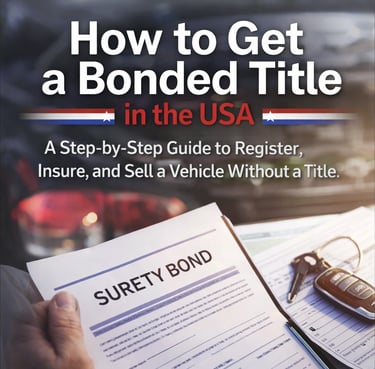
What to Do If the Seller Never Gave You the Title
You bought the car. You paid the money. You shook hands, signed a bill of sale, maybe even drove away feeling relieved, excited, or proud.
Then reality hits.
There is no title. https://bondedtitleusa.com/get-bonded-title-usa-ebook
No envelope in the mail.
No follow-up text.
No response when you call.
No proof that you legally own the vehicle you just paid for.
If you are reading this, you are probably feeling some mix of panic, anger, confusion, and dread. You might be asking yourself:
Did I just get scammed?
Can I still register this car?
Is this vehicle even legally mine?
What happens if I get pulled over?
Can I fix this without losing the car or thousands of dollars?
Take a breath.
This situation is far more common in the United States than most people realize—and there are legal paths forward, even when the seller disappears, refuses to cooperate, or never had the title in the first place. https://bondedtitleusa.com/get-bonded-title-usa-ebook
This guide will walk you through every possible option, explain what the law actually requires, show you real-world examples, and give you a clear decision framework so you know exactly what to do next—without guessing, panicking, or making costly mistakes.
This is not theory.
This is not fluff.
This is a step-by-step, real-world survival guide.
Why the Vehicle Title Is Everything (And Why Not Having It Is Serious)
A vehicle title is not just paperwork. It is the legal proof of ownership.
Without a title:
You do not legally own the vehicle
You usually cannot register or plate it
You typically cannot sell it
You may not be able to insure it properly
You risk having the vehicle seized or flagged
You could lose the vehicle entirely if the true owner comes forward
In most states, possession of the vehicle does not equal ownership. The title does.
That’s why DMVs, lenders, insurers, and courts treat the title as the final authority.
When a seller fails to give you the title, the law assumes one of several possibilities:
The seller never owned the vehicle
The vehicle has a lien
The title was lost or destroyed
The seller is avoiding taxes or fees
The vehicle may be abandoned or improperly transferred
The transaction was illegal or incomplete
Your job now is to determine which situation you are in—and act accordingly.
Step 1: Confirm Whether the Seller Legally Had the Right to Sell the Vehicle
Before you take any action, you need clarity on one crucial question:
Did the seller legally own the vehicle at the time of sale?
This matters because your available solutions depend entirely on the answer.
Check the Basics
Ask yourself:
Did you see the seller’s name on a title at all?
Was the title promised later?
Did the seller claim it was “lost”?
Did the seller say it was “in the mail”?
Did the seller say it was “signed already”?
If you never saw a title, that is a red flag—but not necessarily fatal.
Run a VIN Check Immediately
Use the vehicle’s VIN to check:
Theft records
Salvage status
Lien history
Title branding
State of last registration
This step alone can prevent catastrophic mistakes.
If the VIN comes back as stolen, stop immediately. Do not drive the vehicle. Do not attempt registration. Contact your local DMV or law enforcement for guidance. https://bondedtitleusa.com/get-bonded-title-usa-ebook
If the VIN shows an active lien, the seller did not have the legal right to sell the vehicle without satisfying that lien.
If the VIN shows a clean history, you still may proceed—but carefully.
Step 2: Try to Recover the Title Directly (Yes, Even If It Feels Awkward)
Before escalating legally, you must make a good-faith effort to resolve the issue with the seller.
This is important because:
Some DMVs require proof of attempted contact
Courts expect reasonable effort
Bonded title processes often require documentation of effort
Contact the Seller in Writing
Do not rely only on calls or texts.
Send a written request (email, certified mail, or both) stating:
Date of sale
Vehicle description (year, make, model, VIN)
Amount paid
Clear request for the title
Reasonable deadline (e.g., 10–14 days)
Keep copies of everything.
If the Seller Claims the Title Is Lost
Ask them to apply for a duplicate title in their state.
Only the titled owner can request a duplicate.
If they refuse or disappear, that refusal becomes evidence.
Step 3: Understand Why the DMV Will Likely Reject Your Registration Attempt
Many buyers assume they can “explain” the situation to the DMV.
Unfortunately, DMVs do not operate on sympathy. They operate on statute.
In most states, to register a vehicle you must provide:
A properly assigned title or
A legally recognized substitute (court order, bonded title, abandoned vehicle process)
A bill of sale alone is almost never enough.
If you show up without a title, you will likely hear phrases like:
“We can’t process this”
“You need to contact the previous owner”
“You need to resolve the title issue first”
“This vehicle is not transferable”
This is where many buyers get stuck—sometimes for months or years.
Step 4: Identify Which Legal Path Applies to Your Situation
There is no single fix. The correct solution depends on why the title is missing.
Let’s break down the main scenarios.
Scenario A: The Seller Had the Title but Never Delivered It
This is the most common situation.
The seller:
Owned the vehicle
Had a valid title
Sold the vehicle
Failed to give you the title afterward
In this case, your options include:
Forcing cooperation
Filing a civil claim
Pursuing a bonded title
Seeking a court-ordered title
If the seller is reachable, pressure often works.
If not, escalation is required.
Scenario B: The Seller Never Had the Title
This is more serious.
This can happen when:
The seller bought the car themselves without a title
The vehicle passed through multiple informal sales
The seller was “title jumping”
The vehicle was abandoned at some point
In this situation, the seller may not be able to help you even if they want to.
Your solution will almost always involve a bonded title or court process.
Scenario C: There Is an Outstanding Lien
If a lien exists:
The lienholder technically owns the vehicle
The title cannot be transferred until the lien is released
You may need to:
Contact the lienholder
Pay off the lien
Obtain lien release documentation
This can be expensive—but ignoring it makes the vehicle unsellable and unregistrable.
Scenario D: The Vehicle Was Abandoned or Unclaimed
This applies in limited cases, such as:
Vehicles left on private property
Vehicles purchased from impound auctions
Vehicles acquired without a clear chain of ownership
Some states allow an abandoned vehicle title process, but requirements are strict.
Step 5: Why a Bonded Title Is Often the Fastest and Safest Solution
In many states, when a title cannot be obtained through normal means, the law provides a fallback:
The bonded title process.
A bonded title allows you to:
Establish legal ownership
Register the vehicle
Obtain plates
Eventually receive a regular title
It is not a loophole.
It is a formal, regulated legal process.
What a Bonded Title Actually Does
A bonded title protects:
The state
Any prior owner
Any lienholder
If someone later proves a superior claim, the bond—not you—pays them.
That protection is what allows the state to issue you a title.
Common Misconception
Many people believe bonded titles are “shady” or “not real titles.”
That is false.
A bonded title is a state-issued title, legally recognized, subject only to a waiting period (usually 3–5 years).
Step 6: What the Bonded Title Process Usually Requires
While exact requirements vary by state, most bonded title processes require:
A bill of sale
Proof of purchase price
VIN inspection
Vehicle appraisal or value determination
Title bond (usually 1.5–2× vehicle value)
Application forms
Fees
The bond is not insurance you pay monthly.
It is a one-time bond purchase, often surprisingly affordable.
Step 7: Emotional Reality Check — Why This Feels So Overwhelming
Let’s be honest.
This situation feels awful.
You did everything right—or thought you did.
You paid real money.
You relied on someone else’s word.
Now you feel trapped by bureaucracy.
Many buyers report:
Sleepless nights
Fear of being pulled over
Embarrassment
Shame for “falling for it”
Anger toward the seller
Anxiety about losing money
Here’s the truth:
You are not stupid.
You are not alone.
This happens every single day in the U.S.
The system is complex, fragmented, and poorly explained.
What matters now is not blame—it’s action.
Step 8: What Not to Do (These Mistakes Make Things Worse)
Avoid these common traps:
❌ Driving the vehicle unregistered for long periods
❌ Falsifying documents
❌ Signing someone else’s name
❌ Using “title services” that promise instant results
❌ Ignoring the problem and hoping it goes away
❌ Selling the vehicle to someone else without disclosure
Each of these can turn a fixable situation into a legal disaster.
Step 9: When Legal Action Against the Seller Makes Sense
In some cases, suing the seller is appropriate.
This is more common when:
The purchase price was high
The seller intentionally misrepresented ownership
The seller refuses to cooperate
Fraud is evident
Small claims court may be sufficient.
However, lawsuits take time, emotional energy, and do not always result in a usable title.
That is why many buyers choose a bonded title instead—it solves the practical problem first.
Step 10: Real-World Example — How a Buyer Recovered Ownership
Imagine this scenario:
You buy a used pickup truck for $4,500 from a private seller. The seller promises to mail the title. Weeks pass. No title. The seller stops responding.
You run a VIN check—clean. No liens. No theft.
You go to the DMV—rejected.
You send a certified letter—no response.
At this point, many people give up.
Instead, you:
Gather your bill of sale
Get a VIN inspection
Apply for a bonded title
Purchase a bond for a fraction of the truck’s value
Receive a bonded title
Register the vehicle legally
Drive without fear
Years later, the bond expires, and the title converts to a standard title.
Problem solved.
Step 11: Why State-by-State Differences Matter More Than You Think
Every state has its own:
Title laws
Bond requirements
Waiting periods
Forms
Fees
What works in one state may fail in another.
This is where most people get stuck—trying to piece together information from forums, outdated DMV pages, and conflicting advice.
Step 12: The Cost of Doing Nothing Is Almost Always Higher
Leaving the vehicle in limbo means:
Ongoing risk
No resale value
Potential fines
Lost insurance coverage
Stress every time you drive
Resolving the title issue is not just about legality—it’s about peace of mind.
Step 13: Why Having a Step-by-Step Guide Saves Time, Money, and Sanity
Most failures happen because people:
Miss a form
Submit incorrect documentation
Buy the wrong bond amount
Follow advice that doesn’t apply to their state
Waste months going in circles
A clear, structured roadmap eliminates guesswork.
Step 14: Take Control of the Situation Now
If the seller never gave you the title, you are at a crossroads.
You can:
Stay stuck
Keep stressing
Risk legal trouble
Or you can:
Take control
Follow a proven process
Secure legal ownership
Protect your investment
Final Call to Action
If you want a clear, step-by-step, state-aware roadmap that walks you through exactly how to resolve a missing title situation—without confusion, wasted trips, or costly mistakes—
👉 Get the Get Bonded Title USA Ebook now.
Inside, you’ll find:
Plain-English explanations
State-specific guidance
Document checklists
Bond cost strategies
DMV-ready workflows
Real examples that mirror your situation
Stop guessing.
Stop stressing.
Start fixing the problem the right way.
Get the Get Bonded Title USA Ebook today and finally make the vehicle legally yours. https://bondedtitleusa.com/get-bonded-title-usa-ebook
Step 15: What Happens If You Get Pulled Over Without a Title or Registration
This is one of the most common fears people have once they realize the seller never gave them the title—and it’s a valid fear.
If you are driving a vehicle that:
Is not registered in your name
Does not have valid plates
Cannot be tied to you through DMV records
then a routine traffic stop can escalate quickly.
What Law Enforcement Actually Sees
When an officer runs the plate or VIN, they can see:
Registered owner (which is not you)
Title status
Lien flags
Theft reports
Insurance status
If the seller never transferred the title, you are invisible in the system.
Best-case scenario:
You receive a citation for failure to register
You are ordered to correct the issue within a time limit
Worst-case scenario:
The vehicle is impounded
You must prove lawful possession
You incur towing and storage fees
The vehicle becomes harder—not easier—to recover
This is why delaying action makes things worse, not better.
Step 16: Insurance Complications When the Title Is Missing
Many buyers assume insurance solves everything.
It doesn’t.
Why Insurance Alone Is Not Enough
Insurance covers risk, not ownership.
Most insurers will insure a vehicle based on:
VIN
Garaging address
Driver history
But if a claim occurs, ownership questions can surface fast.
If you get into an accident and cannot prove legal ownership:
Claims may be delayed
Payouts may be reduced
Ownership disputes may block settlements
In extreme cases, insurers can deny claims if material facts were misrepresented.
This is not about fear—it’s about reality.
Step 17: The Hidden Problem of “Title Jumping”
One of the most common reasons sellers never give the title is title jumping.
What Title Jumping Is
Title jumping occurs when:
A seller buys a vehicle
Never titles it in their name
Sells it to you using the previous owner’s title—or no title at all
This is illegal in most states.
Why sellers do it:
To avoid taxes
To avoid fees
To flip vehicles quickly
To hide ownership gaps
Why it hurts you:
You cannot legally complete the transfer
The chain of ownership is broken
The DMV rejects your application
If title jumping is involved, the seller often cannot fix the problem for you—even if they want to.
Step 18: Why “Just Get a Duplicate Title” Often Fails
You may hear advice like:
“Just ask the seller to get a duplicate title.”
This only works if:
The seller is the titled owner
The seller is cooperative
The seller is alive
The seller is reachable
The seller has no liens
If any of those fail, this path collapses.
Duplicate titles are not available to buyers.
Only the titled owner can request one.
This is why so many buyers end up stuck in limbo.
Step 19: When a Bill of Sale Helps—and When It Doesn’t
A bill of sale is important, but its power is limited.
What a Bill of Sale Can Do
Prove payment
Establish good faith
Support bonded title applications
Help in court
Show transaction details
What a Bill of Sale Cannot Do
Replace a title
Override lien rights
Prove legal ownership alone
Force the DMV to register the vehicle
Think of the bill of sale as supporting evidence, not the solution.
Step 20: Court-Ordered Titles — Powerful but Slow
In some states, courts can issue an order directing the DMV to issue a title.
This usually requires:
Filing a petition
Notifying interested parties
Waiting statutory periods
Attending hearings
Paying filing fees
Court-ordered titles can work—but they are:
Time-consuming
Stressful
Inconsistent by jurisdiction
Many buyers choose bonded titles because they bypass court entirely.
Step 21: The Bonded Title Timeline (What to Expect)
People often ask:
“How long does this take?”
While it varies by state, a typical bonded title timeline looks like this:
Gather documents (1–7 days)
VIN inspection (same day to 1 week)
Vehicle valuation (same day)
Purchase bond (same day)
Submit application (same day)
DMV processing (2–8 weeks)
Title issuance
Compared to months—or years—of waiting on a seller, this is fast.
Step 22: How Much a Bonded Title Actually Costs
This surprises many people.
The bond amount is based on vehicle value—not purchase price.
Typical bond costs:
$100–$300 for many vehicles
Rarely more than a few hundred dollars
One-time payment
No monthly fees
The bond amount might be $5,000 or $10,000—but you do not pay that amount. You pay a small percentage.
This is why bonded titles are accessible to everyday buyers.
Step 23: What Happens After the Bond Period Ends
Bond periods typically last:
3 years
5 years (depending on state)
If no claims are made during that time:
The bond expires
The title becomes standard
All restrictions are removed
You then own the vehicle like any other titled owner.
Step 24: What If Someone Files a Claim Against the Bond?
This is rare—but possible.
If someone claims:
They were the rightful owner
They had a lien
The vehicle was improperly sold
The bond exists to handle that dispute.
If the claim is valid:
The bond pays them
You keep the vehicle (in many cases)
You are not personally liable beyond the bond
This is why the state allows bonded titles—it protects everyone involved.
Step 25: Why Online Forums Often Give Dangerous Advice
You’ll see posts like:
“Just sign the title yourself”
“Use a title service”
“Register it in another state”
“No one checks”
These shortcuts can result in:
Felony charges
Vehicle seizure
Permanent title flags
Insurance denial
Criminal liability
There is a right way to fix this—and many wrong ones.
Step 26: Emotional Burnout Is Real—and It’s Preventable
Dealing with missing titles drains people.
They feel:
Powerless
Angry
Exhausted
Stupid (even though they’re not)
The stress doesn’t come from the problem—it comes from uncertainty.
Once you have a clear plan, stress drops immediately.
Step 27: Decision Framework — What Should You Do Right Now?
Ask yourself:
Is the seller cooperative?
Does the seller legally own the vehicle?
Are there liens?
Has the DMV rejected registration?
Do I need this vehicle on the road soon?
If answers are unclear, bonded titles are often the most efficient solution.
Step 28: Why State-Specific Guidance Changes Everything
Generic advice fails because:
Forms differ
Bond multipliers differ
Inspections differ
Fees differ
Waiting periods differ
One missed detail can cause rejection.
This is why structured guidance matters.
Step 29: Stop Letting the Seller Control Your Outcome
As long as you wait on the seller:
You have no timeline
You have no leverage
You have no certainty
The moment you start a formal process, you regain control.
Step 30: This Is Fixable—Even If It Doesn’t Feel Like It
Thousands of buyers resolve missing-title situations every year.
Not because they were lucky.
Because they followed a process.
Final, Strong CTA (Read This Carefully)
If the seller never gave you the title, guessing is expensive—and waiting is dangerous.
You need:
A clear roadmap
Correct documents
The right bond amount
The right order of steps
State-specific clarity
👉 Get the Get Bonded Title USA Ebook now.
This is not theory.
This is not recycled forum advice.
This is a practical, step-by-step system built specifically for people in your exact situation.
You already paid for the vehicle.
Now make it legally yours.
Get the Get Bonded Title USA Ebook today—and end the title nightmare for good. https://bondedtitleusa.com/get-bonded-title-usa-ebook
BondedTitleUSA.com is an informational resource and does not provide legal advice. DMV rules vary by state.
Contact
infoebookusa@aol.com
© 2026. All rights reserved.